CM Conrad Sangma Activates Climate Task Forces Ahead of El Niño

Synopsis
Meghalaya CM Conrad Sangma chaired the State Council on Climate Change on September 25, directing immediate activation of District Climate Adaptation Task Forces, proposing Block-Level Climate Action Teams, and flagging the November–March window as critical for El Niño preparedness.
Key Takeaways
Meghalaya CM Conrad Sangma chaired the State Council on Climate Change on September 25, 2026 to address El Niño preparedness.
Sangma directed the immediate activation of District Climate Adaptation and Resilience Task Forces across the state.
The council proposed Block-Level Climate Action Teams , spring rejuvenation, and plantation expansion in vulnerable catchment areas.
Natural farming scale-up through farmer-to-farmer training and addressing soft rot in ginger were key agriculture priorities.
The November–March period was identified as critical, with drinking water contingency plans a top concern if rainfall falls below normal.
Elected representatives are to be engaged in grassroots IEC and awareness campaigns alongside district and block-level monitoring reviews.
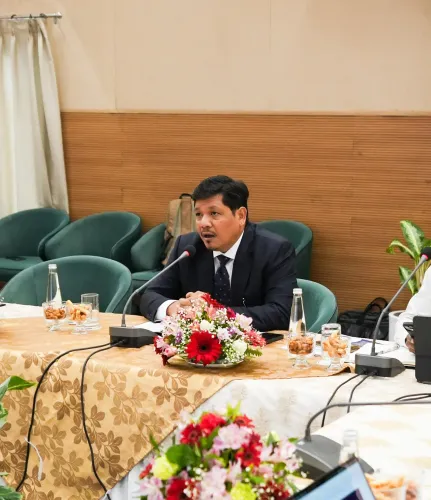
With the November–March window fast approaching — the period Meghalaya Chief Minister Conrad Sangma has flagged as 'critical' — the state is racing to get its climate defences in order before El Niño tightens its grip on the northeast. On Friday, September 25, 2026, Sangma chaired a meeting of the Meghalaya State Council on Climate Change, and he didn't stop at discussion: he directed the immediate activation of District Climate Adaptation and Resilience Task Forces across the state.
What the Council table decided — and why now
The meeting mapped out a wide front of action. Sangma said climate risk and vulnerability mapping is already underway across districts, with a sharper focus on stretching preparedness into the most exposed zones. Proposals tabled include standing up Block-Level Climate Action Teams, rejuvenating springs and critical water sources, and expanding plantation drives — particularly in vulnerable catchment areas where depleted cover amplifies drought and erosion risk.
The CM was direct about uncertainty: 'El Niño is a reality, but its impacts are difficult to predict. Our approach must therefore be based on preparedness and adaptation, backed by clear plans and SOPs for different scenarios.' The signal is clear — Meghalaya is building for multiple scenarios, not betting on one forecast.
Springs, ginger and the natural farming push
Two issues anchored the agriculture discussion. First, scaling up natural farming through inter-departmental convergence and farmer-to-farmer training — a ground-up knowledge transfer model that bypasses bureaucratic lag. Second, confronting a very immediate crop challenge: soft rot affecting ginger, one of Meghalaya's key cash crops. The research on spring rejuvenation is not incidental — the state's hilly terrain means rural communities depend heavily on springs for both drinking water and irrigation, and rainfall shortfalls hit these sources fastest.
Drinking water preparedness in a below-normal rainfall scenario was highlighted as a priority by Sangma, who called for 'adequate' contingency planning at the district level. Strong monitoring mechanisms — with reviews reaching down to the block and village levels — were flagged as essential to track whether any of these plans are actually working.
Elected representatives and grassroots IEC in the loop
Perhaps the most consequential institutional decision was the directive to bring elected representatives into awareness campaigns. It's a recognition that community-level information, education and communication (IEC) can't travel purely through bureaucratic channels — local leaders are the last-mile link between a state policy and a farming household.
The post was also tagged to @PMOIndia and @byadavbjp — a public signal that Meghalaya is seeking central visibility, and potentially resources, for its adaptation agenda. India's National Action Plan on Climate Change (2008) mandates state-level action councils of precisely this kind, but translating that mandate into activated task forces with defined SOPs has been uneven across states. Meghalaya is now putting that mechanism under pressure — and putting it on record.
If the November–March window arrives with below-normal rainfall, the district task forces that Sangma activated today become the first real test of whether the plan holds at ground level.
Point of View
A distinction that matters when weather windows are narrow. Tagging the Prime Minister's Office and the Union environment portfolio in the same post is a calculated bid for central resources and co-ownership of outcomes, consistent with how smaller states leverage visibility to unlock top-down support. The emphasis on farmer-to-farmer training and elected-representative engagement reflects a hard-learned lesson from Northeast India's uneven extension networks: institutional knowledge fails at the last mile without human relay. If the November–March El Niño impact lands hard, this September meeting will either be cited as the turning point — or as the preparation that wasn't enough.
NationPress
25 Sept 2026
Frequently Asked Questions
What did Meghalaya CM Conrad Sangma decide at the climate change meeting?
Sangma directed the immediate activation of District Climate Adaptation and Resilience Task Forces and proposed Block-Level Climate Action Teams, spring rejuvenation, and expanded plantations in catchment areas to prepare for El Niño-related climate risks.
Why is El Niño a concern for Meghalaya?
El Niño, driven by Pacific Ocean warming, can weaken the Indian monsoon and reduce rainfall, threatening Meghalaya's spring-dependent water supply and agriculture — particularly ginger farming — during the November–March dry period.
What are Block-Level Climate Action Teams in Meghalaya?
They are proposed local coordination units at the block level, designed to improve inter-departmental convergence and carry climate preparedness planning closer to rural communities and farmers.
What is natural farming and why is Meghalaya scaling it up?
Natural farming reduces dependence on chemical inputs, improving soil resilience under erratic rainfall. Meghalaya is scaling it through farmer-to-farmer training to build adaptation at the grassroots level ahead of uncertain weather conditions.
Which period has Meghalaya flagged as most critical for El Niño impact?
The November–March window has been identified as the most critical period, when below-normal rainfall could stress drinking water sources and agriculture across the state.