CM Pramod Sawant to Hand Out Mhaje Ghar Sanads in Margao

Synopsis
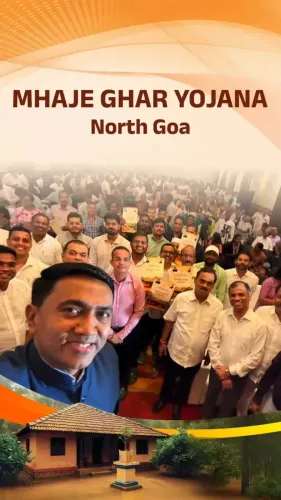
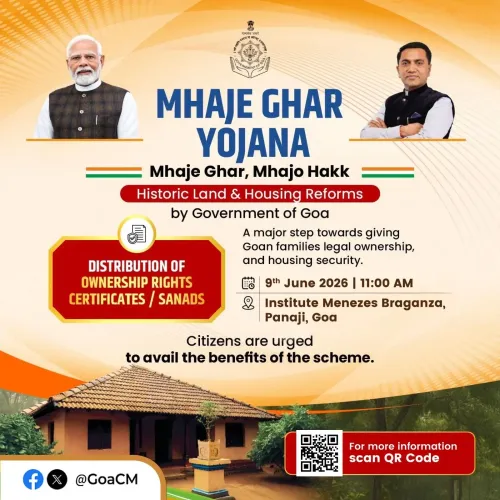
The Chief Minister's Office of Goa has announced that CM Pramod Sawant will distribute ownership rights certificates under the Mhaje Ghar Yojana at Ravindra Bhavan, Margao, on 4 June 2026, in what the office calls a major step toward securing property titles for Goan families.
Key Takeaways
CM Pramod Sawant will attend the Mhaje Ghar Yojana Sanad distribution on 4 June 2026.
The event will be held at Ravindra Bhavan, Margao, in South Goa.
The scheme focuses on granting formal ownership rights certificates to Goan families.
The Chief Minister's Office called it a major step toward securing ownership for residents.
The initiative aligns with Goa's long-running land-title regularisation under the Goa Land Revenue Code.
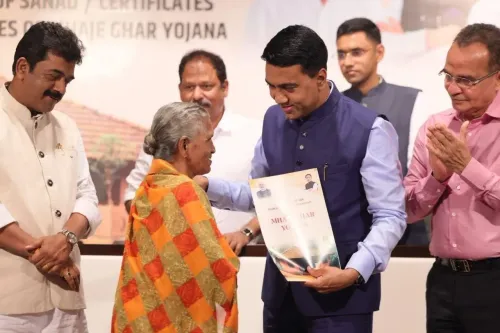
The Chief Minister's Office of Goa has announced that Chief Minister Dr. Pramod Sawant will attend the distribution of Ownership Rights Certificates, known as Sanads, under the Mhaje Ghar Yojana at Ravindra Bhavan, Margao, on 4 June 2026. The office described the event as 'a major step towards securing ownership rights for Goan families'.
Context
The announcement, posted on the evening of 3 June 2026, signals an in-person ceremony in South Goa, where Margao functions as the district's administrative hub and a frequent venue for state government functions.
In the post, the office stated that the Chief Minister 'will attend the Distribution of Ownership Rights Certificates (Sanads) under the Mhaje Ghar Yojana'. The framing positions the handover as a milestone in the implementation of the scheme, which focuses on formalising property titles for resident families.
Policy backdrop
Goa has pursued incremental land-title regularisation for decades, including successive amendments to the Goa Land Revenue Code aimed at granting occupancy and ownership rights to long-term occupants. The lineage of these measures stretches back to the 1980s and reflects the state's distinctive land-tenure history, shaped by Portuguese-era records, mundkar protections for dwellers, and government-acquired plots.
Sanad distribution events of this kind are typically coordinated by the revenue department and used to mark visible progress on tenure security. By holding the function at Ravindra Bhavan, a prominent cultural complex in Margao, the state government is locating the event in a high-visibility public venue.
Stakeholders and impact
Dr. Pramod Sawant, who has served as Chief Minister since 2019 and represents the BJP, has overseen a range of welfare and infrastructure programmes during his tenure. The Mhaje Ghar Yojana fits within that portfolio as a property-rights initiative directly aimed at households.
The principal beneficiaries identified by the office are Goan families who stand to receive formal ownership documents. For recipients, a Sanad converts informal or occupancy-based claims into a recognised title, which can affect access to credit, inheritance clarity, and protection against eviction. Civic stakeholders, panchayats and the revenue administration are typically involved in identifying eligible households and processing the underlying paperwork.
For the wider South Goa region, large-scale handovers can also serve as a barometer of how quickly long-pending title issues are being resolved on the ground.
What's next
Attention will turn to subsequent tranches of Sanad distribution under the same scheme and to any supplementary allocations or legislative amendments tabled in the Goa Legislative Assembly. The scale of the 4 June handover, the geographic spread of recipients, and follow-on rounds in other talukas will indicate whether the state intends to sustain the pace of formalisation.
If the Mhaje Ghar Yojana continues to scale, it could become a defining welfare marker of the current administration, linking a long-standing land-records challenge in Goa to a visible delivery mechanism in the form of certificate distribution events.
Point of View
Where Portuguese-era records and mundkar protections have left many households without clean titles. By personally handing out Sanads, the Chief Minister is converting an administrative process into a political milestone, signalling that tenure security is a flagship welfare deliverable. The scheme's traction will be judged less on the optics of a single function and more on the cadence of subsequent tranches across talukas. If sustained, it could reshape how welfare delivery is communicated in the state.
NationPress
16 Sept 2026
Frequently Asked Questions
What is the Mhaje Ghar Yojana in Goa?
It is a Goa government scheme that distributes ownership rights certificates, called Sanads, to families, formalising their property titles. The Chief Minister's Office has described it as a step toward securing ownership rights for Goan families.
When and where is the Mhaje Ghar Sanad distribution event?
The event is scheduled for 4 June 2026 at Ravindra Bhavan in Margao, South Goa. Chief Minister Dr. Pramod Sawant is set to attend the function.
Who will attend the Margao Sanad distribution?
Chief Minister Dr. Pramod Sawant will attend the event, according to the Chief Minister's Office of Goa. The function will hand over ownership rights certificates to beneficiary families.
What is a Sanad in the context of Goa land rights?
In this context, a Sanad is an ownership rights certificate issued by the state that formalises a family's title to a property. It converts occupancy or informal claims into a recognised legal document.
Why is land-title regularisation important in Goa?
Goa's land records carry a complex legacy from Portuguese-era documentation and mundkar protections, leaving many long-term occupants without clear titles. Regularisation measures under the Goa Land Revenue Code aim to resolve this tenure insecurity.