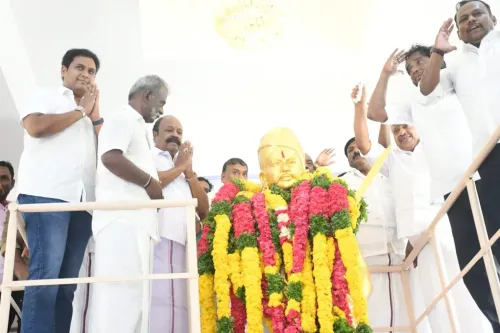
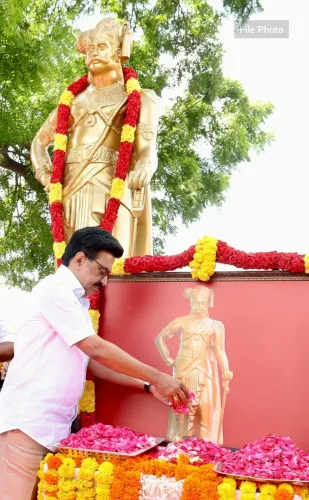
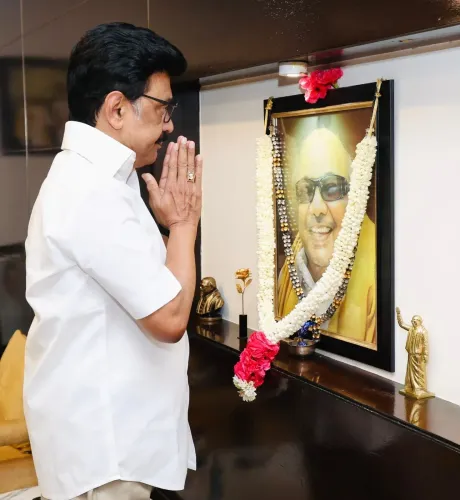
Stalin pays tribute to Tamil border struggle martyrs
Synopsis
DMK president M. K. Stalin paid tribute on November 1 to martyrs of Tamil Nadu's border struggles, naming leaders like M. P. Sivagnanam and Marshal Nesamani, and recalling his government's 2021 decision to honour 110 surviving participants with Rs. 1 lakh each under the Dravidian Model.
Key Takeaways
Stalin marked the Tamil border struggle martyrs' remembrance day on 1 November 2026 .
The border agitations secured towns including Tiruttani, Hosur, Kanyakumari, and Sengottai within Tamil Nadu following the States Reorganisation Act.
Key leaders named by Stalin include M.
Sivagnanam (Silambu Selvar) , Marshal A.
Nesamani , Mangalangkizhar, Thanulinga Nadar, Ponnappa Nadar, and Abdul Razak.
In 2021 , the DMK government honoured 110 surviving participants of the border struggle with Rs.
1 lakh and a commemorative gift each under the Dravidian Model framework.
Many fighters who participated in the agitations lost their lives or were imprisoned in pursuit of Tamil Nadu's present territorial boundaries.
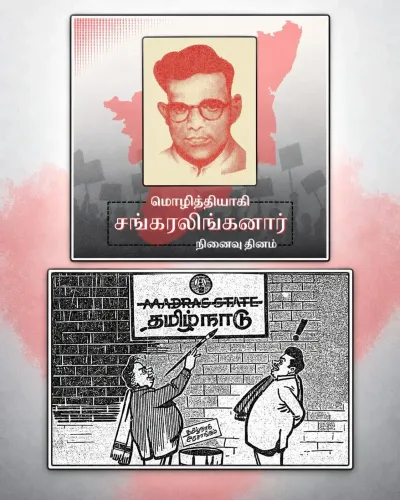
On the remembrance day of Tamil Nadu's border struggle martyrs, DMK president M. K. Stalin offered a salute to the fighters whose sacrifices secured towns like Tiruttani, Hosur, Kanyakumari, and Sengottai within Tamil Nadu's present boundaries — and reminded the state that this map was not given freely, but won.
The battle cry that redrew the map
Stalin's post centres on one defiant slogan from the agitations of the mid-20th century: 'Maalavan Kundram (Tirupati) ponaal enna, Velvaan Kundram aavadhu (Tiruttani) engalukku vendum' — roughly, 'Let Tirupati go to Andhra, but Tiruttani at least must be ours.' That rallying cry captured the essence of a protracted territorial fight sparked by the States Reorganisation Act, which redrew India's internal boundaries along linguistic lines in the 1950s.
The agitation was never bloodless. Stalin named several leaders who stood at the front of those protests — Silambu Selvar M. P. Sivagnanam, Marshal A. Nesamani, Mangalangkizhar, Thanulinga Nadar, Ponnappa Nadar, and Abdul Razak — noting that many participants lost their lives. The towns they fought to keep, from the temple-town of Tiruttani in the north to the southernmost district of Kanyakumari, are today integral parts of Tamil Nadu.
What the DMK government did in 2021 for 110 surviving martyrs
Stalin also pointed to a concrete act of recognition from his own administration. In 2021, under what the DMK calls its #DravidianModel governance framework, his government identified 110 living participants of the border struggles — men and women who had been jailed for their activism — and honoured each with a cash gift of Rs. 1 lakh along with a commemorative award.
The gesture carries symbolic weight beyond the amount itself. Decades after the agitations, many of those fighters had lived in obscurity. The DMK's decision to seek them out and publicly felicitate them positioned welfare for historical activists as a pillar of the Dravidian governance model, linking the party's ideological inheritance to present-day state action.
A pattern of territorial memory in Dravidian politics
This is not a one-off observance. DMK administrations have returned to these border struggles as a recurring touchstone — tying the territorial shape of modern Tamil Nadu directly to Dravidian movement sacrifice. For Stalin, publicly invoking figures like M. P. Sivagnanam and Marshal Nesamani serves a dual function: it honours a largely unsung chapter of regional history, and it reinforces the DMK's claim to be the custodian of that history.
Every November, as this remembrance day arrives, the question worth watching is whether ceremonial tribute translates into further structural support — extended pensions, expanded eligibility, or institutional recognition — for the dwindling circle of those who fought to give Tamil Nadu its shape. That circle, Stalin's post quietly reminds us, grows smaller each year.
Point of View
Reinforcing the narrative that Dravidian governance uniquely honours Tamil sacrifices. The reference to the 2021 cash award for surviving martyrs is deliberate: it converts historical sentiment into a traceable welfare action, distinguishing symbolic tribute from policy delivery. Regionally, invoking the border agitations on November 1 — a date that resonates as 'Rajyotsava' in Karnataka — subtly reasserts Tamil Nadu's own founding story at a moment when interstate territorial questions remain politically live. The pattern suggests the DMK will continue using martyrs' remembrance days as occasions to both educate younger voters about Dravidian movement history and stress-test the party's credentials as Tamil Nadu's institutional memory.
NationPress
1 Nov 2026
Frequently Asked Questions
What is Tamil Nadu's border struggle remembrance day?
It is an annual observance honouring activists who fought to ensure Tamil-speaking territories like Tiruttani, Hosur, Kanyakumari, and Sengottai were included within Tamil Nadu's boundaries following India's States Reorganisation Act of the 1950s.
Who was Silambu Selvar M. P. Sivagnanam?
M. P. Sivagnanam, known by the honorary title Silambu Selvar, was a prominent leader of the mid-20th century Tamil border agitations who organised protests demanding that Tamil-speaking regions remain part of Madras State, later Tamil Nadu.
What did the DMK government give to border struggle survivors in 2021?
In 2021, the DMK government under M. K. Stalin identified 110 living participants of the border struggles who had been imprisoned for their activism and honoured each with Rs. 1 lakh in cash and a commemorative memorial gift under its Dravidian Model governance programme.
Why is Tiruttani significant to Tamil Nadu's border history?
Tiruttani, a temple town, was a central demand of the border agitation — activists rallied under the slogan that even if Tirupati went to Andhra Pradesh, Tiruttani must remain Tamil. It is today part of Tamil Nadu's Tiruvallur district.
What is the Dravidian Model that Stalin refers to?
The Dravidian Model is the DMK's self-described governance framework, emphasising social justice, welfare, and the ideological legacy of the Dravidian movement — used by Stalin's government to justify and brand a range of welfare and recognition initiatives since 2021.