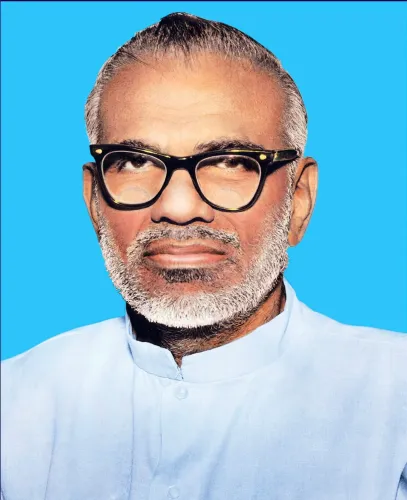
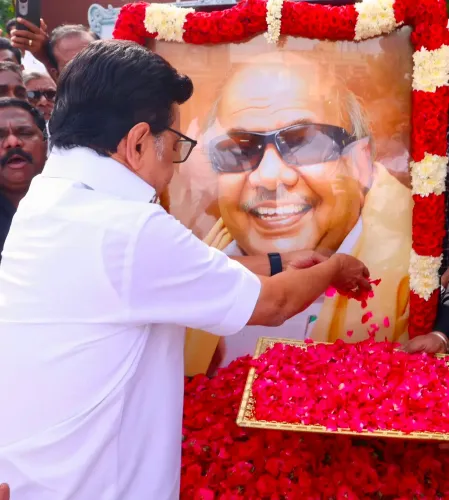
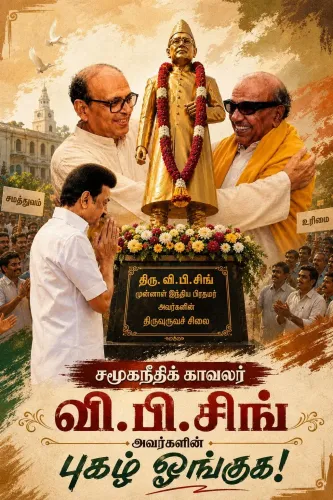
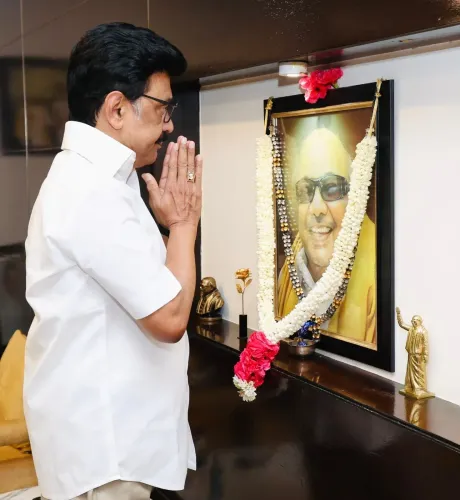
Stalin Remembers C.P. Adithanar, Father of Tamil Journalism
Synopsis
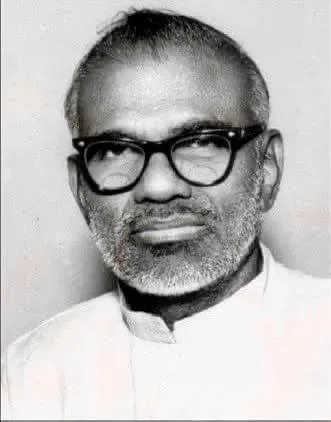
DMK president M. K. Stalin on 27 September 2026 honoured C. P. Adithanar — founder of Dina Thanthi, twice DMK MLA, Tamil Nadu Assembly Speaker under Annadurai, and minister under Karunanidhi — on his birth anniversary, celebrating his role in making Tamil journalism accessible to ordinary readers.
Key Takeaways
Stalin paid a public tribute to C.
Adithanar on his birth anniversary, 27 September 2026 .
Adithanar is credited with transforming Tamil journalism by adopting simple, accessible language so ordinary readers could follow world events.
Ramasamy personally praised him with the phrase 'செயற்கரிய செய்த பெரியார்' — 'one who achieved the near-impossible.' Adithanar served twice as a DMK MLA , as Speaker of the Tamil Nadu Legislative Assembly under Chief Minister C.
Annadurai from 1967 , and as a minister in M.
Karunanidhi's cabinet.
Stalin honoured Adithanar's contributions to the Tamil language, Tamil journalism, and Tamil society as an enduring legacy.
A man Periyar himself honoured with the phrase 'செயற்கரிய செய்த பெரியார்' — 'one who achieved the near-impossible' — was remembered on his birth anniversary on Sunday, 27 September 2026, as DMK president M. K. Stalin paid tribute to C. P. Adithanar, widely recognised as the father of Tamil journalism.
Stalin's post celebrated Adithanar as the man who transformed Tamil journalism by adopting a simple, accessible style of writing so that even an ordinary reader could understand world affairs. The tribute, posted in Tamil, described him as the 'பிதாமகர்' — the grandfather or founding patriarch — of Tamil journalism.
The Journalist Who Rewrote Tamil for the Common Reader
C. P. Adithanar is most closely associated with founding Dina Thanthi, the Tamil daily that became one of the most widely read newspapers in the state — precisely because it broke from the ornate, high-register Tamil of its era and spoke directly to working-class readers. That editorial philosophy was not incidental; it was a political act in its own right, rooted in the same Dravidian democratisation of culture that Periyar championed.
It was that spirit that earned him Periyar E. V. Ramasamy's rare personal praise. Being called 'செயற்கரிய செய்த பெரியார்' — one who has accomplished what is difficult to achieve — by the movement's towering patriarch was, in Dravidian political culture, about as high a distinction as a public figure could receive.
From the Press to the Assembly to the Cabinet
Adithanar's public life never stayed confined to the press room. He served twice as a DMK Legislative Assembly member, bridging journalism and electoral politics in a way the Dravidian movement consistently encouraged. When C. N. Annadurai — revered as Pērarignar Anna, the great scholar — became Tamil Nadu's Chief Minister in 1967, Adithanar was elected Speaker of the Tamil Nadu Legislative Assembly, one of the most constitutionally significant positions in state governance.
He later served as a minister in M. Karunanidhi's DMK cabinet in the early 1970s, cementing a career that spanned the press, the legislature, and the executive — a trifecta few figures in any Indian state's modern history can claim.
Why DMK Keeps This Memory Alive
Stalin's tribute is part of a long-running DMK practice of publicly marking the anniversaries of early Dravidian movement figures who merged cultural mission with political action. For the party, Adithanar is not a historical footnote — he is proof that democratising language and democratising power are the same project. Invoking his birth anniversary on a public platform also reaffirms the DMK's self-image as the custodian of Tamil linguistic identity and media history.
Stalin wrote that he honours and remembers, on this day, the contributions Adithanar made to the Tamil language, Tamil journalism, and Tamil society. The framing — language, journalism, society as a triad — is deliberate. It positions Adithanar's legacy not as nostalgia but as ongoing obligation.
Seven decades after Periyar called him a man who achieved the near-impossible, the question the DMK implicitly poses is whether Tamil journalism today still holds that standard.
Point of View
Accessible language, and legislative power, the party reinforces its claim to be both the cultural guardian of Tamil identity and the natural governing force of Tamil Nadu. The choice to foreground Periyar's own praise of Adithanar is especially pointed: it roots today's DMK leadership in an unbroken chain of Dravidian validation. In a media landscape where Tamil-language digital platforms are booming, celebrating the architect of accessible Tamil journalism also sends a signal about the party's values on language equity. The tribute is ceremonial in form but ideological in function.
NationPress
27 Sept 2026
Frequently Asked Questions
Who is C. P. Adithanar?
C. P. Adithanar is regarded as the father of Tamil journalism and the founder of the Tamil daily Dina Thanthi. He transformed Tamil-language journalism by using simple, accessible prose so that ordinary readers could understand world events, and was publicly praised by Dravidian reformer Periyar E. V. Ramasamy.
What political positions did C. P. Adithanar hold?
Adithanar served twice as a DMK Legislative Assembly member, was elected Speaker of the Tamil Nadu Legislative Assembly when C. N. Annadurai became Chief Minister in 1967, and later served as a minister in M. Karunanidhi's DMK cabinet in the early 1970s.
Why did Periyar praise C. P. Adithanar?
Periyar E. V. Ramasamy honoured Adithanar with the Tamil phrase 'செயற்கரிய செய்த பெரியார்,' meaning 'one who achieved the near-impossible,' recognising his landmark contribution to making Tamil journalism accessible to the common reader.
What did M. K. Stalin say about C. P. Adithanar?
On Adithanar's birth anniversary on 27 September 2026, DMK president M. K. Stalin posted a tribute in Tamil calling him the founding patriarch of Tamil journalism and honouring his contributions to the Tamil language, Tamil journalism, and Tamil society.
What is Dina Thanthi known for?
Dina Thanthi is a Tamil-language daily founded by C. P. Adithanar that became one of Tamil Nadu's most widely read newspapers, largely because it pioneered a plain, accessible style of Tamil writing aimed at working-class and general readers.