CM Yogi: Supreme Court clears 468 TTZ industrial NOCs in Agra

Synopsis
The Chief Minister's Office of Uttar Pradesh announced that the Supreme Court has cleared all pending NOC cases for 468 industrial units in Agra's Taj Trapezium Zone. CM Yogi Adityanath framed the development as part of Agra's dual progress as a Smart City and Safe City, resolving a long-standing regulatory and judicial backlog.
Key Takeaways
The Supreme Court of India has approved all pending NOC cases for 468 industrial units within the Taj Trapezium Zone (TTZ) in Agra.
Chief Minister Yogi Adityanath described the development as part of Agra's growth as both a Smart City and a Safe City .
The TTZ was established through Supreme Court directives from the mid-1990s to protect the Taj Mahal from industrial pollution.
Agra was selected under the Central government's Smart Cities Mission launched in 2015 .
The clearance resolves a long-standing judicial backlog that had constrained economic activity for industrial units in the zone.
Further details on environmental monitoring and Safe City infrastructure rollout in Agra are awaited.
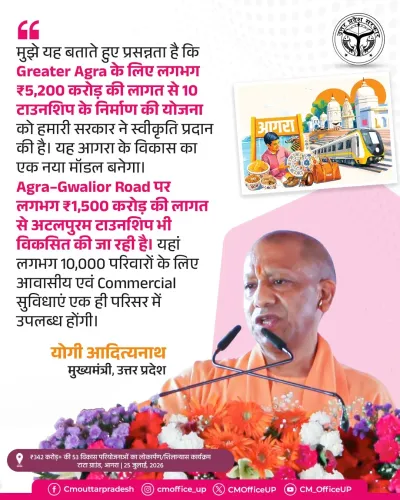
The Chief Minister's Office of Uttar Pradesh announced on Saturday, 25 July 2026 that all pending cases related to No Objection Certificates (NOCs) for 468 industrial units within the Taj Trapezium Zone (TTZ) have received approval from the Supreme Court of India, a development Chief Minister Yogi Adityanath described as part of Agra's emergence as both a Smart City and a Safe City.
Quoting Chief Minister Yogi Adityanath, the official post stated: 'Agra Smart City ke saath-saath Safe City ke ek naye model ke roop mein bhi aage badh raha hai' — 'Agra is advancing not only as a Smart City but also as a new model of a Safe City.' The statement added that all pending NOC-related cases for 468 industrial units under the TTZ have now received Supreme Court sanction.
Context
The Taj Trapezium Zone is a protected environmental buffer encircling the Taj Mahal in Agra, established through a series of Supreme Court directives beginning in the mid-1990s. The framework was designed to curb industrial pollution that threatened the integrity of the UNESCO World Heritage monument. Industrial units operating within this zone have been required to obtain environmental clearances and NOCs, a process that has generated prolonged litigation.
The resolution of 468 pending NOC cases represents a significant clearing of a long-standing judicial backlog that has constrained economic activity in the zone. The Supreme Court's approval signals that these units have met the requisite environmental and regulatory standards set under the TTZ framework.
Policy Backdrop
Agra was selected under the Smart Cities Mission, the Central government programme launched in 2015 to upgrade infrastructure and governance across 100 cities nationwide. The city's inclusion placed it on a path of technology-enabled urban development, encompassing surveillance infrastructure, civic services, and connectivity upgrades.
Successive state governments in Uttar Pradesh have sought to balance Agra's identity as a heritage tourism hub with the economic aspirations of its industrial base. The TTZ framework, while protective of the Taj Mahal, has long been cited by industry stakeholders as a source of regulatory uncertainty. The Yogi Adityanath administration's framing of the Supreme Court clearance as part of a 'Safe City' model suggests a dual-track approach: environmental compliance alongside urban security and modernisation.
Stakeholders and Impact
The 468 industrial units awaiting NOC resolution stand to benefit most directly, as the Supreme Court's approval removes a critical legal uncertainty that had potentially stalled operations, investments, and workforce decisions. Residents of Agra and environmental advocates who have historically monitored pollution levels around the Taj Mahal will watch whether the clearances are accompanied by robust monitoring mechanisms.
The broader business community in the TTZ region may view this development as a signal that the state government is actively pursuing judicial resolution of legacy compliance issues rather than allowing them to remain in indefinite limbo. Tourism stakeholders, for whom the Taj Mahal's visual and environmental condition is a direct economic concern, will also have an interest in how the cleared units are subsequently monitored.
What's Next
Attention will now turn to the rollout of the cleared NOCs and whether the state government issues detailed guidelines on post-approval environmental monitoring within the TTZ. The 'Safe City' dimension referenced by CM Yogi Adityanath is also expected to see further elaboration, potentially covering surveillance infrastructure, emergency response systems, and policing upgrades in Agra.
If the state follows through on both tracks — industrial regularisation and urban safety infrastructure — Agra could become a template for how heritage cities in India navigate the intersection of economic development, environmental protection, and modern governance.
Point of View
Which has sought to present Uttar Pradesh as a state that resolves legacy regulatory disputes rather than perpetuating them. Framing Agra simultaneously as a Smart City and a Safe City reflects a deliberate attempt to broaden the city's governance narrative beyond heritage tourism. The move also signals that judicial engagement — rather than administrative bypass — remains the preferred route for resolving the complex environmental-industrial tensions that have defined the TTZ since the 1990s. How effectively the state monitors the cleared units will determine whether this becomes a genuine policy milestone or a procedural one.
NationPress
25 Oct 2026
Frequently Asked Questions
What is the Taj Trapezium Zone and why does it matter for industries?
The Taj Trapezium Zone (TTZ) is a designated environmental buffer area around the Taj Mahal in Agra, created through Supreme Court orders from the mid-1990s to limit industrial pollution that could damage the monument. Industries operating within this zone require specific NOCs and environmental clearances, making the TTZ a key regulatory constraint for businesses in the Agra region.
What did the Supreme Court approve regarding Agra's industrial units?
The Supreme Court of India approved all pending NOC-related cases for 468 industrial units within the Taj Trapezium Zone, according to an announcement by the Chief Minister's Office of Uttar Pradesh on 25 July 2026. This clears a long-standing judicial backlog for these units.
What is Agra's Smart City and Safe City plan under CM Yogi?
Agra was selected under the Central government's Smart Cities Mission launched in 2015, which focuses on upgraded infrastructure, technology-enabled governance, and improved civic services. CM Yogi Adityanath has additionally positioned Agra as a 'Safe City,' a model expected to include surveillance, emergency response, and policing infrastructure upgrades.
How does the TTZ NOC clearance benefit industrial units in Agra?
The Supreme Court's approval removes the legal uncertainty that had stalled operations, investments, and workforce decisions for 468 industrial units in the TTZ. It allows these businesses to operate with regulatory clarity while remaining within the environmental framework protecting the Taj Mahal.
What happens next after the Supreme Court clears TTZ industrial NOCs?
The focus will shift to the actual rollout of the cleared NOCs and the establishment of post-approval environmental monitoring mechanisms within the TTZ. Further government announcements on Agra's Safe City components — including surveillance and policing upgrades — are also expected.