SC stays Senthil Balaji's arrest in TASMAC corruption case, orders cooperation
Synopsis
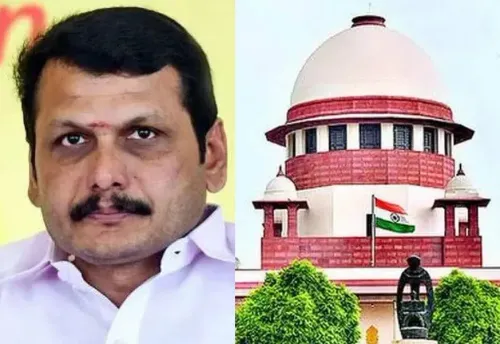
The Supreme Court on 31 July halted the arrest of DMK MLA and former Tamil Nadu minister V. Senthil Balaji in the TASMAC corruption case — but with strings attached. Balaji must surrender his passport, cooperate with the DVAC probe, and stay clear of witnesses. The case, involving alleged irregularities spanning 2021 to 2025, will return to court in three weeks.
Key Takeaways
The Supreme Court on 31 July stayed the arrest of V.
Senthil Balaji in the TASMAC corruption case .
A bench of CJI Surya Kant and Justice Joymalya Bagchi issued notice on Balaji's special leave petition challenging the Madras High Court's rejection of anticipatory bail.
Balaji must deposit his passport with the investigating officer and fully cooperate with the DVAC probe.
The FIR was registered on 28 July over alleged irregularities in TASMAC between 2021 and 2025 .
The matter will be heard again after three weeks ; any breach of conditions could result in the stay being vacated.
DMK MLA and former Tamil Nadu minister V. Senthil Balaji on Friday, 31 July secured interim protection from arrest from the Supreme Court in a Directorate of Vigilance and Anti-Corruption (DVAC) case alleging large-scale corruption in the functioning of the Tamil Nadu State Marketing Corporation (TASMAC). A bench headed by Chief Justice of India (CJI) Surya Kant issued notice on Balaji's special leave petition challenging the Madras High Court's refusal to grant him anticipatory bail.
Key Conditions of the Stay
The Supreme Court bench made the arrest stay conditional on Balaji's full cooperation with the ongoing investigation. The court directed him to deposit his passport with the investigating officer, cooperate fully with the probe, and ensure that no witnesses are influenced during the pendency of the proceedings.
The matter has been posted for further hearing after three weeks. The bench stated: 'If he is guilty, he will have to face consequences,' signalling that the stay was not an exoneration but a procedural safeguard pending investigation.
What Happened in Court
Earlier in the day, Justice V. Mohana recused herself from hearing the matter. CJI Surya Kant subsequently informed the parties that the case would be taken up by a bench comprising himself and Justice Joymalya Bagchi, citing urgency.
Senior advocate Guru Krishnakumar, appearing for the Tamil Nadu government, opposed the grant of anticipatory bail, contending that the allegations involved a serious corruption case worth hundreds of crores of rupees. He also cited Balaji's criminal antecedents and raised the risk of evidence being destroyed.
When the state government expressed concern that custodial interrogation might be necessary, Justice Bagchi assured that the court would ensure Balaji's participation in the probe. 'If there is any breach or any perception of breach, come to us,' he told the Tamil Nadu government. Senior advocate Kapil Sibal had on Thursday mentioned the special leave petition for urgent listing before the CJI-led bench.
The Madras High Court's Ruling
The Supreme Court intervention came after the Madras High Court declined to grant Balaji pre-arrest bail. A single-judge bench of Justice G.K. Ilanthiraiyan had dismissed the anticipatory bail plea, holding that the gravity of the allegations warranted custodial interrogation. The court noted that the accused allegedly abused their official positions, entered into a criminal conspiracy, and caused substantial financial loss to the state exchequer.
The TASMAC Corruption Case
The case stems from an FIR registered by the DVAC on 28 July against Balaji and several others over alleged irregularities in TASMAC between 2021 and 2025, when he served as Minister for Electricity, Prohibition and Excise in the M.K. Stalin-led DMK government.
According to the prosecution, Balaji allegedly conspired with private individuals, distillery and brewery companies, transport contractors, bottling firms, and unidentified TASMAC officials to manipulate official processes, misappropriate public funds, and facilitate the laundering of illicit money, causing substantial losses to the state.
Balaji denied the allegations, contending before the Madras High Court that the FIR was based on vague and omnibus accusations without identifying any specific tender, contract, or transaction linking him to the alleged offences. He also claimed the case was politically motivated, registered due to hostility following the Karur stampede controversy.
What Happens Next
With the arrest stay in place, the DVAC probe is expected to continue with Balaji's cooperation. The Supreme Court will take up the matter again in three weeks, when it will assess compliance with the conditions imposed. Any breach of the court's directives could result in the stay being vacated.
Point of View
But it also places the court in the position of supervising a state-level corruption investigation in real time. What is notable is how quickly the matter escalated: the FIR was registered on 28 July, the High Court rejected bail, and the Supreme Court intervened within days. That speed reflects either the gravity of the political stakes or the strength of Balaji's legal team — possibly both. The TASMAC case is also a test of whether anti-corruption agencies in states with incumbent governments can investigate senior ministers without political interference running in either direction. The court's warning — 'if there is any breach, come to us' — suggests it is watching closely.
NationPress
14 Sept 2026
Frequently Asked Questions
Why did the Supreme Court stay Senthil Balaji's arrest?
The Supreme Court stayed Senthil Balaji's arrest on 31 July after he challenged the Madras High Court's refusal to grant him anticipatory bail in the DVAC-TASMAC corruption case. The bench, led by CJI Surya Kant, issued the stay subject to Balaji cooperating fully with the ongoing investigation and surrendering his passport.
What is the TASMAC corruption case against Senthil Balaji?
The case involves an FIR registered by the Directorate of Vigilance and Anti-Corruption on 28 July against Balaji and others over alleged large-scale irregularities in the functioning of the Tamil Nadu State Marketing Corporation between 2021 and 2025. The prosecution alleges he conspired with private parties to misappropriate public funds and launder illicit money, causing substantial losses to the state exchequer.
What conditions did the Supreme Court impose on Senthil Balaji?
The court directed Balaji to deposit his passport with the investigating officer, cooperate fully with the DVAC probe, and ensure that no witnesses are influenced during the pendency of the proceedings. The arrest stay remains in force only as long as these conditions are met.
Why did the Madras High Court reject Senthil Balaji's anticipatory bail?
Justice G.K. Ilanthiraiyan of the Madras High Court held that the gravity of the allegations warranted custodial interrogation. The court noted that the accused allegedly abused official positions, entered into a criminal conspiracy, and caused substantial financial loss to the state, concluding that the grounds urged by the defence did not outweigh the need for a thorough investigation.
What happens next in the Senthil Balaji case?
The Supreme Court has posted the matter for further hearing after three weeks. The DVAC probe will continue in the interim, with Balaji required to cooperate. If the court finds any breach of its conditions, the Tamil Nadu government has been told it may approach the bench immediately.