CM Fadnavis Opens SCLR Phase 2, Saving 35 Minutes

Synopsis
Maharashtra CM Devendra Fadnavis inaugurates SCLR Phase 2, a 1.40-km elevated stretch from Bharat Nagar Road to Vakola Junction. Combined with eight sub-flyovers, the project completes a 10.30-km integrated signal-free corridor linking Mumbai's Western and Eastern Express Highways, promising 35-minute travel savings.
Key Takeaways
Phase 2 of SCLR — a 1.40-km elevated road from Bharat Nagar Road to Vakola Junction — was inaugurated on 13 August 2026 .
Eight sub-flyovers complete SCLR's 10.30-km integrated elevated network across Mumbai's mid-section.
Commuters can now access SCLR directly from the Western Express Highway via the Santa Cruz flyover .
The corridor provides unbroken travel through BKC, Kalina, Kurla, and Chembur to the Eastern Express Highway .
The project is expected to save commuters up to 35 minutes of travel time on this east-west route.
MMRDA executed the project as part of its signal-free corridor mandate for the Mumbai Metropolitan Region.
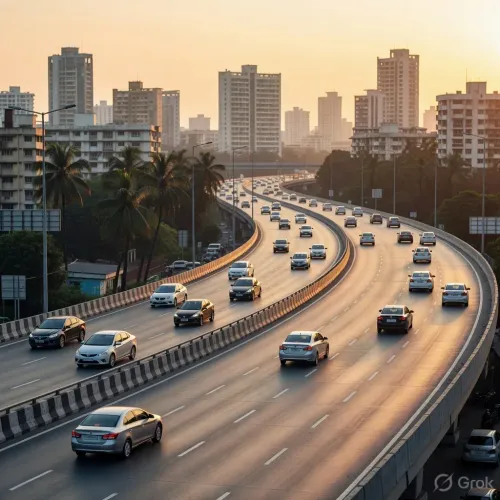
Mumbai's east-west commute just got a serious upgrade. The Chief Minister's Office of Maharashtra announced on Thursday, 13 August 2026 the inauguration of Phase 2 of the Santa Cruz Chembur Link Road (SCLR) — a 1.40-kilometre elevated stretch from Bharat Nagar Road to Vakola Junction that completes one of the city's most ambitious signal-free corridors.
What the new stretch unlocks
With Phase 2 now open, SCLR's integrated network of eight sub-flyovers stitches together a continuous 10.30-kilometre elevated grid across Mumbai's mid-section. The CMO's post confirmed that commuters will now be able to access SCLR directly from the Western Express Highway via the Santa Cruz flyover — no diversions, no signal stops. From there, the corridor runs unbroken through BKC, Kalina, Kurla, and Chembur all the way to the Eastern Express Highway.
The headline number: a claimed travel-time saving of 35 minutes on one of Mumbai's most congested east-west routes. That figure, if it holds in real-world traffic, would represent a meaningful shift for the hundreds of thousands of commuters who cross this belt daily.
MMRDA's decade-long east-west puzzle, now solved
The Mumbai Metropolitan Region Development Authority (MMRDA) has pursued the SCLR for years as the critical missing link between Mumbai's two main arterial highways. The project was designed in phases precisely because land acquisition, utility relocation, and the complexity of building elevated infrastructure over dense urban fabric made a single-shot execution impossible.
Phase 2's completion closes that loop. The eight sub-flyovers — each addressing a specific intersection or grade-crossing — are what transform a patchwork of elevated segments into a genuinely integrated network. Chief Minister Devendra Fadnavis, tagged directly in the CMO post, has championed Mumbai's elevated-corridor push as a centrepiece of the state's urban mobility agenda.
The bigger infrastructure arc this fits into
Maharashtra's successive governments have bet heavily on elevated roads and flyovers as the fastest route to decongesting Mumbai, even as metro lines are built in parallel. SCLR's completion is part of that broader MMRDA playbook — signal-free corridors that let surface traffic flow while metro construction proceeds overhead or underground on adjacent alignments.
The next question is integration: how the completed SCLR connects operationally with metro corridors and other link roads still under construction across the Mumbai Metropolitan Region. A standalone corridor is useful; a corridor that feeds into a broader seamless network is transformative.
For Mumbai's commuters, the message from Mantralaya today is simple — the wait is over. The road is open.
Point of View
Completing a multi-phase MMRDA project ahead of any major electoral cycle is a useful proof-point that the state can execute complex urban engineering. The deeper policy question is whether signal-free corridors alone can absorb Mumbai's traffic growth, or whether they merely redistribute congestion to new chokepoints — a tension that will sharpen as more metro lines open and compete for the same commuter base.
NationPress
28 Sept 2026
Frequently Asked Questions
What is the Santa Cruz Chembur Link Road Phase 2?
SCLR Phase 2 is a 1.40-kilometre elevated road from Bharat Nagar Road to Vakola Junction in Mumbai, inaugurated on 13 August 2026 . It completes MMRDA's integrated 10.30-km signal-free east-west corridor.
How much time will SCLR save for Mumbai commuters?
The Chief Minister's Office of Maharashtra stated that the completed SCLR corridor will save commuters up to 35 minutes of travel time on the east-west route between the Western and Eastern Express Highways.
Which areas does the SCLR corridor connect?
The SCLR connects the Western Express Highway (via the Santa Cruz flyover) to the Eastern Express Highway , passing through BKC, Kalina, Kurla, and Chembur .
Who built the Santa Cruz Chembur Link Road?
The SCLR was built and executed by the Mumbai Metropolitan Region Development Authority (MMRDA) under the Maharashtra government's urban infrastructure programme.
How many flyovers are part of the SCLR network?
The completed SCLR network includes eight sub-flyovers , forming a continuous 10.30-kilometre integrated elevated corridor across Mumbai's mid-section.