Why is security being enhanced along the India-Bangladesh border in Tripura?
Click to start listening
Synopsis
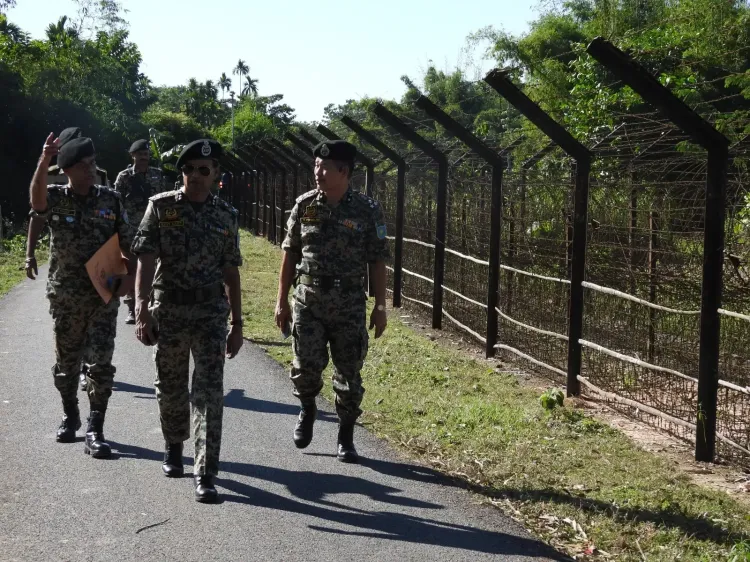
In a bid to bolster safety, Tripura has increased security along its international border due to reported movements of militants linked to two armed groups from Bangladesh. This heightened vigilance aims to address potential threats and maintain public order amidst ongoing tensions in the region.
Key Takeaways
- Security measures have been heightened in Tripura due to militant activity.
- A night curfew is implemented from 6 p.m. to 6 a.m.
- Residents within 300 meters of the border are exempt from restrictions.
- The BSF's reports spurred the curfew declaration.
- Tripura's border is vulnerable to smuggling and crime.
Agartala, Jan 3 (NationPress) Security measures have been heightened along specific segments of the international border in Tripura due to concerns regarding the activities of militants from two armed groups based in Bangladesh—the Parbatya Chattagram Jana Samhati Samiti (PCJSS) and the United People's Democratic Front (UPDF), as reported by officials on Saturday.
The District Magistrate of Gomati district, Rinku Lather, issued a statement indicating that credible information had been received from the Border Security Force (BSF) about the potential movement of PCJSS and UPDF militants, along with fears of illicit infiltration by Bangladeshi nationals, including Rohingyas and members of militant factions, crossing the border with the intent to commit crimes, engage in smuggling, and disrupt public order.
In response to the BSF's findings, the District Magistrate declared a night curfew under Section 163 of the Bharatiya Nagarik Suraksha Sanhita (BNSS), 2023, aimed at maintaining peace and stability by thwarting the actions of anti-national elements and groups that threaten the safety of the public.
According to the notification, the night curfew will be enforced from 6 p.m. to 6 a.m. until February 28 in designated border areas within the Karbook Sub-Division of Gomati district.
Under this order, no individual shall possess lathis, firearms, or any other weapons, with exceptions made for law enforcement personnel from the Central Reserve Police Force (CRPF) and the BSF on duty. Police officers and government officials fulfilling their responsibilities are also exempt from these restrictions.
Furthermore, residents living within 300 meters of the international border are also excluded from these limitations, as stated in the District Magistrate's notification.
Tripura has an extensive 856-km-long boundary with Bangladesh, surrounded on three sides by the neighboring nation, rendering it particularly susceptible to smuggling and various cross-border criminal activities.
The Gomati and Dhalai districts of Tripura share borders with the conflict-ridden Chittagong Hill Tracts (CHT) in southeastern Bangladesh.
In a related incident, Tripura Police detained 13 individuals affiliated with the PCJSS, including two women, in June of the previous year.
These individuals reportedly suffered injuries during clashes with a rival faction in Panchari, located in the CHT of Bangladesh, and crossed into India seeking medical treatment.
Reports suggest that they entered India unlawfully through Raishyabari in Dhalai district following a violent confrontation across the border.
Many of the detainees were seen with bandages on their legs and arms. The armed conflict involving the ‘Shanti Bahini’ in the CHT concluded with a bipartite agreement between the PCJSS and the Bangladesh government on December 2, 1997.
The ‘Shanti Bahini’ had long advocated for a sovereign CHT for indigenous tribal communities, including the Chakmas, Mogs, and others residing in the hilly area.
Reports indicate that attacks against indigenous populations in the CHT by the Bangladesh Army and illegal settlers have escalated since the fall of former Prime Minister Sheikh Hasina's Awami League government on August 5, 2024. The Buddhist Chakmas primarily inhabit the CHT of southeastern Bangladesh, as well as the Chin and Arakan provinces of Myanmar, and several northeastern states of India.
Various tribal groups in the CHT have asserted that the Bangladesh government has failed to fulfill the obligations set forth in the 1997 CHT Peace Accord.
Indian Chakma leaders have also called for the implementation of the CHT Peace Accord to safeguard the rights of tribal communities in the hill region.
Point of View
It is crucial to prioritize the safety of citizens while addressing the complex dynamics of militancy and cross-border movements. The government's proactive measures reflect a commitment to safeguarding public interests.
NationPress
03/01/2026
Frequently Asked Questions
What is the reason for the increased security in Tripura?
The heightened security measures are in response to reports of militant movements from Bangladesh-based groups, specifically the PCJSS and UPDF, posing potential threats to public safety.
What are the restrictions in place due to the night curfew?
The night curfew prohibits individuals from carrying weapons, except for law enforcement personnel, and is enforced from 6 p.m. to 6 a.m. in certain border areas.
How long will the night curfew last?
The night curfew will be in effect until February 28 in designated border areas of Gomati district.