Amit Shah dares Rahul Gandhi to debate BJP Yuva Morcha
Synopsis
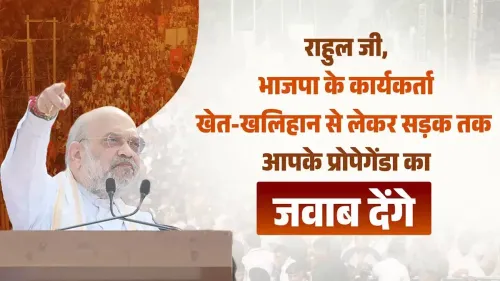
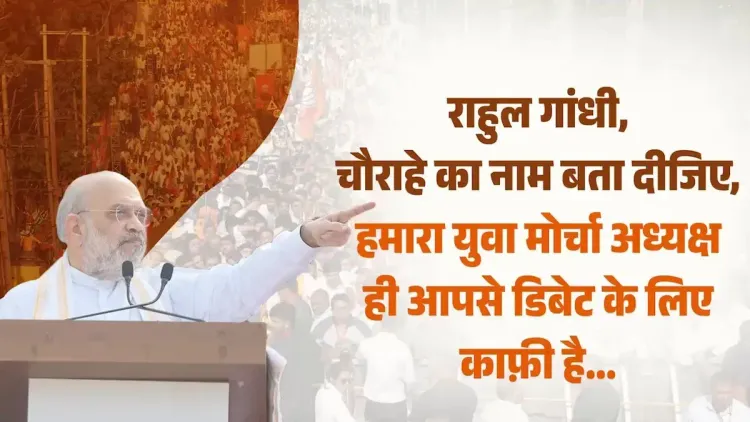
Union Home Minister Amit Shah challenged Rahul Gandhi to debate BJP's Yuva Morcha president at any Haryana crossroads, asserting that laws and national debates belong in Parliament — not on the street.
Key Takeaways
Union Home Minister Amit Shah posted a direct challenge to Rahul Gandhi on 5 November 2026 .
Shah argued that law-making and national debate belong in Parliament , not on the street.
He dared Gandhi to pick any chowk in Haryana and face the BJP Yuva Morcha president in an open debate.
Naming Haryana specifically signals the state's continuing political salience for both the BJP and Congress.
The move frames Gandhi as a peer of the BJP's youth wing rather than a ministerial equal — a deliberate rhetorical choice.
No response from Congress or Gandhi had been issued at the time of publication.
A sharp political volley landed on Thursday, 5 November 2026, when Union Home Minister Amit Shah turned a governance argument into a pointed personal challenge — daring Rahul Gandhi to pick any crossroads in Haryana and face the BJP Yuva Morcha president in an open debate.
Shah's challenge: Parliament versus the street
Shah's post, in Hindi, opened with a constitutional salvo: 'Kanoon banane aur desh ki samasyaon par charcha sadak par nahin, sansad mein hoti hai' — 'Laws are made and national problems are discussed not on the street, but in Parliament.' The line is a direct rebuttal to opposition-led street protests, asserting that agitational politics outside the legislature is, at best, theatre.
Having made the constitutional point, Shah immediately pivoted to provocation: if Gandhi has such a passion for street-side argument, let him choose any chowk — a crossroads — in Haryana, and the BJP's youth wing president will show up to debate. The choice of Haryana, a state with a charged history of both electoral battles and protest movements between the BJP and Congress, is deliberate and loaded.
Why Haryana, why Yuva Morcha
Haryana has been a consistent flashpoint in BJP-Congress rivalry — from assembly election fights to farmer-related agitations that have crossed its borders. By naming the state specifically, Shah plants the challenge on terrain where the ruling party has recent political capital and where any acceptance — or refusal — by Gandhi would carry immediate local resonance.
The BJP Yuva Morcha, the party's youth wing, exists precisely to mobilise young activists and take ideological battles to new audiences. Nominating its president rather than a senior minister is a calculated move: it frames Gandhi not as a peer of the Home Minister, but as someone who can be matched by BJP's younger cadre — a rhetorical downgrade dressed as an open invitation.
The recurring BJP-Congress debate-on-the-streets divide
This exchange fits a well-worn pattern. The BJP has repeatedly argued that opposition parties — the Indian National Congress chief among them — use street protests and public rallies as a substitute for parliamentary engagement, particularly when they feel their numbers inside the House are too thin to force the government's hand. Congress and its allies counter that public mobilisation is a democratic right and that the ruling party uses parliamentary procedure to stifle scrutiny.
Neither argument is new. What gives this round its edge is the personal targeting of Gandhi by name, the specific geography of Haryana, and the viral directness of the format: a one-line dare on social media that is far easier to share than a committee report.
The ball is now publicly in Rahul Gandhi's court — and in Haryana, every chowk is watching.
Point of View
Ensuring that any response or non-response by Gandhi plays on BJP-friendly terrain. More broadly, the exchange reflects the two parties' deepening battle over the legitimacy of street politics versus legislative engagement — a fault line that will only sharpen as the next electoral cycle approaches.
NationPress
6 Nov 2026
Frequently Asked Questions
What did Amit Shah say to Rahul Gandhi on 5 November 2026?
Amit Shah posted on X challenging Rahul Gandhi to pick any crossroads in Haryana for an open debate, saying the BJP Yuva Morcha president would take him on — adding that laws and national debates belong in Parliament, not on the street.
Why did Amit Shah specifically mention Haryana in his challenge?
Haryana is a politically competitive state with an active history of BJP-Congress rivalry and protest politics, making it a pointed and strategically resonant choice for Shah's challenge.
What is the BJP Yuva Morcha?
BJP Yuva Morcha is the youth wing of the Bharatiya Janata Party, tasked with mobilising young voters and activists and taking ideological battles to new audiences.
What is the BJP's argument about street protests versus Parliament?
The BJP has consistently argued that law-making and policy debate are the domain of Parliament, and that street agitations by the opposition are a substitute for meaningful legislative engagement.
Has Rahul Gandhi responded to Amit Shah's debate challenge?
No response from Rahul Gandhi or the Indian National Congress had been issued at the time of publication.