Is the SHANTI Bill One of Modi Government's Largest Science Reforms That Breaks a Six-Decade Stalemate in the Nuclear Sector?
Synopsis
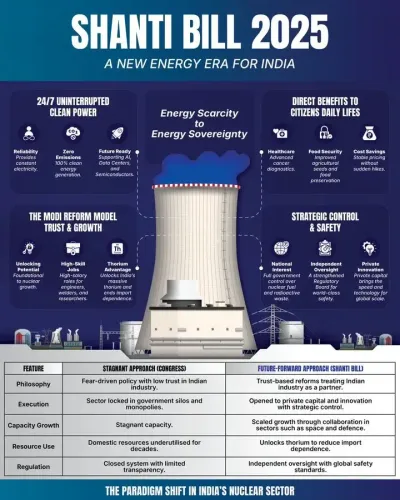
The SHANTI Bill marks a pivotal moment in India's nuclear history, breaking a long-standing deadlock and setting the stage for sustainable energy development. This significant reform, championed by Prime Minister Modi's administration, promises to reshape the nuclear landscape in India, emphasizing safety, innovation, and public interest.
Key Takeaways
The SHANTI Bill ends a 60-year stalemate in the nuclear sector.
It aims to promote clean and sustainable nuclear energy.
India's nuclear capacity is expected to reach around 100 GW by 2047.
The bill has garnered wide acceptance across various sectors.
It emphasizes safety and public interest in nuclear energy use.
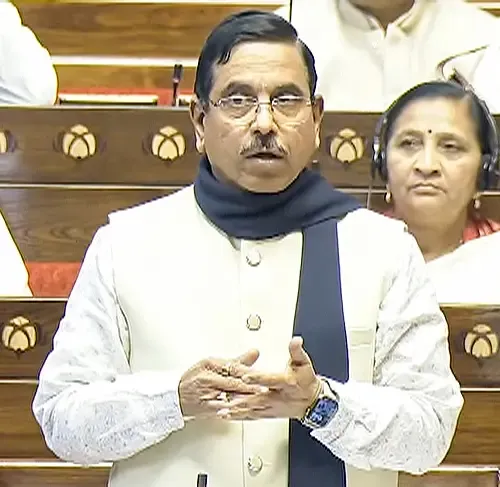
New Delhi, Dec 28 (NationPress) The SHANTI Bill is poised to be recognized as one of the most significant science reforms under the leadership of Prime Minister Narendra Modi, as it has successfully ended a six-decade impasse in the nuclear sector, asserted Union Minister for Science & Technology, Dr. Jitendra Singh, on Sunday.
The minister stated that the SHANTI (Sustainable Harnessing and Advancement of Nuclear Energy for Transforming India) Bill heralds a transformative shift in India’s nuclear landscape, unlocking its capabilities for peaceful, clean, and sustainable energy whilst adhering to stringent standards of safety, sovereignty, and public welfare. He stressed that such a reform seemed impossible for over sixty years and was actualized solely through PM Modi’s efforts to dismantle outdated taboos and synchronize India’s policies with global best practices.
According to Dr. Singh, the third term of PM Modi is notably marked by courageous, structural reforms that prioritize science, innovation, and entrepreneurship. He pointed out that while previous reform phases were tied to pivotal political and strategic choices, Modi 3.0 will be remembered for dismantling long-standing barriers in sectors critical to India’s technological and economic future.
Reiterating India’s enduring commitment to the peaceful use of nuclear energy, he reminisced that from the era of Dr. Homi Bhabha, India’s nuclear initiative was aimed at development, healthcare, and energy security. The SHANTI Bill, he asserted, fortifies this foundational principle by facilitating expansion for civilian applications such as clean power generation, medical usage, and cutting-edge research, while firmly excluding any deviation from peaceful intentions.
Addressing the requirements of the emerging AI, quantum, and data-driven economy, the Minister noted that nuclear energy is vital for delivering reliable, continuous power, unlike intermittent renewable sources. He observed that as India shifts away from fossil fuels and coal, nuclear energy will play a crucial role in sustaining advanced technologies, digital infrastructure, and strategic sectors.
Dr. Singh also revealed that India’s nuclear power capacity has surged from approximately 4.4 GW in 2014 to nearly 8.7 GW today, with a clear roadmap to significantly increase capacity in the upcoming years. He stated the government’s ambition to reach around 100 GW of nuclear capacity by 2047, enabling nuclear energy to fulfill nearly 10 percent of India’s electricity needs and support the national Net Zero commitment.
He also highlighted the expanding influence of nuclear science in healthcare, particularly in cancer diagnosis and treatment through nuclear medicine and isotopes. He asserted that nuclear technology is increasingly contributing to life-saving medical interventions, reinforcing that atomic science today is a driving force for human welfare and societal progress.
Regarding future preparedness, Dr. Singh mentioned that India is also progressing towards small modular reactors, which are ideal for dense urban areas, industrial corridors, and emerging economic zones. He noted that these reactors will further bolster energy security while ensuring environmental accountability.
The minister pointed out that the SHANTI Bill has garnered broad support across the scientific community, industry, startups, and the innovation ecosystem, reflecting a strong national consensus on the necessity to reform and modernize India’s nuclear sector. The Bill exemplifies the Modi 3.0 reform-first approach, where science-driven policy decisions are charting India’s journey towards becoming a developed nation by 2047.
Point of View
The SHANTI Bill represents a crucial step towards modernizing India's nuclear sector. With a commitment to safety and sustainability, the reforms associated with this bill are poised to enhance India's energy security and position it as a leader in nuclear innovation, aligning with both national interests and global best practices.
NationPress
9 Oct 2026
Frequently Asked Questions
What is the SHANTI Bill?
The SHANTI Bill stands for Sustainable Harnessing and Advancement of Nuclear Energy for Transforming India, aimed at reforming India's nuclear sector after a six-decade gap.
Who introduced the SHANTI Bill?
The SHANTI Bill was introduced by Union Minister for Science & Technology, Dr. Jitendra Singh, under the leadership of Prime Minister Narendra Modi.
What are the key benefits of the SHANTI Bill?
The key benefits include unlocking potential for clean and sustainable nuclear energy, enhancing energy security, and fostering advancements in healthcare and research.
How does the SHANTI Bill relate to India's energy goals?
The SHANTI Bill aims to significantly increase India's nuclear power capacity to meet around 10% of its electricity needs by 2047, supporting the national Net Zero commitment.
Is the SHANTI Bill widely accepted?
Yes, the SHANTI Bill has received broad support from the scientific community, industry players, startups, and the innovation ecosystem.