Shekhawat on India's cultural resurgence and tourism-led growth
Synopsis
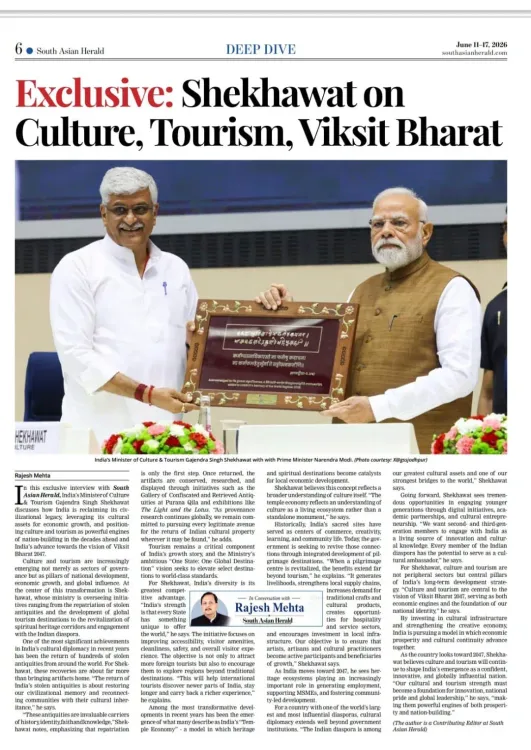
Union Culture and Tourism Minister Gajendra Singh Shekhawat shared glimpses of an interview with South Asian Herald's Rajesh Mehta on 12 June 2026, discussing India's cultural revival, tourism-led growth, and the government's 12-year policy journey under PM Narendra Modi.
Key Takeaways
Union Culture and Tourism Minister Gajendra Singh Shekhawat gave an interview to Rajesh Mehta of South Asian Herald on 12 June 2026 .
The discussion covered India's cultural resurgence, tourism-led economic growth, and the 12-year policy journey under PM Narendra Modi .
Key government schemes underpinning this trajectory include Swadesh Darshan (2015), PRASAD (2014-15), and Adopt a Heritage (2017).
A revised National Tourism Policy (circa 2022) set higher GDP contribution targets for the tourism sector.
The ministry has integrated culture and tourism portfolios to project India's soft power and generate heritage-linked employment.
Upcoming tourism performance data and fresh sanctions under Swadesh Darshan 2.0 or PRASAD are key indicators to watch.
Union Culture and Tourism Minister Gajendra Singh Shekhawat on Friday, 12 June 2026, shared highlights of a wide-ranging interview he gave to Rajesh Mehta of South Asian Herald, covering India's cultural resurgence, tourism-led economic growth, and what he described as the transformative journey of the past 12 years under Prime Minister Narendra Modi.
Context
Shekhawat posted a glimpse of the interaction on X, noting it was an 'insightful' exchange on three broad themes: India's cultural revival, the role of tourism as a growth engine, and the policy trajectory since 2014. The minister did not release the full interview text, and specific figures or quotes from the conversation remain unconfirmed at this stage.
South Asian Herald is a publication focused on South Asian current affairs and has previously engaged Indian policymakers for on-record conversations on governance and development themes.
Policy Backdrop
The Culture and Tourism Ministry has anchored much of its work since 2014 on a cluster of flagship schemes. The Swadesh Darshan scheme, launched in 2015, funds the development of thematic tourist circuits across states, while the PRASAD scheme — initiated in 2014-15 — upgrades infrastructure at pilgrimage and heritage sites. A third initiative, Adopt a Heritage (rolled out in 2017), invites corporate participation in monument upkeep under a public-private model.
A revised National Tourism Policy framework, updated around 2022, set a higher target for tourism's contribution to GDP, treating inbound and domestic visitor receipts as a strategic economic lever. The current phase — Swadesh Darshan 2.0 — shifts emphasis toward sustainable and responsible tourism circuits, building on the original scheme's infrastructure push.
Parallel efforts have included monument digitisation, international marketing campaigns, and the integration of the culture and tourism portfolios to project India's soft power while generating employment through heritage-based economic activity.
Stakeholders and Impact
The tourism industry — spanning hospitality, travel trade, and local handicraft economies — stands as the primary stakeholder in the policy direction Shekhawat outlined. Heritage conservation groups have also engaged with the ministry's monument-upkeep programmes, particularly under the Adopt a Heritage framework.
The broader ambition, as articulated through successive ministry statements, is to position India as a leading global cultural destination while simultaneously expanding domestic visitor footfall at centrally protected sites. Employment generation in tourism-adjacent sectors — guides, artisans, hospitality workers — is cited as a key social dividend of this approach.
What's Next
Observers will watch for the release of updated tourism performance data and any fresh project sanctions under Swadesh Darshan 2.0 or PRASAD in upcoming budget cycles or ministry reviews. The full South Asian Herald interview, once published, is expected to offer more granular detail on the minister's positions on heritage policy and tourism targets for the remainder of the current government's term.
With India actively seeking to grow its share of global tourist arrivals, Shekhawat's public engagement with international and regional media signals a continued push to build the country's cultural-diplomatic profile alongside its domestic tourism economy.
Point of View
The ministry is signalling that these portfolios are no longer peripheral — they are central to the government's growth story. The emphasis on a '12-year transformative journey' is a deliberate rhetorical anchor, tying scheme outcomes directly to PM Modi's leadership tenure. Whether the full interview delivers substantive policy detail or remains aspirational will determine how much traction it gains beyond the party's own communication ecosystem.
NationPress
14 Sept 2026
Frequently Asked Questions
What did Gajendra Singh Shekhawat say in the South Asian Herald interview?
Shekhawat discussed India's cultural resurgence, tourism-led economic growth, and the government's policy journey over the past 12 years under PM Narendra Modi, though the full interview text has not yet been publicly released.
What is the Swadesh Darshan scheme?
Swadesh Darshan is a central government scheme launched in 2015 to develop thematic tourist circuits across Indian states, aimed at boosting domestic and inbound tourism infrastructure.
What is the PRASAD scheme in India?
PRASAD — Pilgrimage Rejuvenation and Spiritual Augmentation Drive — was initiated in 2014-15 to upgrade infrastructure at pilgrimage and heritage sites across India.
Who is Rajesh Mehta of South Asian Herald?
Rajesh Mehta is a journalist or representative associated with South Asian Herald, a publication covering South Asian current affairs, who conducted the referenced interview with Minister Shekhawat.
What is India's tourism policy goal under the Modi government?
A revised National Tourism Policy framework updated around 2022 targets a higher contribution from tourism to India's GDP, with schemes like Swadesh Darshan 2.0 focusing on sustainable heritage-based circuits.