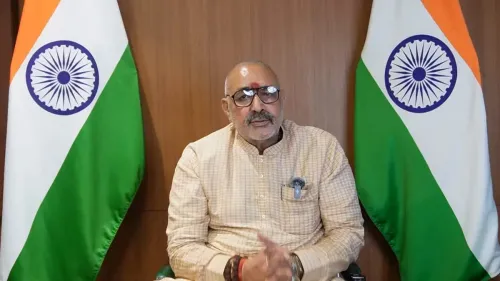
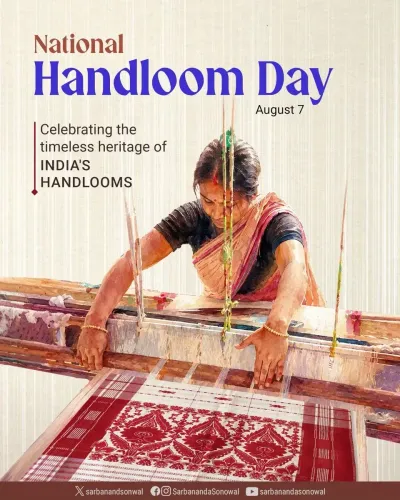
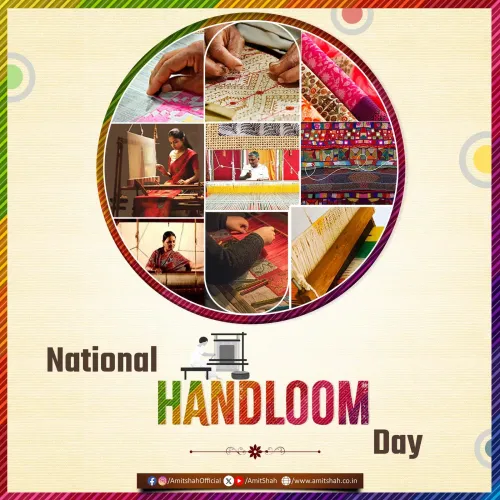
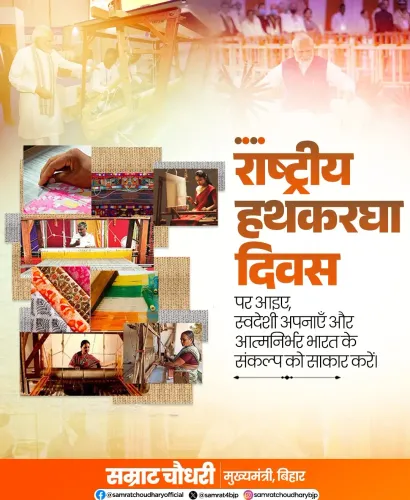
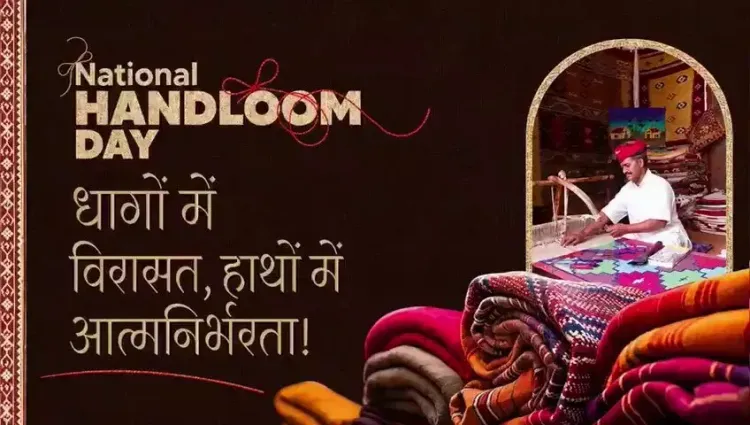
Shekhawat Marks National Handloom Day, Salutes India's Weavers
Synopsis
Union Culture and Tourism Minister Gajendra Singh Shekhawat marked National Handloom Day on 7 August 2026, honouring over 35 lakh weavers — 70% women — and crediting ODOP and GeM platforms for lifting handloom exports under the Atmanirbhar Bharat framework.
Key Takeaways
National Handloom Day is observed every 7 August since 2015 , commemorating the launch of the Swadeshi Movement on the same date in 1905 .
More than 35 lakh weavers are active in India's handloom sector, with over 70 percent being women.
The One District One Product (ODOP) scheme provides branding and market linkages for district-specific handloom clusters.
The Government e-Marketplace (GeM) , launched in 2016 , enables direct government procurement from handloom artisans.
Minister Shekhawat framed buying handloom as an act of solidarity with weavers and a commitment to Atmanirbhar Bharat .
On a day rooted in resistance — the 7 August 1905 Swadeshi Movement that lit the fire of indigenous pride against British cloth — Union Culture and Tourism Minister Gajendra Singh Shekhawat used National Handloom Day 2026 to remind India that the loom is not a relic. It is a livelihood, a legacy, and a statement.
Shekhawat's post, shared on 7 August 2026, frames handloom as the intersection of three forces: heritage, employment, and self-reliance. 'विरासत, रोजगार और आत्मनिर्भरता की पहचान — भारतीय हथकरघा!' ('Heritage, employment and self-reliance — Indian handloom!') he wrote, invoking the spirit of the Swadeshi Movement that galvanised a nation over a century ago.
From 1905 to 2015: How a Freedom Movement Became a National Day
The thread connecting 1905 to today is deliberate. When the Swadeshi Movement erupted in Bengal on 7 August 1905, its central act was the rejection of British mill cloth in favour of hand-spun, hand-woven Indian fabric. Prime Minister Narendra Modi revived that symbolism in 2015, institutionalising National Handloom Day on the same date — anchoring a contemporary economic programme to a moment of anti-colonial defiance. The choice of date was never incidental; it was a message.35 Lakh Weavers, 70% of Them Women
The minister's post puts numbers to the sector's human scale: more than 35 lakh weavers sustain Indian handloom today, and over 70 percent of them are women. That single statistic reframes handloom policy as women's economic policy. In rural and semi-urban India, the loom is frequently the primary income source for households — and for millions of women, it is the only formal economic identity they hold. Shekhawat's explicit call-out of this demographic is a signal that the sector's gender dimension is now central to how the government narrates its own programme.ODOP, GeM, and the Push to Take Handloom Global
Beyond the symbolism, the minister points to two platforms doing practical heavy lifting. The One District One Product (ODOP) scheme — rolled out from 2018 — gives district-specific handloom clusters a branding and market-linkage framework, helping a Maheshwari weaver in Madhya Pradesh or a Pochampally craftsperson in Telangana reach buyers who would never have found them through traditional trade channels. The Government e-Marketplace (GeM), launched in 2016, opens government procurement — a vast, reliable buyer — directly to artisans, cutting out intermediaries and improving margins. Together, Shekhawat argues, technology and easy credit are pushing handloom exports to 'new heights.'Buying Handloom as a Political Act
The minister closes with a line that doubles as a call to action: purchasing a handloom product is not mere shopping — it is an act of solidarity with weavers and a vote for Atmanirbhar Bharat (self-reliant India). It is the same logic that powered the Swadeshi Movement in 1905, updated for an era of e-commerce and global supply chains. The loom has changed. The argument has not. India's handloom story is as old as its freedom struggle — and, if the policy scaffolding holds, its next chapter may be written in export ledgers and GeM dashboards.Point of View
Rural women's empowerment, and the Atmanirbhar Bharat economic narrative into a single, coherent message. Shekhawat's invocation of the 1905 Swadeshi Movement is not incidental — it is a deliberate attempt to give contemporary trade policy the moral weight of the freedom struggle. The emphasis on women comprising over 70 percent of the weaver workforce signals that handloom is increasingly being positioned within the government's broader gender-inclusion agenda. Whether the export momentum cited translates into verifiable income gains for weavers at the loom will be the metric that separates symbolism from substance.
NationPress
7 Aug 2026
Frequently Asked Questions
When is National Handloom Day celebrated in India?
National Handloom Day is celebrated every year on 7 August , a date chosen to commemorate the launch of the Swadeshi Movement on 7 August 1905 . It was instituted in 2015 under Prime Minister Narendra Modi.
Why is 7 August significant for India's handloom sector?
On 7 August 1905 , the Swadeshi Movement was launched in Calcutta, calling for the use of indigenous cloth and the boycott of British textiles. This date was chosen as National Handloom Day to connect modern handloom promotion to that historic act of economic self-reliance.
How many weavers are there in India's handloom industry?
According to figures cited by Minister Shekhawat, more than 35 lakh weavers are engaged in India's handloom sector, of whom over 70 percent are women.
What is the ODOP scheme and how does it help handloom weavers?
The One District One Product (ODOP) scheme, rolled out from 2018 , supports district-specific products — including handlooms — through branding, market linkages, and cluster development, helping local artisans access wider markets.
How does GeM help handloom artisans in India?
The Government e-Marketplace (GeM) , launched in 2016 , allows government departments to procure handloom products directly from weavers and artisans, bypassing intermediaries and improving earnings for craftspeople.