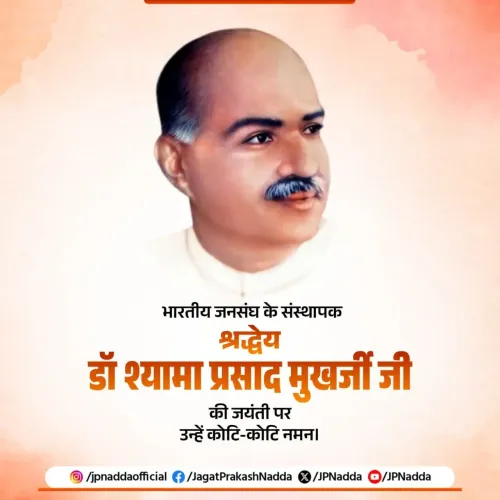
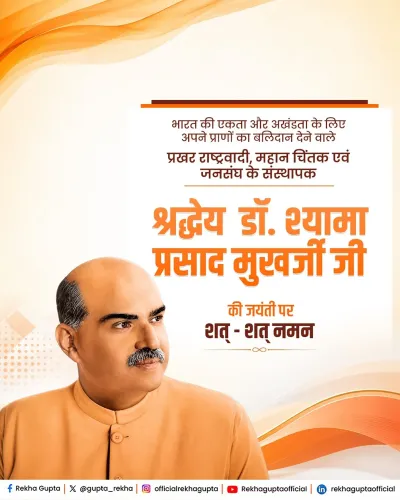
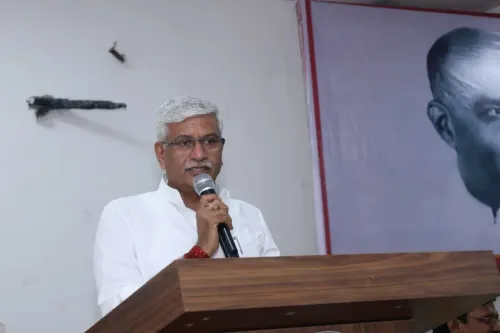
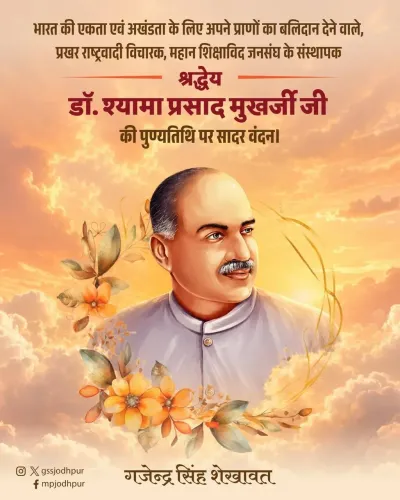
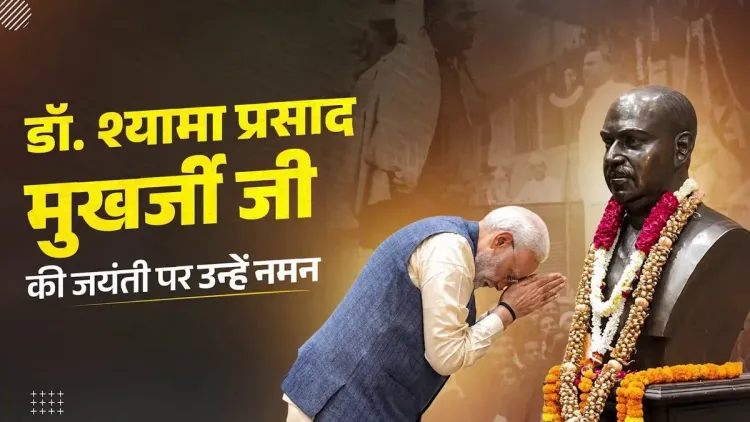
Shekhawat Pays Tribute to Dr. Shyama Prasad Mukherjee on Birth Anniversary
Synopsis
Union Culture Minister Gajendra Singh Shekhawat marked Dr. Shyama Prasad Mukherjee's 125th birth anniversary on 6 July 2026, honouring the Jana Sangh founder as an immortal martyr and drawing a direct ideological line from his sacrifices to the BJP government's abrogation of Article 370, the CAA, and the National Education Policy.
Key Takeaways
Shyama Prasad Mukherjee was born on 6 July 1901 in Bengal and became Calcutta University's youngest Vice-Chancellor at age 33 .
He resigned from the Union Cabinet in 1950 over the Nehru-Liaquat Pact and the persecution of Hindus in East Pakistan.
He founded the Bharatiya Jana Sangh in 1951 as an ideological alternative centred on national integration.
Mukherjee died on 23 June 1953 in detention after entering Kashmir without a permit to protest its special constitutional status.
Minister Shekhawat linked the abrogation of Article 370 (2019) , the Citizenship Amendment Act (2019) , and the National Education Policy (2020) to Mukherjee's founding vision.
The tribute reinforces the BJP's narrative of ideological continuity from Jana Sangh to the present ruling dispensation.
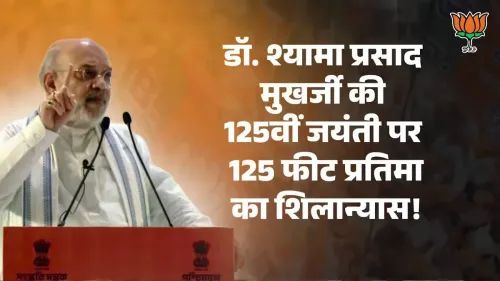
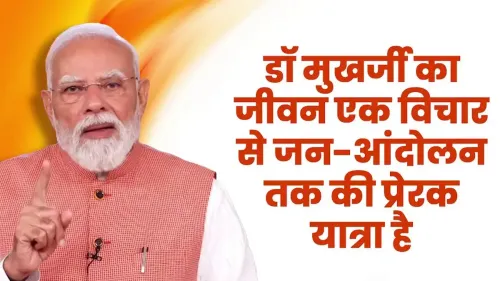
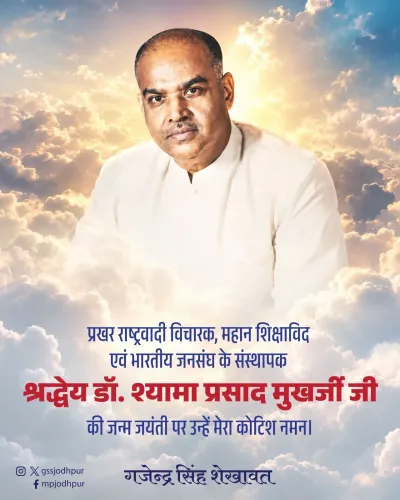
Union Culture and Tourism Minister Gajendra Singh Shekhawat on Monday, 6 July 2026, paid tribute to Dr. Shyama Prasad Mukherjee on his birth anniversary, hailing him as an immortal martyr of undivided India and tracing the ideological lineage from the Bharatiya Jana Sangh to the present-day Bharatiya Janata Party.
Context
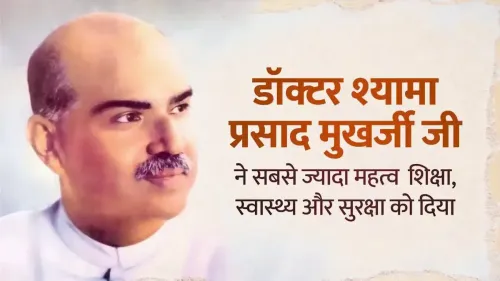
Dr. Shyama Prasad Mukherjee was born on 6 July 1901 in Bengal. Shekhawat noted that Mukherjee became the youngest Vice-Chancellor of Calcutta University at the age of 33, and after independence served as the country's first Minister of Industry and Supply, where he laid what the minister described as a strong foundation for a self-reliant India. The post, written in Hindi, opens with the salutation 'koti-koti naman' — meaning 'salutations from millions' — reflecting the reverence the BJP accords to Mukherjee as a founding ideological figure.
Shekhawat recalled that the Nehru-Liaquat Pact of 1950 — an agreement between India and Pakistan on the treatment of minorities — and the persecution of Hindus in East Pakistan deeply disturbed Mukherjee, prompting him to resign from the cabinet. Placing national interest above political office, Mukherjee founded the Bharatiya Jana Sangh in 1951, offering what Shekhawat called a new ideological alternative to the country.
Policy Backdrop
The post highlights Mukherjee's opposition to the principle of 'do vidhan, do nishan aur do pradhan' — 'two constitutions, two flags, and two heads of state' — a formulation that captured his resistance to the special constitutional status granted to Jammu and Kashmir under Article 370. Mukherjee entered Kashmir without the permit then required of Indian citizens, was arrested, held under detention, and died on 23 June 1953 under circumstances that his supporters have long attributed to official neglect of medical care.
Shekhawat draws a direct line from that sacrifice to contemporary legislative milestones, citing the abrogation of Article 370 in August 2019, the Citizenship Amendment Act enacted in December 2019, and the National Education Policy approved in July 2020 under Prime Minister Narendra Modi as steps towards realising Mukherjee's unfinished agenda. The framing situates these policy actions within a continuum of cultural-nationalist thought that the BJP traces back to the Jana Sangh's founding principles.
Stakeholders and Impact
The tribute carries significance for the BJP's organisational base, particularly its cadre in West Bengal — Mukherjee's home state — where the party has invested heavily in expanding its footprint. Commemorations of this kind reinforce the party's narrative of ideological continuity, connecting grassroots workers to a founding martyr whose causes — national integration, a uniform constitutional framework for all states, and cultural nationalism — remain central to the BJP's platform.
For historians and opposition parties, the anniversary also invites scrutiny of the circumstances of Mukherjee's death in Nehru-era custody, a subject that has featured in parliamentary debates and remains a point of political contestation between the BJP and the Congress.
What's Next
The BJP and affiliated organisations typically mark 6 July with events across the country, from party offices in New Delhi to programmes in Kolkata, keeping Mukherjee's legacy visible in the political calendar. As Parliament's monsoon session approaches, references to Mukherjee's positions on federal asymmetry and citizenship are likely to recur in floor debates, particularly on any legislation touching Jammu and Kashmir or minority affairs. Shekhawat's post closes with the assertion that Mukherjee's message of 'Nation First' will continue to inspire generations to come — a phrase that doubles as a contemporary political rallying call for the ruling party.
Point of View
Using a founding martyr's birth anniversary to validate its most consequential legislative actions — from Article 370's abrogation to the CAA — as fulfilment of a decades-old ideological promise rather than partisan novelty. By invoking Mukherjee's resignation over the Nehru-Liaquat Pact, the post implicitly frames the Congress-era leadership as complicit in the injustices Mukherjee opposed, a contrast that serves the BJP's long-running electoral narrative in West Bengal. The timing ahead of Parliament's monsoon session suggests the messaging is as much about energising the cadre as it is about historical commemoration. Such tributes also serve a generational function, inducting newer BJP supporters into an origin story that pre-dates the party's 1980 formation.
NationPress
5 Oct 2026
Frequently Asked Questions
Who was Dr. Shyama Prasad Mukherjee?
Dr. Shyama Prasad Mukherjee was a Bengali politician and academic born on 6 July 1901 who served as India's first Minister of Industry and Supply after independence, founded the Bharatiya Jana Sangh in 1951, and died in detention in Kashmir on 23 June 1953 while protesting the state's special constitutional status.
Why did Shyama Prasad Mukherjee resign from the cabinet?
Mukherjee resigned from Prime Minister Nehru's cabinet in 1950 over the Nehru-Liaquat Pact, which he felt failed to adequately protect Hindus facing persecution in East Pakistan.
What was the 'do vidhan, do nishan, do pradhan' slogan?
The slogan — meaning 'two constitutions, two flags, two heads of state' — was Mukherjee's critique of Article 370, which granted Jammu and Kashmir a separate constitution and special federal status that he argued was incompatible with national integration.
How did Shyama Prasad Mukherjee die?
Mukherjee was arrested in 1953 after entering Jammu and Kashmir without the permit then required of Indian citizens. He died on 23 June 1953 while under detention, with his supporters attributing his death to neglect of medical care.
What is the connection between Jana Sangh and BJP?
The Bharatiya Jana Sangh, founded by Mukherjee in 1951, merged with other parties to form the Janata Party in 1977 and its former members subsequently established the Bharatiya Janata Party in 1980, which the BJP regards as the direct ideological successor to Jana Sangh.