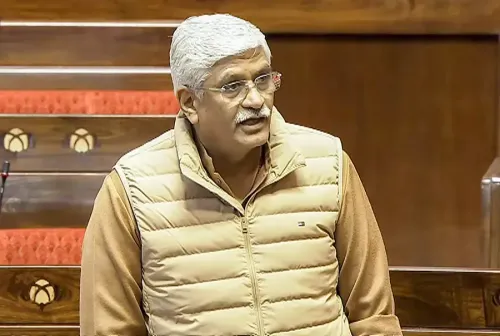
Shekhawat sanctions ₹7 crore for tribal homestays in 3 states
Synopsis
Union Tourism Minister Gajendra Singh Shekhawat has sanctioned over ₹7 crore under the tribal homestay sub-scheme of Swadesh Darshan 2.0 for clusters in Chhattisgarh, Meghalaya, and Nagaland, aiming to generate community-led livelihoods through sustainable tourism.
Key Takeaways
₹7 crore+ in Central Financial Assistance sanctioned across three tribal homestay projects in a single announcement.
Chhattisgarh receives ₹1.8 crore for the Bagicha-Mayali-Jashpur tribal cluster.
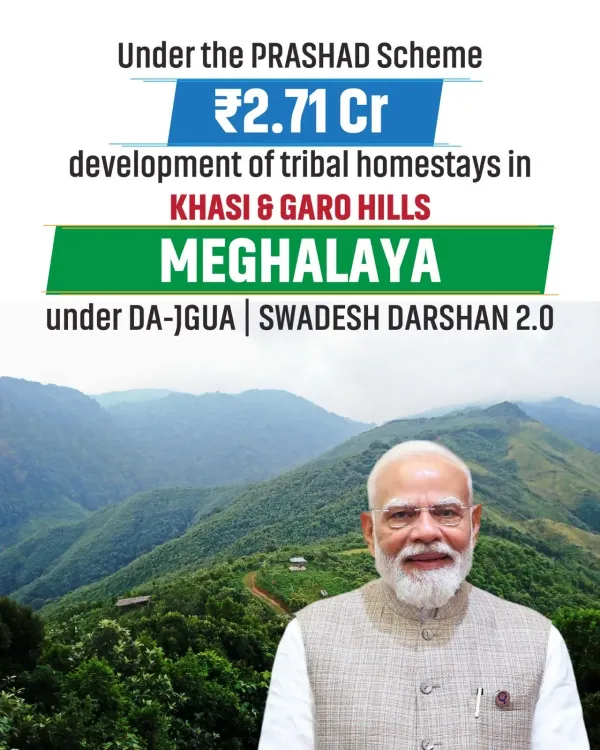
Meghalaya receives ₹2.71 crore for Khasi Hills and Garo Hills clusters.
Nagaland receives ₹2.5 crore for Tsurangkong-Longchem and Satakha clusters.
Funding flows through the 'Development of Homestays in Tribal Areas' sub-scheme under Swadesh Darshan 2.0 , the Ministry of Tourism's community-focused sustainable tourism programme.
The model positions tribal families as owners and operators, keeping tourism revenues within the community rather than with outside commercial operators.
Three tribal clusters — spread across the forests of Chhattisgarh, the highlands of Meghalaya, and the hills of Nagaland — are set to become India's newest community-run tourism destinations, as Union Culture and Tourism Minister Gajendra Singh Shekhawat announced Central Financial Assistance totalling over ₹7 crore for homestay development on Tuesday, 29 September 2026.
What got sanctioned — and where
The grants flow through the 'Development of Homestays in Tribal Areas' sub-scheme under Swadesh Darshan 2.0, the Ministry of Tourism's revamped sustainable-tourism programme. Three projects have been cleared: ₹1.8 crore for tribal homestays in the Bagicha-Mayali-Jashpur cluster in Chhattisgarh; ₹2.71 crore for homestays across the Khasi Hills and Garo Hills clusters in Meghalaya; and ₹2.5 crore for homestays in the Tsurangkong-Longchem and Satakha clusters in Nagaland.
Together, the three sanctions add up to just over ₹7 crore in Central Financial Assistance — each rupee earmarked not for hotels or resorts, but for community-owned homestay infrastructure in regions where tribals are both the hosts and the primary economic beneficiaries.
Swadesh Darshan 2.0 — the policy engine behind the grants
Swadesh Darshan was originally launched in 2014-15 to build theme-based tourist circuits. Its upgraded version, Swadesh Darshan 2.0, recalibrated the model — shifting emphasis away from large commercial infrastructure and toward sustainable, community-participatory tourism. The tribal homestay sub-scheme sits at the sharpest edge of that philosophy: small-scale, deeply local, and designed to keep the economic value inside the community.
The three states chosen — one in central India, two in the Northeast — are not accidental picks. Jashpur in Chhattisgarh has one of the state's highest tribal population concentrations. The Khasi and Garo communities of Meghalaya have long practiced a rich cultural tradition that has drawn niche travellers but lacked organised infrastructure. And Nagaland's remote clusters carry distinctive Naga heritage, festivals, and landscapes that remain largely off the mainstream tourist map.
Community livelihoods as the centrepiece
Shekhawat framed the announcement squarely around economic empowerment, writing: 'Tourism that empowers communities. Tourism that celebrates our heritage.' The model sidesteps the standard critique of government tourism schemes — that outsiders capture most of the value — by vesting ownership and operation with tribal families themselves.
For tribal communities in these clusters, a government-backed homestay network means a reliable revenue stream that does not require migration to cities. It also means that visitors arriving for the culture stay, eat, and spend within the village — a multiplier that a highway hotel simply cannot replicate.
Watch for utilisation and rollout timelines as the real test: sanctioned funds are the starting gun, not the finish line. Whether these clusters emerge as living, breathing tourism destinations will depend on implementation quality, connectivity, and on-ground training for homestay hosts. The government's credibility on tribal tourism now rides on all three.
Point of View
However, will be measured not at the announcement stage but when travellers actually arrive and homestay hosts actually earn — making rollout accountability the next pressure point for opposition scrutiny and civil-society monitoring alike.
NationPress
29 Sept 2026
Frequently Asked Questions
What is the Swadesh Darshan 2.0 tribal homestay scheme?
The 'Development of Homestays in Tribal Areas' is a sub-scheme under Swadesh Darshan 2.0 — the Ministry of Tourism's updated sustainable-tourism programme — that provides Central Financial Assistance to develop community-owned homestay infrastructure in tribal regions of India.
How much money has been sanctioned for tribal homestays in Chhattisgarh, Meghalaya, and Nagaland?
A total of over ₹7 crore has been sanctioned: ₹1.8 crore for the Bagicha-Mayali-Jashpur cluster in Chhattisgarh, ₹2.71 crore for Khasi Hills and Garo Hills clusters in Meghalaya, and ₹2.5 crore for Tsurangkong-Longchem and Satakha clusters in Nagaland.
What is Swadesh Darshan and when was it launched?
Swadesh Darshan was launched in 2014-15 by the Ministry of Tourism to develop theme-based tourist circuits across India. Swadesh Darshan 2.0 is its revamped version, introduced later, with greater emphasis on sustainable, responsible, and community-participatory tourism.
Who announced the tribal homestay funding in September 2026?
Union Culture and Tourism Minister Gajendra Singh Shekhawat announced the Central Financial Assistance for the three tribal homestay projects on 29 September 2026.
Which tribal communities benefit from the Meghalaya homestay grant?
The Meghalaya grant of ₹2.71 crore targets the Khasi Hills and Garo Hills clusters, benefiting the Khasi and Garo tribal communities of the state.