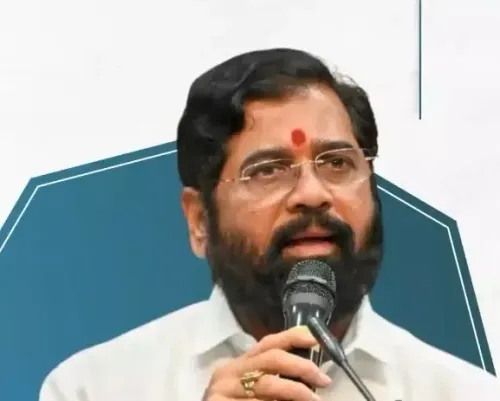
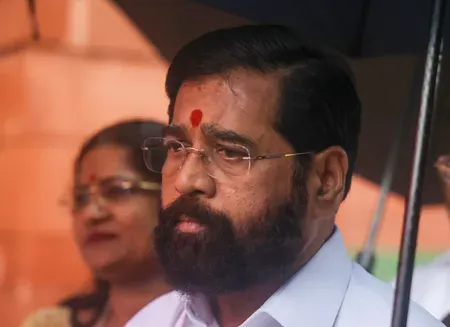
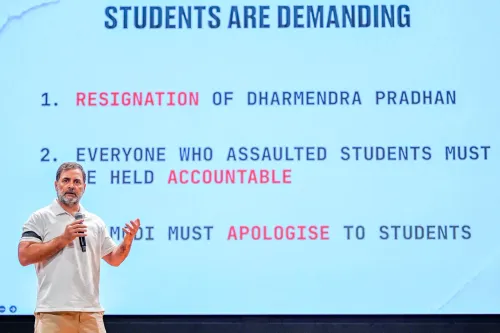
Eknath Shinde slams Rahul Gandhi over PM residence protest call
Synopsis
Maharashtra Deputy CM Eknath Shinde has gone on the offensive against Rahul Gandhi, questioning whether a protest call outside the PM's residence — a restricted zone — amounted to an attempt to 'create anarchy.' The confrontation lays bare how the NEET paper leak has become the sharpest political fault line between the ruling alliance and the Opposition heading into the monsoon session.
Key Takeaways
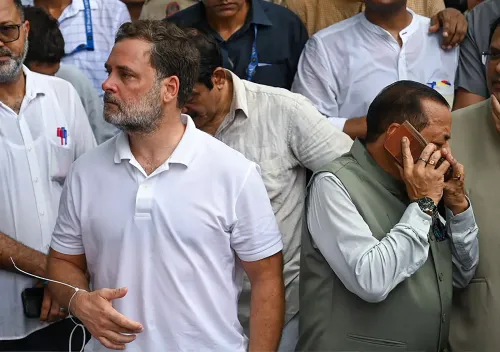
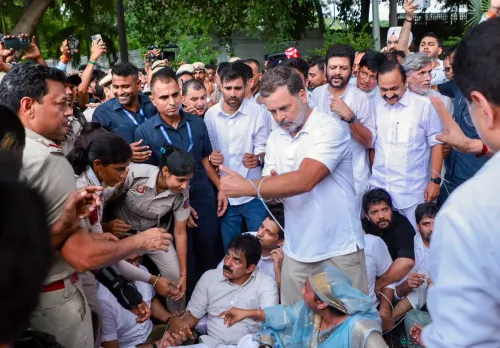
Maharashtra Deputy CM Eknath Shinde on Wednesday attacked Rahul Gandhi for calling a protest outside PM Modi's official residence.
Shinde called the move 'extremely irresponsible,' alleging it was an attempt to 'play politics on the shoulders of students.' The protest was linked to the NEET paper leak controversy, which Shinde acknowledged as 'unfortunate.' The Centre conducted a NEET re-examination in which 20 to 22 lakh students appeared and nearly 11 lakh qualified, according to Shinde.
Combined participation across NEET, JEE, and CUET was reportedly 40 to 50 lakh students.
Shinde credited PM Modi with personally monitoring the corrective process to restore examination integrity.
Maharashtra Deputy Chief Minister Eknath Shinde on Wednesday launched a sharp attack on Leader of Opposition Rahul Gandhi, questioning his decision to call for a protest outside Prime Minister Narendra Modi's official residence — a location where demonstrations are legally prohibited. Shinde, who also heads the Shiv Sena faction in the ruling alliance, accused Gandhi of irresponsibility and political opportunism in the wake of the NEET paper leak controversy.
Shinde Questions Gandhi's Intent
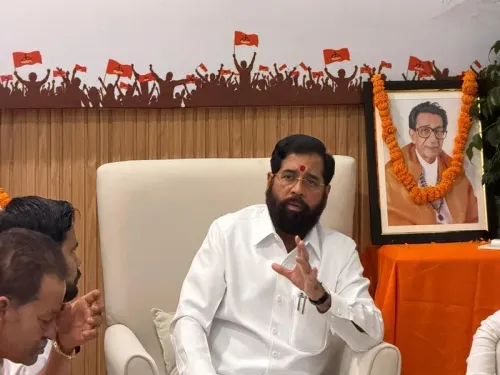
Speaking in Mumbai, Shinde posed a series of pointed questions at the Congress leader. 'What exactly did Rahul Gandhi intend to achieve by urging people to gather at a location where protests are prohibited? Was there a plot to cause sabotage at the Prime Minister's residence? Was this an attempt to create anarchy in the country?' he said.
Shinde argued that as the Leader of Opposition in the Lok Sabha, Gandhi carries a significant constitutional responsibility and is expected to conduct himself with commensurate maturity. He accused Gandhi of setting a 'dangerous precedent' by directing demonstrators toward a restricted zone.
NEET Controversy at the Centre of the Row
The protest call by Gandhi was linked to the NEET exam paper leak incident, which triggered nationwide outrage among students and parents. Shinde acknowledged the episode as 'unfortunate' but maintained that the Union government responded swiftly and decisively.
'The re-examination for NEET was conducted with complete transparency and rigour. Around 20 to 22 lakh students appeared for the exam, with nearly 11 lakh qualifying,' Shinde said. He added that subsequent national-level examinations — JEE and CUET (Common University Entrance Test) — also proceeded without disruption, with a combined 40 to 50 lakh students participating across the three exams.
Government's Response Defended
Shinde credited Prime Minister Modi and the Centre with personally overseeing corrective measures. 'Intervention at the highest level ensured that the examination system became more secure, transparent, and trustworthy,' he alleged, contrasting what he described as the government's constructive response with what he called the Opposition's attempt to 'politicise the issue.'
Notably, this is not the first time the NEET controversy has become a flashpoint between the ruling coalition and the Opposition. The paper leak, which reportedly surfaced ahead of the May 2024 examination, drew calls for a Central Bureau of Investigation (CBI) probe and a Supreme Court hearing, making it one of the most politically charged education-related crises in recent years.
Political Fallout
Shinde's broadside reflects the ruling alliance's broader strategy of framing the Congress-led Opposition's protests as destabilising rather than democratic. Critics of this position argue that questioning examination integrity is a legitimate legislative function of the Opposition, and that the protest call was a response to student grievances that had not been adequately addressed through parliamentary channels.
With student unrest over competitive exam integrity still simmering, the political battle over the NEET fallout is unlikely to subside soon.
Point of View
The ruling alliance sidesteps accountability on the NEET paper leak itself. The questions he raised — 'sabotage,' 'anarchy' — are strong words for what was, at its core, a demonstration demand. Meanwhile, the substantive issue of how the leak occurred and who was held responsible remains incompletely answered in public. The ruling coalition's pivot to attacking the messenger risks deepening the perception that the examination system's credibility crisis has been managed politically rather than institutionally resolved.
NationPress
21 Oct 2026
Frequently Asked Questions
Why did Eknath Shinde attack Rahul Gandhi over the PM residence protest?
Shinde criticised Gandhi for calling supporters to protest outside PM Modi's official residence, which is a legally restricted zone where demonstrations are not permitted. He alleged it was an irresponsible move that exploited student anger over the NEET paper leak for political gain.
What is the NEET paper leak controversy?
The NEET paper leak refers to the alleged breach of the National Eligibility cum Entrance Test question paper ahead of the May 2024 examination, which triggered widespread student protests and legal scrutiny including a Supreme Court hearing. The incident raised serious questions about the integrity of India's centralised medical entrance system.
What action did the government take after the NEET paper leak?
According to Deputy CM Shinde, the Centre conducted a re-examination with 20 to 22 lakh students appearing and nearly 11 lakh qualifying. Subsequent exams — JEE and CUET — also proceeded smoothly, with PM Modi personally monitoring the corrective process, Shinde claimed.
Who is Eknath Shinde?
Eknath Shinde is the Deputy Chief Minister of Maharashtra and the chief leader of the Shiv Sena faction aligned with the ruling Mahayuti alliance. He previously served as Chief Minister of Maharashtra from 2022 to 2024.
Is protesting outside the PM's residence legal?
Demonstrations outside the Prime Minister's official residence in New Delhi are prohibited under law. Shinde cited this restriction as the basis for his allegation that Gandhi's protest call was irresponsible and potentially aimed at creating disorder.