Shivraj Singh Chouhan marks World Rural Development Day
Synopsis
Union Agriculture Minister Shivraj Singh Chouhan marked World Rural Development Day on 6 July 2026 by reaffirming India's commitment to inclusive rural growth, women's empowerment through the Lakhpati Didi scheme, and village-level infrastructure — framing prosperous villages as the cornerstone of the Viksit Bharat 2047 vision.
Key Takeaways
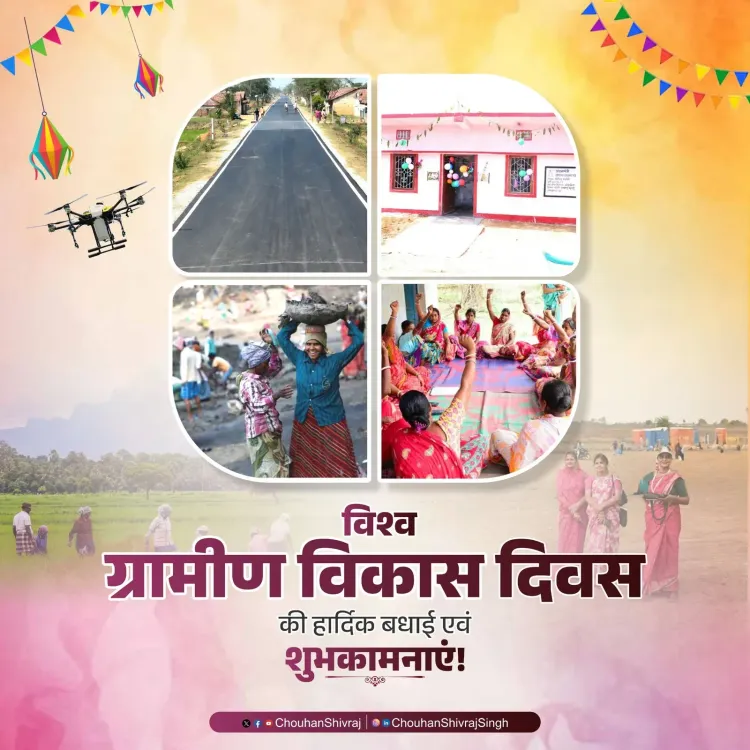
Union Agriculture Minister Shivraj Singh Chouhan posted on 6 July 2026 to mark World Rural Development Day .
He described villages as 'the soul of India' and the foundation of the country's agriculture-based economy and culture.
The minister highlighted the Lakhpati Didi initiative, which aims to help rural women earn at least Rs 1 lakh annually through self-help groups.
Key policy instruments cited include DAY-NRLM , Pradhan Mantri Awas Yojana-Gramin , and Mission Antyodaya .
Chouhan called for making every village 'poverty-free and employment-rich' as part of the Viksit Bharat 2047 national development goal.
Progress on Lakhpati Didi coverage and NRLM targets is expected to face scrutiny in the next parliamentary session on rural development grants.
Union Agriculture Minister Shivraj Singh Chouhan on Monday, 6 July 2026, marked World Rural Development Day by reaffirming the government's commitment to inclusive village-level growth, women's economic empowerment, and rural infrastructure — framing prosperous villages as the foundation of a Viksit Bharat (Developed India).
Context
World Rural Development Day, observed on 6 July, serves as an annual occasion for governments and civil society to spotlight the challenges and progress of rural economies worldwide. Chouhan, who holds the dual portfolio of Union Minister of Agriculture and Farmers Welfare and Rural Development, used the occasion to address all citizens, posting in Hindi on X: 'Gaanvon ki samridhi, Viksit Bharat ka sashakt aadhar' — 'The prosperity of villages is the strong foundation of a Developed India.'
In the post, Chouhan described villages as 'Bharat ki aatma' — 'the soul of India' — and as the bedrock of the country's culture, traditions, and agriculture-based economy. He credited Prime Minister Narendra Modi's leadership for continuous work on rural development, livelihood enhancement, women's empowerment, and expansion of basic infrastructure.
Policy Backdrop
The minister's message echoes a sustained policy arc that has unfolded over more than a decade. The Deendayal Antyodaya Yojana-National Rural Livelihoods Mission (DAY-NRLM), launched in 2011, organises rural poor — particularly women — into self-help groups (SHGs) to create pathways to sustainable income. Pradhan Mantri Awas Yojana-Gramin, rolled out in 2015, targets pucca housing for rural families, while Mission Antyodaya (2017) sought convergent, saturation-based delivery of multiple schemes at the village level.
A key programme Chouhan specifically invoked is the Lakhpati Didi initiative — a flagship scheme under DAY-NRLM that aims to enable rural women to earn at least Rs 1 lakh annually through SHG-linked livelihoods. His stated aspiration: 'Har behen lakhpati bane' — 'Every sister should become a Lakhpati Didi.' These schemes collectively sit under the broader Atmanirbhar Bharat framework, which integrates rural livelihood, housing, sanitation and infrastructure goals.
Stakeholders and Impact
Rural women and small farmers are the primary intended beneficiaries of the programmes Chouhan referenced. Women's SHGs, which form the operational backbone of DAY-NRLM and the Lakhpati Didi scheme, have expanded significantly across states, providing credit access, skill training, and market linkages to millions of households below and near the poverty line.
Chouhan, a former four-term Chief Minister of Madhya Pradesh, brings direct administrative experience with rural welfare delivery at the state level to his current central role. His post calls on citizens collectively to work toward making every village 'gareebi mukt, rozgaar yukt' — 'poverty-free and employment-rich' — as a step toward the government's Viksit Bharat 2047 vision.
What's Next
The ministry's stated commitment to inclusive and self-reliant rural development will be tested against ground-level outcomes as the next parliamentary session takes up rural development grants and NRLM annual targets. Progress on Lakhpati Didi coverage — the number of women SHG members crossing the Rs 1 lakh annual income threshold — is expected to be a key metric scrutinised by lawmakers and civil society alike.
With Viksit Bharat 2047 as the overarching national goal, the government's ability to demonstrate measurable gains in rural incomes, housing, and women's economic participation will increasingly define the political and policy narrative around India's development story in the years ahead.
Point of View
Rather than bureaucrats, reflects a broader communication strategy of co-opting public sentiment into the development narrative.
NationPress
5 Oct 2026
Frequently Asked Questions
What is World Rural Development Day and when is it observed?
World Rural Development Day is an annual observance focused on rural prosperity and sustainable village economies, marked on 6 July each year.
What is the Lakhpati Didi scheme?
Lakhpati Didi is a government initiative under the Deendayal Antyodaya Yojana-National Rural Livelihoods Mission (DAY-NRLM) that aims to help rural women earn at least Rs 1 lakh annually through self-help group-linked livelihoods.
What did Shivraj Singh Chouhan say on World Rural Development Day 2026?
Chouhan posted in Hindi on X, calling villages 'the soul of India' and reaffirming the government's commitment to inclusive rural development, women's empowerment through Lakhpati Didi, and poverty-free villages as part of the Viksit Bharat vision.
What rural development schemes has the Modi government launched?
Key schemes include DAY-NRLM for rural livelihoods and self-help groups (2011), Pradhan Mantri Awas Yojana-Gramin for rural housing (2015), and Mission Antyodaya for convergent delivery of rural welfare programmes (2017).
Who is Shivraj Singh Chouhan?
Shivraj Singh Chouhan is India's Union Minister of Agriculture and Farmers Welfare and Rural Development, and a senior BJP leader who served four terms as Chief Minister of Madhya Pradesh.