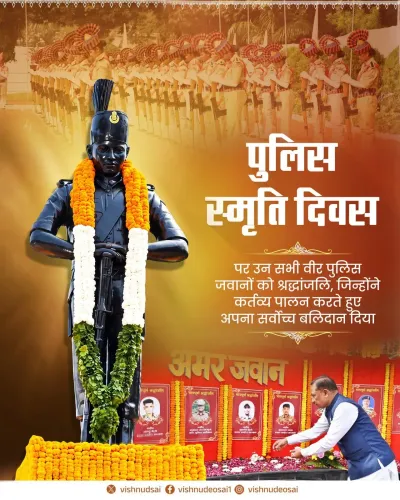
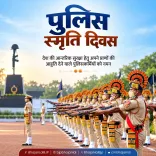
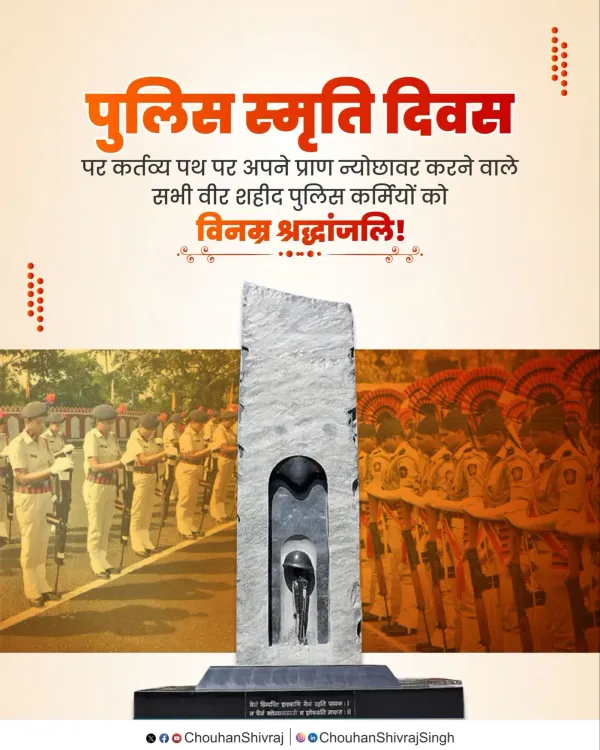
Shivraj Singh Chouhan pays tribute on Police Smriti Diwas
Synopsis
Union Agriculture Minister Shivraj Singh Chouhan honoured martyred police personnel on Police Smriti Diwas, observed on 21 October since the 1959 Hot Springs incident in Ladakh when ten CRPF personnel were killed in an ambush.
Key Takeaways
Police Smriti Diwas is observed every year on 21 October to honour police and paramilitary personnel martyred in the line of duty.
The observance dates to the 1959 Hot Springs incident in Ladakh , in which ten CRPF personnel were killed during a patrol ambush.
Union Minister Shivraj Singh Chouhan offered tribute in Hindi, invoking the values of 'service, dedication and courage' displayed by martyred police personnel.
Chouhan stated that the sacrifices of security forces 'have kept the nation's integrity inviolable' and that 'every Indian will always be proud of them.' Indian political leaders across party lines mark this date annually, reflecting a broad national consensus on recognising police sacrifices.
Every year on 21 October, India pauses to remember the police personnel who gave their lives so the nation could hold its ground — and this year, Union Agriculture Minister Shivraj Singh Chouhan added his voice to that solemn roll call with a heartfelt tribute on Police Commemoration Day (Police Smriti Diwas).
In his post, Chouhan wrote: 'Seva, samarpan aur sahas jaise mulyon ko dharan kar matrubhumi ki raksha ke liye apna sarvochch balidan dene wale veer shaheed policekarmion ke charno mein Police Smriti Diwas par shraddhasuman arpit karta hun.' — 'On Police Commemoration Day, I offer my respectful homage at the feet of the brave martyred police personnel who embraced the values of service, dedication and courage and made the ultimate sacrifice in defence of the motherland.'
He further noted that the 'courageous personalities and sacrifices of our valiant soldiers have kept the nation's integrity inviolable,' adding that 'every Indian will always be proud of you all.' The post closed with 'Jai Hind!'
The 1959 Hot Springs ambush that started it all
Police Commemoration Day is observed every year on 21 October to mark the anniversary of the 1959 Hot Springs incident in Ladakh, in which ten CRPF personnel were killed during a patrol ambush — one of the earliest and starkest reminders that India's internal security forces face battlefield dangers no less lethal than those on a conventional front.
The date has since become the focal point for tributes to all police and paramilitary personnel martyred in the line of duty, from border outposts to counter-insurgency operations across the country's most volatile terrain.
A recurring moment of national recognition
Across party lines and across years, senior political leaders — Union ministers, chief ministers, governors — mark Police Smriti Diwas with public statements. The practice reflects a broad, durable consensus in Indian public life: that the sacrifices of police and paramilitary forces, often rendered far from the public eye, deserve formal, visible acknowledgement from elected representatives.
For Chouhan, a leader who spent nearly two decades as Chief Minister of Madhya Pradesh before joining the Union Cabinet, tributes to security personnel carry the weight of administrative experience — a former state executive who dealt directly with law-and-order and internal security decisions now offering remembrance from the national stage.
Today, as wreaths are laid and names are read out at memorials across the country, the nation's debt to its police martyrs is acknowledged — not as ceremony, but as conscience.
Point of View
The tribute underscores a continuity between his long tenure as a state executive — where law-and-order was a daily accountability — and his current Union Cabinet role. The annual convergence of political voices on this date also signals how police welfare and martyrdom recognition have become a stable plank of mainstream political messaging in India, largely insulated from partisan contestation.
NationPress
21 Oct 2026
Frequently Asked Questions
What is Police Smriti Diwas and why is it observed on 21 October?
Police Smriti Diwas, or Police Commemoration Day, is observed every year on 21 October to honour police and paramilitary personnel who died in the line of duty. The date marks the anniversary of the 1959 Hot Springs incident in Ladakh , when ten CRPF personnel were killed in an ambush.
What did Shivraj Singh Chouhan say on Police Smriti Diwas 2026?
Shivraj Singh Chouhan paid tribute to martyred police personnel, saying their sacrifices rooted in 'service, dedication and courage' have kept India's integrity inviolable, and that every Indian will always be proud of them.
What was the Hot Springs incident of 1959?
The Hot Springs incident took place on 21 October 1959 in Ladakh , when ten CRPF personnel were killed during a patrol ambush. It became the founding event for Police Commemoration Day, observed annually on that date.
Who is Shivraj Singh Chouhan?
Shivraj Singh Chouhan is the Union Minister of Agriculture and Farmers Welfare and Rural Development, a senior BJP leader, and a former four-term Chief Minister of Madhya Pradesh .
How is Police Commemoration Day marked in India?
Police Commemoration Day is marked across India with wreath-laying ceremonies, parades, and tributes from political leaders at national and state levels. Senior leaders including Union ministers and chief ministers traditionally issue public statements honouring the martyrs.