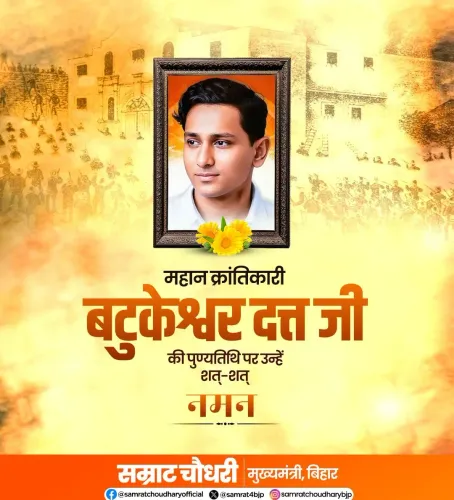
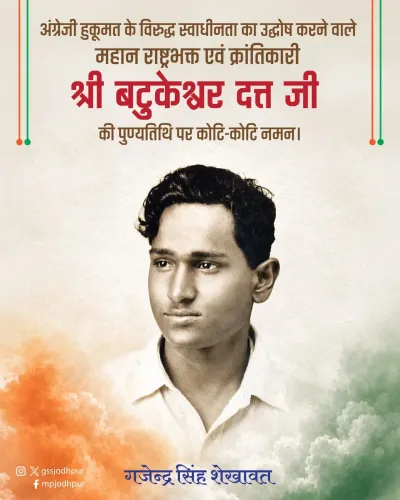
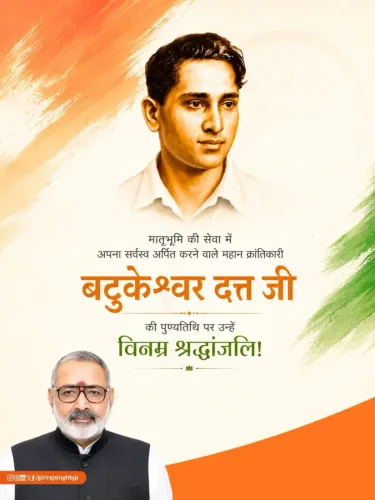
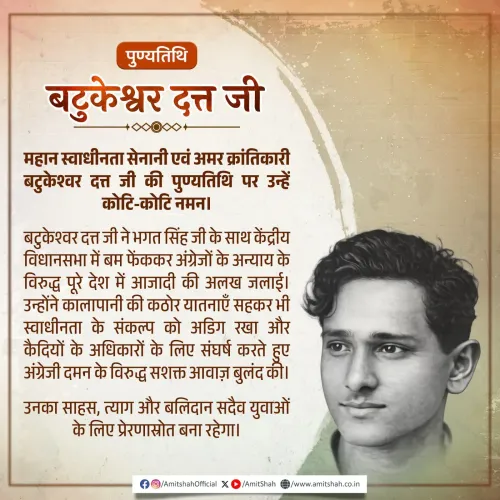
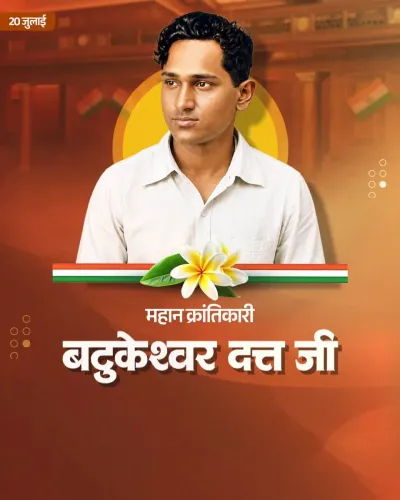
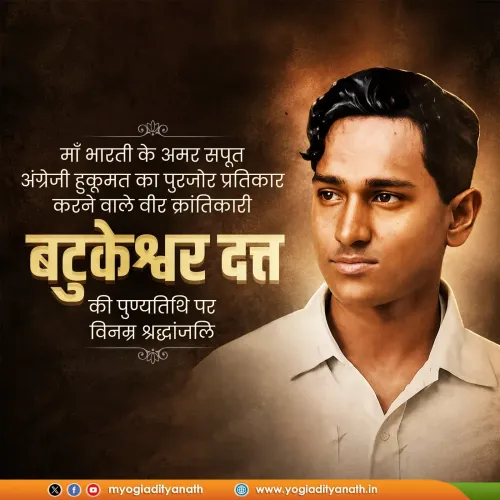
Shivraj Singh Chouhan Pays Tribute to Revolutionary Batukeshwar Dutt
Synopsis
Union Agriculture Minister Shivraj Singh Chouhan on 20 July 2026 paid tribute to revolutionary freedom fighter Batukeshwar Dutt on his death anniversary, hailing his sacrifice in the 1929 Central Legislative Assembly bombing alongside Bhagat Singh as an eternal inspiration for Indian youth.
Key Takeaways
Union Agriculture Minister Shivraj Singh Chouhan posted a tribute to revolutionary Batukeshwar Dutt on his death anniversary on 20 July 2026 .
Chouhan described Dutt as an 'unparalleled servant of Mother India' whose struggle would inspire patriotism in future generations.
Batukeshwar Dutt and Bhagat Singh famously bombed the Central Legislative Assembly on 8 April 1929 to protest colonial repression, courting arrest to publicise their cause.
Dutt was sentenced to life transportation and endured years of imprisonment, including hunger strikes for political prisoners' rights.
The tribute is part of a consistent pattern of BJP leaders commemorating armed-resistance figures of the independence era on social media.
With Independence Day (15 August) weeks away, further ministerial tributes to freedom fighters are expected.
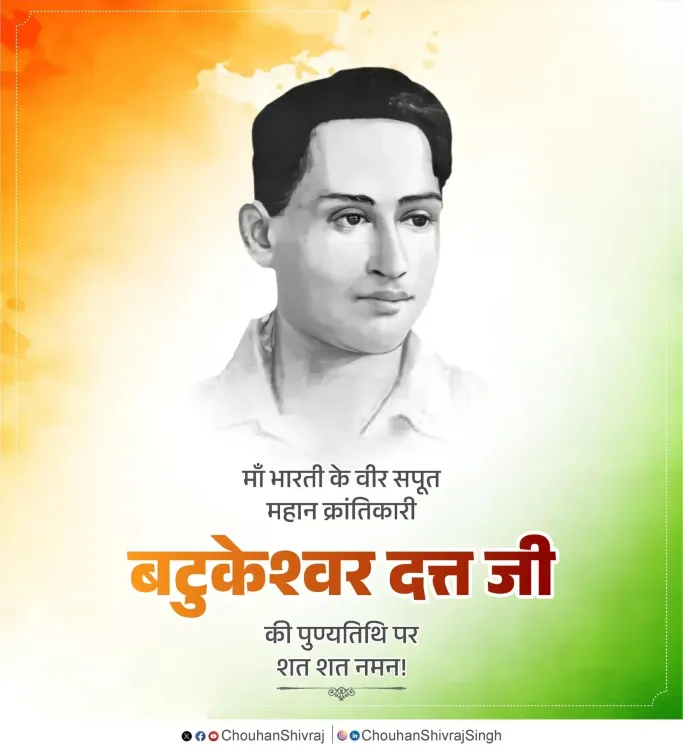
Union Agriculture Minister Shivraj Singh Chouhan on Monday, 20 July 2026 paid homage to freedom fighter Batukeshwar Dutt on his death anniversary, posting a heartfelt tribute on X that hailed Dutt as a devoted servant of the motherland and an extraordinary revolutionary.
In his post, Chouhan wrote in Hindi: 'माँ भारती के अनन्य सेवक, महान क्रांतिकारी बटुकेश्वर दत्त जी की पुण्यतिथि पर शत-शत नमन करता हूँ!' — ('I bow a hundredfold in tribute to the great revolutionary Batukeshwar Dutt, an unparalleled servant of Mother India, on his death anniversary!'). He added that Dutt's 'incomparable struggle and contribution for the freedom of the motherland will forever inspire the spirit of patriotism in future generations.'
Context
Batukeshwar Dutt occupies a defining place in India's revolutionary freedom movement. On 8 April 1929, Dutt and fellow revolutionary Bhagat Singh threw non-lethal smoke bombs into the Central Legislative Assembly in Delhi to protest repressive colonial legislation, deliberately courting arrest to turn their trial into a political platform. The act was accompanied by the now-iconic slogan 'Inquilab Zindabad' — 'Long Live the Revolution.'
Dutt was subsequently sentenced to transportation for life and endured years of imprisonment, including a prolonged hunger strike in jail to demand equal treatment for Indian political prisoners. He lived to see independence but spent his post-1947 years in relative obscurity, a fact that drew public attention and sympathy in his final years.
Policy Backdrop
Commemorating armed-resistance figures of the independence era has been a consistent feature of official public memory since the 1950s, with the Ministry of Culture and state governments organising annual programmes around the death and birth anniversaries of revolutionary leaders. The current ruling dispensation has placed particular emphasis on elevating the profiles of revolutionary freedom fighters alongside Gandhian icons in national discourse.
Senior BJP ministers and leaders regularly use social media platforms to mark such anniversaries, framing these tributes as part of a broader effort to keep the sacrifices of lesser-remembered revolutionaries alive in public consciousness — especially among younger Indians.
Stakeholders and Impact
The tribute is directed at the general public and, in particular, Indian youth — a demographic Chouhan explicitly invoked by expressing hope that Dutt's legacy will 'forever inspire the spirit of patriotism in future generations.' Such messaging from senior ministers carries institutional weight, reinforcing school and cultural curricula that seek to broaden the canon of recognised freedom fighters beyond the most prominent names.
Historians and civil society groups focused on revolutionary history have long advocated for greater recognition of figures like Dutt, whose post-independence years were marked by hardship. Ministerial tributes on social media, while ceremonial, contribute to sustaining that advocacy in public memory.
What's Next
With Independence Day on 15 August approaching, a further wave of ministerial commemorations of freedom fighters — both Gandhian and revolutionary — is expected across social media and at official events. Chouhan's tribute to Dutt is likely to be one of several such posts from the Union Cabinet in the weeks ahead, forming part of a broader pre-Independence Day cycle of public remembrance that has become a fixture of Indian political communication.
Point of View
Placing revolutionary armed-resistance figures on equal footing with Gandhian icons in public memory. By invoking 'future generations' explicitly, the message is calibrated as much toward youth outreach as historical remembrance. Coming weeks before Independence Day, it is part of a predictable but politically purposeful pre-August commemorative cycle. The consistency of such posts from senior ministers signals an institutional, not merely personal, commitment to this narrative of national memory.
NationPress
21 Jul 2026
Frequently Asked Questions
Who was Batukeshwar Dutt?
Batukeshwar Dutt was an Indian revolutionary who, alongside Bhagat Singh, threw smoke bombs into the Central Legislative Assembly in Delhi on 8 April 1929 to protest colonial laws. He was sentenced to life transportation and spent years in prison before India's independence.
Why did Shivraj Singh Chouhan pay tribute to Batukeshwar Dutt?
Shivraj Singh Chouhan posted the tribute on Batukeshwar Dutt's death anniversary, honouring his sacrifice for India's freedom and expressing hope that his legacy would inspire patriotism in future generations.
What did Batukeshwar Dutt and Bhagat Singh do in 1929?
On 8 April 1929, Batukeshwar Dutt and Bhagat Singh threw non-lethal smoke bombs in the Central Legislative Assembly to protest repressive British colonial legislation, deliberately surrendering to turn their trial into a political statement.
What is the significance of Batukeshwar Dutt's death anniversary?
Dutt's death anniversary, known as his 'punyatithi', is observed as a day to remember his extraordinary contribution to India's independence movement, particularly his willingness to endure lifelong imprisonment for the cause of freedom.
Why do BJP ministers regularly post tributes to revolutionary freedom fighters?
BJP leaders have consistently used social media to commemorate armed-resistance figures of the independence era, framing it as an effort to highlight revolutionary contributions alongside Gandhian leaders and keep their sacrifices alive in public memory, especially among younger Indians.