CM Yogi: Jamunaha Block in Shravasti Ranks No. 1 Among 500 Aspirational Blocks
Synopsis
Jamunaha development block in Shravasti, Uttar Pradesh has secured the top national rank among 500 Aspirational Development Blocks on development parameters. Chief Minister Yogi Adityanath called the achievement a new identity for a historically underdeveloped district, signalling a shift in Shravasti's governance standing.
Key Takeaways
Jamunaha development block in Shravasti district , Uttar Pradesh has ranked first among 500 Aspirational Development Blocks across India.
Chief Minister Yogi Adityanath described the result as 'the new identity of a new Shravasti.' The Aspirational Blocks Programme is a central government initiative monitored by NITI Aayog , targeting India's most backward sub-district units.
The programme was expanded in 2023 from the district level to include 500 development blocks nationwide.
Shravasti has historically been among the most underdeveloped districts in Uttar Pradesh on health, education, and income indicators.
The ranking creates a potential replicable model for other backward blocks in Uttar Pradesh .
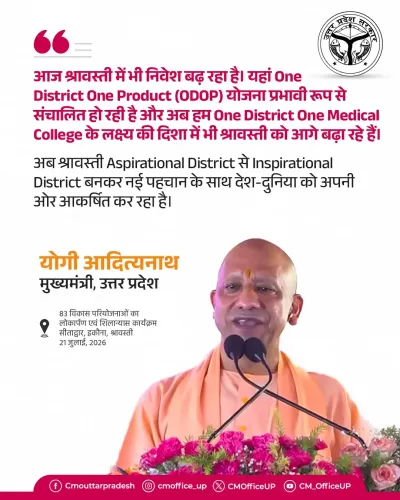
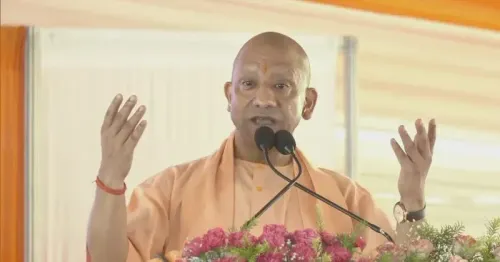
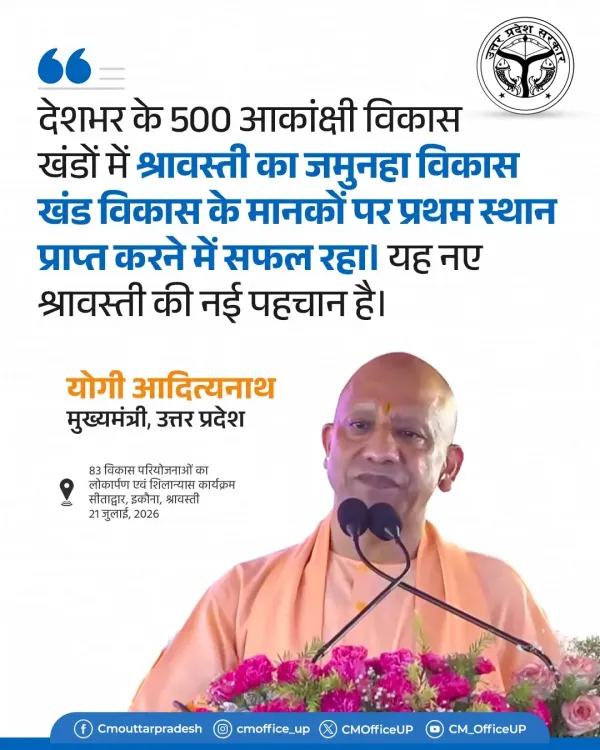
The Chief Minister's Office of Uttar Pradesh announced on Tuesday, 21 July 2026 that Jamunaha development block in Shravasti district has secured the first position among all 500 Aspirational Development Blocks across India on development parameters, with Chief Minister Yogi Adityanath calling it a new identity for a new Shravasti.
Quoting Chief Minister Adityanath directly, the post stated: 'Deshbhar ke 500 aakaankshi vikas khandon mein Shravasti ka Jamunaha vikas khand vikas ke maanakon par pratham sthan prapt karne mein safal raha. Yeh naye Shravasti ki nayi pahchaan hai.' — 'Among 500 Aspirational Development Blocks across the country, Shravasti's Jamunaha development block has succeeded in securing first place on development standards. This is the new identity of a new Shravasti.'
Context
Shravasti is a district in eastern Uttar Pradesh that has historically ranked among India's most underdeveloped regions on composite indicators of health, education, and household income. For decades, its name was associated with poverty and administrative neglect rather than governance achievement. The district's sudden rise to the top of a national ranking marks a notable shift in its public profile. The recognition comes under the Aspirational Blocks Programme, a central government initiative that identifies 500 backward development blocks nationwide and tracks their progress through real-time data dashboards. The programme is monitored by NITI Aayog and measures outcomes across multiple domains including health, nutrition, education, agriculture, and basic infrastructure.Policy Backdrop
NITI Aayog first introduced the Aspirational Districts Programme in 2018, selecting 112 backward districts and monitoring them on 49 indicators through a competitive ranking system. The logic was to use public rankings to incentivise district and block administrations, creating peer pressure and bureaucratic accountability at the ground level. The programme was expanded in 2023 to include an Aspirational Blocks component, drilling down from the district to the sub-district level across all states. The 500 blocks selected under this component represent some of the most lagging administrative units in the country. Jamunaha block in Shravasti was among the blocks included in this expanded cohort, and its climb to the national summit on development metrics is the headline outcome of the current ranking cycle. Index-based, competitive governance has been a defining feature of central and state policy since 2018, with public rankings used as a tool to direct resources and administrative attention toward lagging units. Chief Minister Yogi Adityanath, who has governed Uttar Pradesh since 2017, has consistently aligned state priorities with central aspirational programme frameworks, particularly in the state's historically backward eastern belt.Stakeholders and Impact
The most direct beneficiaries of Jamunaha's ranking are the rural communities within the block, whose access to health services, schooling, agricultural support, and infrastructure has presumably improved to a degree sufficient to outperform all other aspirational blocks nationally. Block and district administration officials in Shravasti are also central stakeholders, as such rankings directly reflect on local governance capacity. For Uttar Pradesh as a state, the achievement carries political and administrative significance. The state contains a large share of India's most backward blocks, and a top national ranking for any one of them offers a replicable model that state government can point to across its other aspirational blocks. Chief Minister Adityanath's framing of the result as a 'new identity' for Shravasti signals an intent to use this outcome as a benchmark and a narrative for the state's broader development story.What's Next
Attention will now turn to whether Jamunaha block can sustain its top ranking in subsequent assessment cycles, and whether the Uttar Pradesh government identifies and disseminates the specific administrative practices that drove the block's rise. NITI Aayog periodically publishes updated rankings, and the next cycle will test whether the gains are durable. More broadly, the Jamunaha model may inform state-level efforts to replicate similar outcomes in other backward blocks across eastern and central Uttar Pradesh.Point of View
Which has staked much of its development narrative on transforming eastern Uttar Pradesh's historically lagging districts. Securing the national summit position under a centrally monitored, index-based programme lends the claim institutional credibility beyond state-level self-reporting. The framing of Shravasti as having a 'new identity' is deliberate — it positions a district long associated with poverty as a success story ahead of what is expected to be a politically active period in the state. The broader pattern of competitive, ranking-driven governance pioneered under the Aspirational Districts Programme has now produced a flagship outcome that both the state and central governments are likely to amplify.
NationPress
21 Oct 2026
Frequently Asked Questions
What is the Aspirational Blocks Programme in India?
The Aspirational Blocks Programme is a central government initiative that selects 500 of India's most backward development blocks and tracks their progress on indicators covering health, education, agriculture, and infrastructure, monitored in real time by NITI Aayog.
Why has Jamunaha block in Shravasti ranked first among aspirational blocks?
Jamunaha block in Shravasti, Uttar Pradesh has been ranked first among all 500 Aspirational Development Blocks nationally on development parameters, as announced by the Chief Minister's Office of Uttar Pradesh on 21 July 2026. The specific methodology and block-level statistics underpinning the ranking are subject to NITI Aayog's assessment framework.
What is Shravasti district known for?
Shravasti is a district in eastern Uttar Pradesh historically ranked among India's most underdeveloped regions on composite indicators of health, education, and household income. It is also known for its Buddhist heritage as the site associated with the life of Gautama Buddha.
When did NITI Aayog launch the Aspirational Districts and Blocks programmes?
NITI Aayog launched the Aspirational Districts Programme in 2018, covering 112 backward districts. The programme was expanded in 2023 to include an Aspirational Blocks component targeting 500 development blocks across the country.
What did CM Yogi Adityanath say about Jamunaha block's ranking?
Chief Minister Yogi Adityanath said that Jamunaha development block in Shravasti has succeeded in securing first place on development standards among 500 Aspirational Development Blocks across the country, calling it 'the new identity of a new Shravasti.'