CM Siddaramaiah Plans 80,000-Seat Stadium at Suryanagar

Synopsis
Karnataka CM Siddaramaiah has announced an 80,000-seat international-standard stadium at Suryanagar, to be built by the Karnataka Housing Board — a body historically limited to residential construction. The project aims to drive sports, tourism, jobs, and economic growth, positioning Karnataka's venue as India's second-largest stadium after Gujarat's 90,000-seat facility.
Key Takeaways
CM Siddaramaiah announced plans for an international-standard stadium at Suryanagar on 23 May 2026 .
The stadium will have a seating capacity of 80,000 , making it India's second-largest after the Gujarat stadium with 90,000 seats .
The project will be executed by the Karnataka Housing Board (KHB) and the Housing Department , marking a significant expansion of their traditional mandate.
The government aims to use the stadium as a catalyst for sports, tourism, employment generation, and economic growth in the Suryanagar region.
Key next steps include tender issuance, land acquisition, and finalisation of funding allocations.
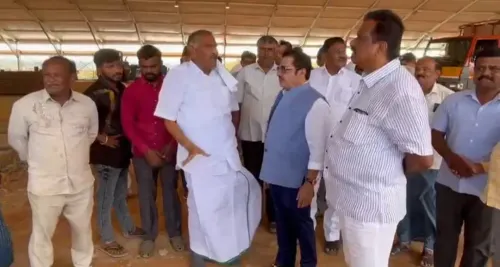
Karnataka Chief Minister Siddaramaiah on Saturday, 23 May 2026, announced that the state government is moving forward with the construction of an international-standard stadium at Suryanagar, a project he described as a forward-looking step toward comprehensive regional development encompassing sports, tourism, employment generation, and economic growth.
Context
Posting in Kannada, CM Siddaramaiah stated: 'By moving ahead with the construction of an international-standard stadium at Suryanagar, we have taken a step forward for the holistic development of this region — covering sports, tourism, job creation, and economic growth.' The announcement marks a significant expansion of the state's infrastructure ambitions beyond Bengaluru and other established urban centres.
Notably, the Chief Minister highlighted that the Karnataka Housing Board (KHB) and the Housing Department — agencies traditionally confined to residential construction — are now spearheading this stadium project. He called this a 'far-sighted step' (dooRadRuShTi hejje) for bodies that had historically focused only on housing.
Policy Backdrop
The proposed stadium at Suryanagar is planned with a seating capacity of 80,000, which CM Siddaramaiah said would make it the second-largest stadium in India. He drew a direct comparison with the stadium in Gujarat, which has a capacity of 90,000 seats, positioning Karnataka's venue as a close rival in scale.
Karnataka governments have, over the years, periodically broadened the mandate of housing bodies to support ancillary urban infrastructure. Assigning the KHB and the Housing Department to a project of this scale and nature represents a notable institutional shift, using existing state machinery for non-traditional, high-impact public works.
Across India, several states have pursued large-capacity stadiums as catalysts for tourism, employment, and regional growth — particularly in areas outside core metropolitan zones. The Suryanagar initiative fits within this broader national pattern of sports infrastructure being leveraged as an engine for multi-sector development.
Stakeholders and Impact
The project is expected to benefit Suryanagar's local residents most directly, with the promise of employment generation during construction and sustained economic activity once the venue is operational. The sports community stands to gain from a world-class facility capable of hosting national and international events.
The tourism sector is also a stated beneficiary, with the government framing the stadium as an anchor for wider regional development. A venue of this capacity, if realised, would have the potential to attract major cricket, football, and athletics events, drawing visitors and associated economic activity to the region.
What's Next
Key milestones to watch include the issuance of tenders, updates on land acquisition status, and the finalisation of funding allocations for the Suryanagar project. Any subsequent government announcements regarding the hosting of national or international sporting events at the proposed venue will be a strong indicator of the project's timeline and ambition.
If executed at the announced scale, the 80,000-seat stadium could reshape Suryanagar's profile from a residential locality into a major sports and economic hub — setting a precedent for how Karnataka deploys its housing agencies in service of integrated urban development goals.
Point of View
000-seat project signals a deliberate effort to repurpose state machinery for high-visibility development goals. The explicit comparison with Gujarat's stadium carries a competitive political undertone, framing Karnataka's ambition in direct interstate terms. For a government navigating fiscal pressures, anchoring the project within an existing agency like KHB may also be a way to route funding and accountability outside conventional public works channels. Whether the KHB can deliver at this scale without precedent will be the defining test of this policy bet.
NationPress
19 Sept 2026
Frequently Asked Questions
Where is the new international stadium being built in Karnataka?
The stadium is planned at Suryanagar , a locality in Karnataka selected for its potential as a multi-sector development hub covering sports, tourism, and employment.
How many seats will the Karnataka Suryanagar stadium have?
The proposed stadium will have a seating capacity of 80,000 , which CM Siddaramaiah says will make it the second-largest stadium in India.
Which is the largest stadium in India and how does Karnataka's compare?
CM Siddaramaiah referenced a stadium in Gujarat with a capacity of 90,000 seats as the largest; the proposed Suryanagar stadium at 80,000 seats is positioned as the second-largest.
Who is building the Suryanagar stadium in Karnataka?
The Karnataka Housing Board (KHB) and the Housing Department , traditionally focused on residential construction, have been tasked with building the stadium — a significant expansion of their mandate.
What is the purpose of the Suryanagar stadium project?
The government aims to use the stadium to drive comprehensive regional development, including promoting sports, tourism, job creation, and economic growth in the Suryanagar area.