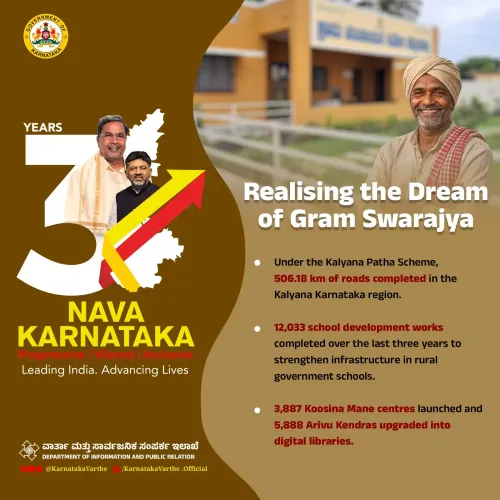
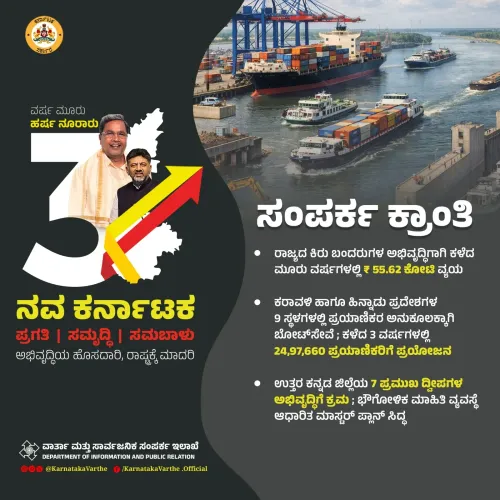
CM Siddaramaiah Marks 3 Years of Farm Welfare Under Nava Karnataka
Synopsis
Karnataka CM Siddaramaiah marks three years of the Nava Karnataka vision, highlighting micro-irrigation expansion, revival of the Krishi Bhagya Scheme, and farm-pond subsidies as cornerstones of the government's agricultural welfare agenda.
Key Takeaways
Siddaramaiah marked three years of the Nava Karnataka government on 22 May 2026 , focusing on agricultural achievements.
The government claims to have expanded micro-irrigation coverage and revived the Krishi Bhagya Scheme , originally launched in 2014–15 .
Large-scale subsidies for farm ponds and allied infrastructure have been cited as key interventions to improve water conservation.
The initiative targets farmers in Karnataka's rainfed and drought-prone districts, where water scarcity is a chronic challenge.
Exact coverage figures and subsidy scales have not been independently verified from public records.
State budget and economic survey data are the next benchmarks for assessing actual on-ground impact.
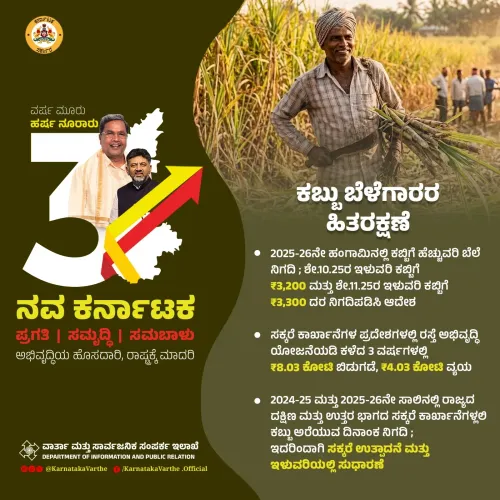
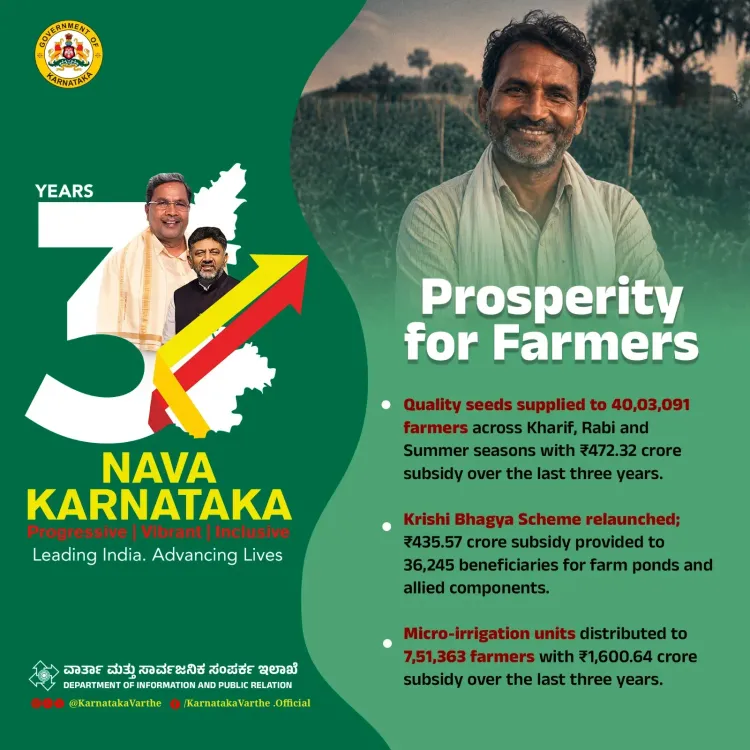
Karnataka Chief Minister Siddaramaiah on Friday, 22 May 2026 highlighted three years of agricultural initiatives under the Nava Karnataka vision, citing expanded micro-irrigation, revival of the Krishi Bhagya Scheme, and subsidies for farm ponds as pillars of the government's rural welfare push.
Context
Posting on X with the hashtags #3YearsOfNavaKarnataka and #GuaranteeSarkara, Siddaramaiah framed the anniversary as evidence of a sustained commitment to farmers. 'A stronger Karnataka is built on empowered farmers, sustainable farming practices, and secure rural livelihoods,' he wrote, summarising the government's stated agricultural philosophy.
The Nava Karnataka branding has been used by the Congress government since it returned to power in 2023, grouping together welfare guarantees and sector-specific reforms under a single development narrative.
Policy Backdrop
The Krishi Bhagya Scheme was originally launched in 2014–15 during Siddaramaiah's first term as Chief Minister, designed to address chronic water scarcity and drought vulnerability in the state's rainfed agricultural districts. It focuses on farm pond construction, on-farm water storage, and productivity improvements.
The government says it has revived and expanded the scheme in the current term, pairing it with broader micro-irrigation coverage and subsidised allied infrastructure. Karnataka's approach mirrors a wider national pattern of combining state-level water-harvesting programmes with centrally-sponsored schemes such as the Pradhan Mantri Krishi Sinchayee Yojana, which targets irrigation efficiency and last-mile water delivery.
Rainfed farming accounts for a substantial share of Karnataka's cultivated area, making water conservation a recurring policy priority across successive state governments. Drought-prone districts in northern and central Karnataka have historically been the primary beneficiaries of such interventions.
Stakeholders and Impact
The primary beneficiaries of these programmes are small and marginal farmers in rain-dependent taluks, along with rural households whose livelihoods depend on seasonal agriculture. Farm ponds and micro-irrigation infrastructure are intended to reduce crop loss during deficit monsoon years and lower dependence on groundwater extraction.
Agricultural resilience has also carried significant electoral weight in Karnataka, where rural constituencies form a decisive voting bloc. The Congress government's 'guarantee' framework — which includes direct-benefit schemes alongside infrastructure investment — has positioned farmer welfare as a central plank ahead of future electoral cycles.
What's Next
Analysts and opposition parties are likely to scrutinise upcoming state budget allocations and economic survey data for verifiable figures on micro-irrigation coverage expansion and farm-pond subsidy disbursements. The government's ability to present audited outcomes — rather than scheme announcements — will determine how the three-year record is assessed by farming communities and independent observers.
With the Nava Karnataka milestone now formally marked, the administration is expected to intensify communication around its rural welfare agenda as it approaches the midpoint of its legislative term.
Point of View
Arriving at a moment when the Congress government needs to demonstrate that its 'guarantee' model delivers structural change and not just cash transfers. By foregrounding the Krishi Bhagya revival — a scheme he first launched in 2014 — the Chief Minister is drawing a continuity line across both his tenures, reinforcing a farmer-first identity that has long been central to his electoral brand. The emphasis on micro-irrigation and water conservation also signals awareness that climate variability and drought risk are now permanent features of Karnataka's agricultural landscape, requiring durable infrastructure over episodic relief. Whether the narrative holds will depend on whether the government can produce audited data on scheme coverage before the next electoral cycle begins in earnest.
NationPress
23 Sept 2026
Frequently Asked Questions
What is the Nava Karnataka scheme?
'Nava Karnataka' is the development vision and branding adopted by the Siddaramaiah -led Congress government since 2023 , grouping together welfare guarantees and sector-specific reforms — including agricultural, social, and infrastructure initiatives — under a single governance narrative.
What is the Krishi Bhagya Scheme in Karnataka?
The Krishi Bhagya Scheme is a Karnataka government initiative first launched in 2014–15 to support rainfed agriculture through farm pond construction, on-farm water storage, and productivity improvements, primarily targeting drought-prone districts.
What has Siddaramaiah done for farmers in Karnataka?
Siddaramaiah has highlighted expanded micro-irrigation coverage, revival of the Krishi Bhagya Scheme , and subsidies for farm ponds and allied infrastructure as key farmer-welfare measures over the past three years under the Nava Karnataka vision.
What is micro-irrigation and why does it matter for Karnataka farmers?
Micro-irrigation refers to drip and sprinkler systems that deliver water directly to crop roots, reducing wastage. For Karnataka, where a large share of farmland is rainfed and drought-prone, expanding micro-irrigation is critical to improving water use efficiency and protecting yields during deficit monsoon years.
What is the GuaranteeSarkara in Karnataka?
'GuaranteeSarkara' — or 'Guarantee Government' — is a term the Karnataka Congress government uses to describe its commitment to delivering on specific welfare promises made during the 2023 assembly election campaign, spanning cash transfers, subsidised utilities, and agricultural support schemes.