CM Siddaramaiah Reaffirms Karnataka's Secular, Inclusive Path
Synopsis
Karnataka Chief Minister Siddaramaiah on June 12, 2026, reaffirmed his government's commitment to social harmony and inclusive progress, stating that no force will be allowed to divide the state on religious, caste or community lines — a position rooted in his decades-long advocacy of pluralist governance.
Key Takeaways
Siddaramaiah declared on June 12, 2026 that Karnataka's strength lies in its diversity and pledged to protect its social fabric.
He stated no force would be permitted to divide people in the name of religion, caste, or community.
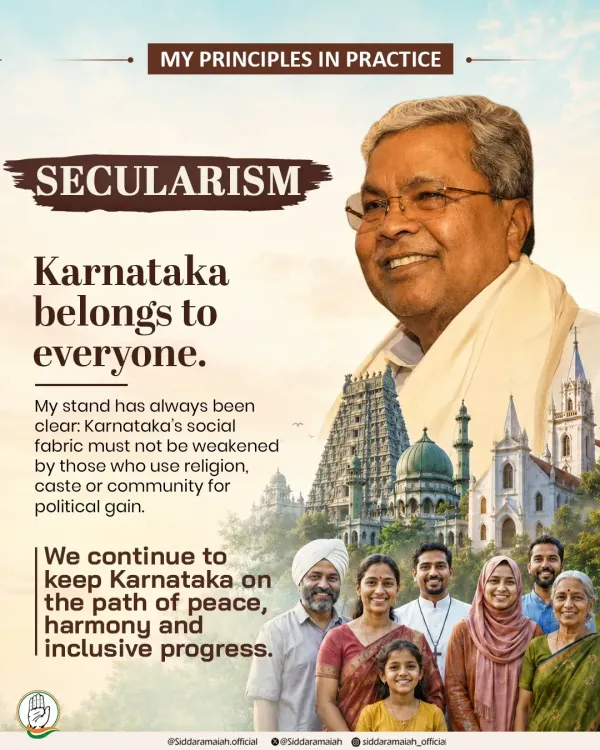
The post was tagged #MyPrinciplesInPractice , framing the stance as a long-held personal conviction.
During his 2013–2018 term, Siddaramaiah introduced minority welfare schemes including scholarships and skill-development programmes under the Ahinda framework.
Karnataka's electorate spans major communities including Muslims, Christians, Lingayats and Vokkaligas , making pluralist governance a key electoral variable.
Policy watchers will track state budget allocations for minority and backward-class welfare schemes as a measure of follow-through.
Karnataka Chief Minister Siddaramaiah on Friday, June 12, 2026, reaffirmed his government's commitment to protecting the state's social fabric, stating that no force would be permitted to divide people on the lines of religion, caste, or community. The senior Congress leader invoked the hashtag #MyPrinciplesInPractice, framing the message as a reflection of long-held personal and political convictions.
Context
In his post, Siddaramaiah wrote: 'Karnataka's strength lies in its diversity. My stand has always been clear: no force should be allowed to weaken our social fabric by dividing people in the name of religion, caste or community.' He added that his government would 'continue to keep Karnataka on the path of peace, harmony and inclusive progress — because Karnataka belongs to everyone.'
The statement comes against the backdrop of periodic communal tensions that have marked Karnataka's political landscape in recent years, alongside a strong tradition of social reform movements in the state. Siddaramaiah has consistently positioned himself as a defender of pluralist values throughout his political career spanning more than four decades.
Policy Backdrop
During his earlier term as Chief Minister from 2013 to 2018, Siddaramaiah introduced a range of minority welfare schemes, including scholarships and skill-development programmes, framed explicitly as tools for inclusive development. His government's approach drew heavily from the Ahinda movement — a Kannada acronym representing minorities, backward classes, and Dalits — which has been the ideological cornerstone of his political identity.
In the 2023 Karnataka assembly election, the Indian National Congress pledged to safeguard the state's secular fabric and resist policies perceived as communally divisive. The party returned to power that year, with Siddaramaiah resuming the Chief Minister's office. His June 2026 statement reinforces that electoral and governance commitment.
Karnataka is home to significant religious and caste communities, including substantial Muslim, Christian, Lingayat, and Vokkaliga populations, making social coalition-building a central feature of competitive politics in the state.
Stakeholders and Impact
The statement is directed at a broad constituency: religious minorities, Other Backward Classes, Dalits, and secular civil society organisations that form the social base of the Congress government in Karnataka. For these groups, the Chief Minister's public reiteration of non-divisive governance carries both symbolic and policy significance.
Opposition parties, particularly the Bharatiya Janata Party, have contested the Congress framing on issues ranging from hijab restrictions to temple-mosque disputes in the state. Siddaramaiah's post implicitly signals that his administration intends to hold its ground on these fault lines ahead of future electoral cycles.
What's Next
Observers will watch whether the statement is followed by concrete policy announcements — particularly in the state budget — relating to minority welfare and backward-class development schemes. Legislative and judicial developments around communal disputes in Karnataka will also be scrutinised for how the government translates this stated principle into administrative action. The Chief Minister's emphasis on 'inclusive progress' suggests that welfare delivery to marginalised communities will remain a defining metric of his government's performance through the remainder of its term.
Point of View
He personalises the secular commitment, insulating it from being read as mere party positioning. The timing, mid-term in his second stint as Chief Minister, suggests the government is shoring up its Ahinda base ahead of potential political turbulence. More broadly, the statement reflects the enduring contest in Indian state politics between pluralist and majoritarian narratives, with Karnataka remaining one of its most consequential arenas.
NationPress
28 Jul 2026
Frequently Asked Questions
What did Karnataka CM Siddaramaiah say on June 12 2026?
Siddaramaiah posted on X that Karnataka's strength lies in its diversity and that no force would be allowed to divide the state on the lines of religion, caste or community, pledging to keep Karnataka on a path of peace, harmony and inclusive progress.
What is the Ahinda movement associated with Siddaramaiah?
Ahinda is a Kannada acronym representing minorities, backward classes and Dalits. Siddaramaiah has built much of his political identity around this social coalition, using it as a framework for welfare policy and electoral mobilisation in Karnataka.
What minority welfare schemes did Siddaramaiah introduce during his earlier term?
During his 2013–2018 term as Chief Minister, Siddaramaiah introduced scholarships and skill-development programmes targeted at minorities and backward classes as part of an inclusive development agenda.
Why is Karnataka considered a communally sensitive state?
Karnataka has a large and diverse population including significant Muslim, Christian, Lingayat and Vokkaliga communities. The state has witnessed periodic communal incidents and political contests over issues such as hijab restrictions and temple-mosque disputes, making social harmony a recurring governance priority.
What should we watch for after Siddaramaiah's statement on inclusive progress?
Policy observers will monitor the Karnataka state budget for allocations to minority and backward-class welfare schemes, as well as any legislative or judicial developments around communal disputes, to assess whether the government's stated commitment translates into concrete administrative action.