Why is Siddaramaiah Criticizing Kumaraswamy's Call for Gita in Schools?
Synopsis
In a heated exchange, Karnataka Chief Minister Siddaramaiah labels H.D. Kumaraswamy as a 'Manuvadi' for advocating the inclusion of the Bhagavad Gita in school curricula. This conflict highlights ideological differences regarding education, moral instruction, and the interpretation of ancient texts in contemporary society.
Key Takeaways
Siddaramaiah criticizes Kumaraswamy's push for the Gita in schools.
The term ‘Manuvadi’ highlights ideological differences.
Kumaraswamy believes the Gita promotes moral values.
Siddaramaiah emphasizes constitutional education.
Debate raises questions about secularism in schooling.
Bengaluru, Dec 6 (NationPress) Labeling H.D. Kumaraswamy as a ‘Manuvadi’, Karnataka Chief Minister Siddaramaiah expressed strong disapproval towards the Union Minister for Heavy Industries and Steel for advocating the introduction of the Bhagavad Gita into school curricula.
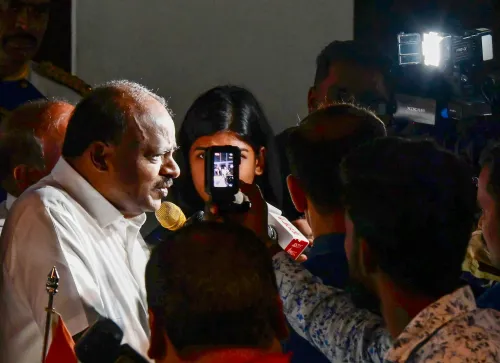
While addressing the media at the Vidhan Soudha following a floral tribute to Dr. B.R. Ambedkar on the occasion of the 69th Mahaparinirvana Day, Siddaramaiah remarked that Kumaraswamy’s position indicated a significant ideological shift.
In response to inquiries on this topic, the Chief Minister noted that the former Chief Minister of Karnataka had appealed to the Union Education Minister for the Gita’s inclusion in educational syllabi.
“Kumaraswamy has transformed into a Manuvadi since aligning with the BJP,” Siddaramaiah stated.
The term Manuvadi is frequently employed in contemporary political discussions to identify individuals perceived as endorsing principles linked to the Manusmriti. This ancient text, attributed to sage Manu, provides a comprehensive set of social conduct guidelines but has faced ongoing criticism for its views seen as unequal, discriminatory towards lower castes, and restrictive of women's rights. Consequently, the term Manuvadi is often utilized by critics to raise alarms about caste hierarchies and social inequality.
Kumaraswamy, in a letter to Union Education Minister Dharmendra Pradhan on Friday, advocated for the integration of the Bhagavad Gita into school education. He characterized the scripture as embodying “timeless, value-based ideals” and suggested that its inclusion would enhance moral education in classrooms. He referenced the National Education Policy, emphasizing that students would gain from exposure to selected teachings that nurture clarity of thought, moral courage, and character strength.
Mentioning the Prime Minister’s recent visit to the Udupi Sri Krishna Math, Kumaraswamy highlighted an event featuring a Gita recitation program. He noted that the Prime Minister emphasized core principles like the concept of Vasudhaiva Kutumbakam and the enduring values upheld in the sacred text. Kumaraswamy argued that such messages are pertinent to modern education and merit a structured introduction in schools.
In contrast, Siddaramaiah reiterated his government’s commitment to constitutional values. While paying tribute to Ambedkar, he portrayed him as a unique national figure who championed the rights of marginalized groups.
“Ambedkar was the architect of our Constitution. He examined various constitutions globally and provided us with a framework that our nation required. He sought transformation in our social system, equal opportunities, and the establishment of social justice,” he emphasized.
The Chief Minister also mentioned that the state has prioritized teaching the Constitution's preamble in schools and colleges, ensuring students comprehend their rights and responsibilities.
“The Constitution grants rights and duties to every individual. We want everyone to grasp the objectives of the Constitution,” he affirmed.
He further noted that Ambedkar's conversion to Buddhism symbolized his battle against deep-rooted social barriers. “He claimed to be born a Hindu but would not die one. He endeavored to reform Hinduism but ultimately adopted Buddhism,” Siddaramaiah concluded.
Point of View
This ongoing dispute reflects the complex interplay between cultural values and educational policies in India. While the introduction of the Bhagavad Gita may resonate with some sections of society, it raises significant questions regarding inclusivity and the secular nature of education. The debate highlights the need for a balanced approach that respects diverse perspectives while upholding constitutional principles.
NationPress
11 Oct 2026
Frequently Asked Questions
What does Siddaramaiah mean by calling Kumaraswamy a 'Manuvadi'?
Siddaramaiah uses the term 'Manuvadi' to criticize Kumaraswamy's support for the inclusion of the Bhagavad Gita in school curricula, suggesting that it aligns with ideologies favoring caste hierarchy.
Why is the Bhagavad Gita being considered for school curricula?
Kumaraswamy argues that the Bhagavad Gita contains timeless, value-based ideals that would enhance moral education and character development among students.
What are the implications of this debate on education?
The discussion around the Gita's inclusion raises concerns about secularism in education and the representation of diverse cultural perspectives within the curriculum.
How does Siddaramaiah view Dr. B.R. Ambedkar's contributions?
Siddaramaiah regards Ambedkar as a pivotal figure who fought for the rights of oppressed communities and as the architect of the Indian Constitution, emphasizing the need for constitutional values in education.
What is the significance of the Constitution's preamble in education?
The preamble is crucial for understanding the rights and duties of citizens, and Siddaramaiah's government emphasizes its teaching to foster awareness among students.