Sitharaman at Atlantic Council: Full Bangkok IMF Session
Synopsis
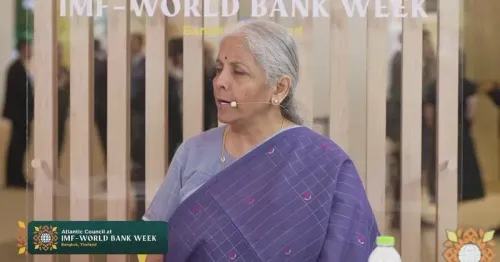
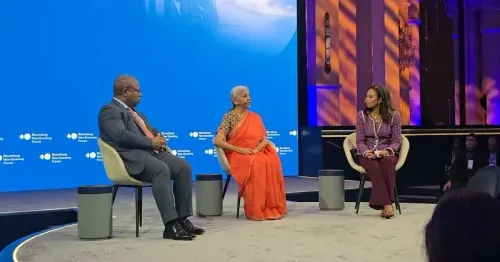
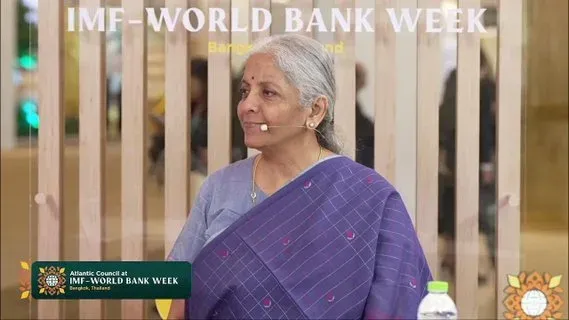
Union Finance Minister Nirmala Sitharaman participated in a full interactive session organised by the Atlantic Council on the sidelines of the IMF-World Bank Annual Meetings in Bangkok, Thailand, with the complete video now released publicly under the hashtag #FutureOfEcon.
Key Takeaways
Union Finance Minister Nirmala Sitharaman addressed a full interactive session hosted by the Atlantic Council in Bangkok, Thailand .
The session was held on the sidelines of the IMF-World Bank Annual Meetings , an annual gathering of finance ministers and central bankers from member countries.
The complete video of the session has been publicly released under the hashtag #FutureOfEcon .
India has been a member of the IMF and World Bank since 1945 and participates in Annual Meetings every year.
Sideline think-tank engagements are a standard part of India's multilateral economic diplomacy and signal India's position on global financial issues to investors and policymakers worldwide.
On the sidelines of the IMF-World Bank Annual Meetings in Bangkok, Thailand, Union Finance Minister Nirmala Sitharaman sat down with the Atlantic Council for a wide-ranging interactive session on the future of the global economy — and the full exchange is now available to watch.
India's voice at the Bangkok sidelines
The session, tagged under the hashtag #FutureOfEcon, was organised by the Washington-based Atlantic Council — one of the world's most closely watched international affairs think tanks — and brought Sitharaman face-to-face with a global policy audience at one of the year's most consequential gatherings of finance ministers and central bankers.
India has participated in IMF-World Bank Annual Meetings every year since its membership began in 1945, and Finance Ministry engagements with think tanks on the sidelines have long formed a standard plank of India's multilateral economic diplomacy. But sideline sessions with institutions like the Atlantic Council carry weight beyond protocol — they shape how global investors and policymakers read India's economic outlook and its position on international financial architecture.
What these sessions typically cover
Sideline discussions at IMF-World Bank meetings typically traverse India's near-term growth prospects, financial-sector stability, and positions on global cooperation frameworks — from debt restructuring in the developing world to the reform of multilateral lending institutions. For a G20 economy that has positioned itself as a bridge between the Global South and advanced economies, Sitharaman's platform here is anything but ceremonial.
The full video of the session has been shared publicly, giving domestic audiences, investors, and policymakers direct access to her unscripted exchange with the Atlantic Council moderators.
Bangkok as a multilateral stage
That this year's Annual Meetings are being hosted on the sidelines in Bangkok — a city that occasionally anchors major international financial gatherings in the Asia-Pacific — puts India's Finance Minister at the centre of a regional and global conversation simultaneously. With the global economy navigating uneven post-pandemic recoveries, persistent inflation pressures in several markets, and ongoing debates over IMF quota reform, the timing of the session adds an extra layer of significance to every word on the table.
The Finance Ministry is expected to release any follow-up statements on bilateral meetings or policy positions announced during the broader Annual Meetings engagement.
Point of View
Unedited session publicly signals confidence in the Finance Minister's unscripted performance and deepens India's image as a transparent interlocutor on multilateral economic issues. Set against ongoing debates over IMF quota reform and the role of emerging economies in global financial governance, this engagement fits squarely into a longer arc of India asserting itself as an indispensable voice — not just a beneficiary — of the Bretton Woods system.
NationPress
16 Oct 2026
Frequently Asked Questions
What did Nirmala Sitharaman speak about at the Atlantic Council in Bangkok?
Sitharaman participated in a full interactive session organised by the Atlantic Council on the sidelines of the IMF-World Bank Annual Meetings in Bangkok, Thailand, themed around the future of the global economy. The specific content of the session has been publicly released as a full video.
What are the IMF-World Bank Annual Meetings?
The IMF-World Bank Annual Meetings are a yearly gathering of finance ministers and central bank governors from member countries to discuss global economic policy, financial stability, and international cooperation.
Where are the 2026 IMF-World Bank Annual Meetings being held?
The 2026 IMF-World Bank Annual Meetings are being held in Bangkok, Thailand.
What is the Atlantic Council?
The Atlantic Council is a Washington-based international affairs think tank that regularly hosts policy discussions with global leaders on economic and geopolitical issues.
Where can I watch Nirmala Sitharaman's full Atlantic Council session?
The full video of Sitharaman's Atlantic Council interactive session has been shared publicly via the Finance Ministry's official social media channels, with a YouTube link posted on 16 October 2026 .