Sitharaman at SRC Platinum Jubilee: Women as Growth Leaders
Synopsis
Union Finance Minister Nirmala Sitharaman addressed the Platinum Jubilee of Seethalakshmi Ramaswami College in Tiruchirappalli, spotlighting PM MUDRA loans, the Lakhpati Didi scheme, and women-led development as the cornerstone of national policy.
Key Takeaways
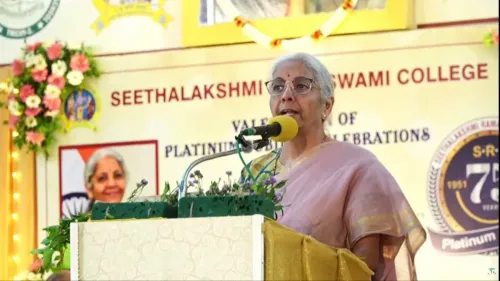
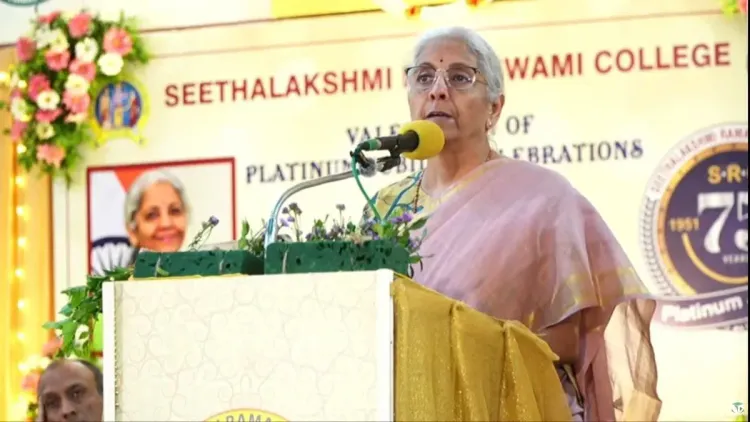
Finance Minister Nirmala Sitharaman spoke at the Platinum Jubilee of Seethalakshmi Ramaswami College, Tiruchirappalli on October 26, 2026 .
SRC was among the first seven colleges in India to receive NAAC accreditation and offers vocational training in horticulture, food processing, apparel, electronics, and sericulture.
About two-thirds of PM MUDRA Yojana loans have been disbursed to women borrowers.
3 crore rural women have achieved Lakhpati Didi status; the national target has been raised to 6 crore .
Sitharaman framed women as 'job creators and leaders of growth' , not welfare recipients, citing PM Modi's policy priority.
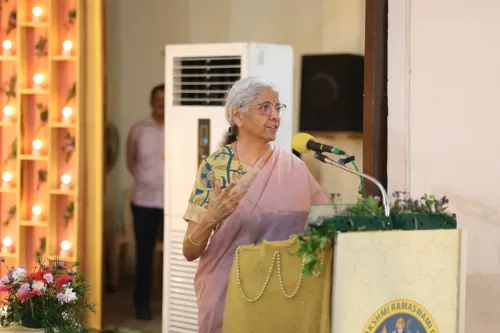
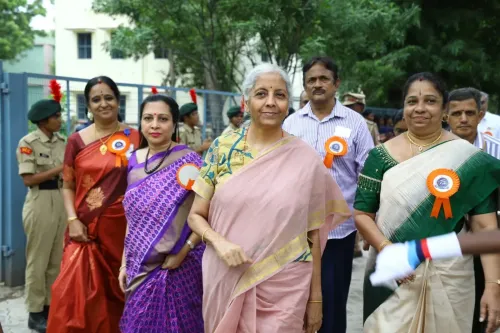
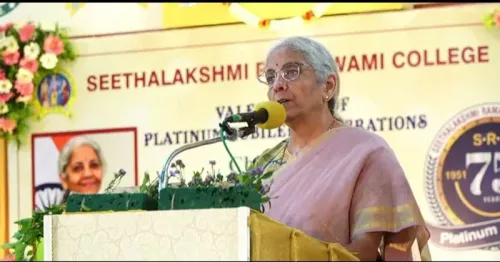
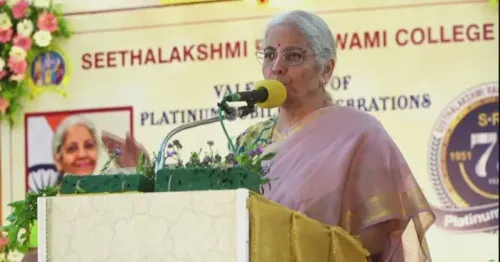
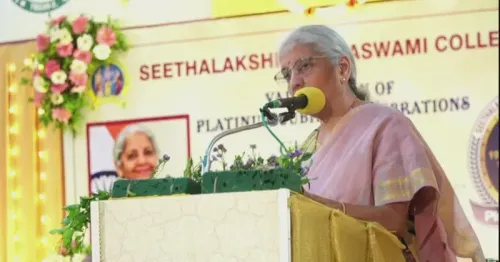
From one of Tamil Nadu's oldest women's colleges, Union Finance Minister Nirmala Sitharaman delivered a charge to a new generation — not just to participate in India's economy, but to lead it. Addressing the Platinum Jubilee Celebrations of Seethalakshmi Ramaswami College in Tiruchirappalli, Tamil Nadu on Monday, October 26, 2026, Sitharaman wove together decades of institutional achievement with the government's flagship women's livelihood programmes, framing the next 25 years as belonging to the women in that hall.
SRC's early-mover legacy in accreditation and vocational skilling
Seethalakshmi Ramaswami College, established in 1951, holds a distinction that sets it apart from most institutions its age: it was among the first seven colleges in India to receive NAAC accreditation, a quality benchmark most institutions are still working toward. Sitharaman pointed to this as evidence of an institution that has 'often moved ahead of its time.'
Beyond academics, the college trains students in horticulture, food processing, apparel making, electronics, and sericulture — a vocational breadth that maps almost directly onto rural and semi-urban livelihood clusters. It is precisely the kind of multi-skill foundation the government has sought to mainstream through its national missions.
MUDRA loans and Lakhpati Didis: the policy scaffolding behind the speech
Sitharaman anchored her address in two signature programmes. She noted that about two-thirds of loans disbursed under PM MUDRA Yojana — the Pradhan Mantri Mudra Yojana launched in 2015 to extend formal micro-credit to small entrepreneurs — have gone to women, helping them start and scale businesses at the grassroots.
She also cited the Lakhpati Didi initiative, which aims to help rural women sustain annual earnings of at least one lakh rupees through skill-linked self-help group networks under Deendayal Antyodaya Yojana–National Rural Livelihoods Mission. The Finance Minister stated that 3 crore rural women have already become Lakhpati Didis, and that the national target has since been raised to six crore.
Women-led development as a centrepiece of national policy
Sitharaman framed both schemes as expressions of a deliberate choice by Prime Minister Narendra Modi — to position women not as beneficiaries of welfare, but as 'job creators and leaders of growth.' The distinction matters: it shifts the narrative from protection to agency, from entitlement to entrepreneurship.
The speech drew a direct line from the classroom in Tiruchirappalli to the national numbers: institutions like SRC, she argued, prepare graduates to step into a momentum already in motion — and to accelerate it. 'Over the next 25 years, it is your turn to lead it,' she told the gathering.
The address is a reminder that women's economic empowerment, long treated as a welfare footnote, now occupies the centre of India's development vocabulary — backed by credit lines, livelihood targets, and the kind of institutional recognition that a platinum jubilee college embodies.
Point of View
One that cuts across economic classes and geographies. Whether the 6-crore Lakhpati Didi target translates into measurable income gains at scale will be the real test of this narrative in the years ahead.
NationPress
26 Oct 2026
Frequently Asked Questions
What is the Lakhpati Didi scheme?
Lakhpati Didi is a government initiative under Deendayal Antyodaya Yojana–National Rural Livelihoods Mission that aims to help rural women earn at least one lakh rupees annually through skill training and self-help group networks. Finance Minister Sitharaman stated that 3 crore rural women have already achieved this status and the target has been raised to 6 crore.
What did Nirmala Sitharaman say at Seethalakshmi Ramaswami College?
Sitharaman addressed the Platinum Jubilee of Seethalakshmi Ramaswami College in Tiruchirappalli on October 26, 2026, highlighting the college's NAAC accreditation legacy, its vocational training programmes, and government schemes like PM MUDRA and Lakhpati Didi that empower women as entrepreneurs and growth leaders.
What percentage of PM MUDRA loans go to women?
According to Finance Minister Sitharaman's address, about two-thirds of loans disbursed under the Pradhan Mantri Mudra Yojana have gone to women borrowers, helping them establish and expand small businesses.
What is special about Seethalakshmi Ramaswami College Tiruchirappalli?
Founded in 1951, Seethalakshmi Ramaswami College was among the first seven colleges in India to receive NAAC accreditation. It also offers vocational training in horticulture, food processing, apparel making, electronics, and sericulture, alongside conventional academics.
When was PM MUDRA Yojana launched?
Pradhan Mantri Mudra Yojana was launched in 2015 to extend formal micro-credit to small and micro enterprises. A large majority of its beneficiaries are women entrepreneurs.