Sitharaman tells I-T Dept: convenience for honest taxpayers, zero tolerance for evasion

Synopsis
Finance Minister Sitharaman used the 167th Income Tax Day to reframe the department's core mission: from revenue collector to service provider. Her three-pillar tax certainty framework and 'five Rs' directive signal a deliberate shift in how the Centre wants the I-T machinery to treat honest taxpayers — even as it tightens the screws on wilful evaders.
Key Takeaways
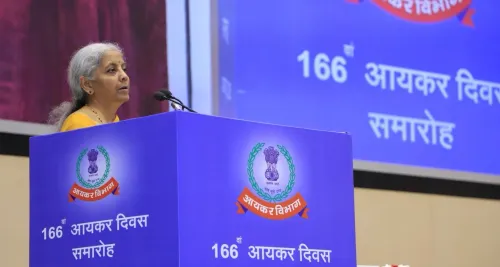
Finance Minister Nirmala Sitharaman addressed the 167th Income Tax Day in New Delhi on 25 July 2025 .
She called for a shift from litigation management to litigation prevention , built on three pillars: clarity, consistency, and institutional learning.
Sitharaman introduced the 'five Rs' framework for taxpayer services: recognise, respond, redress, reflect, and reform.
Officials were directed to distinguish between deliberate tax evasion and bonafide errors , and to exercise their powers with humility.
The Income Tax Act, 2025 was cited as a key step toward reducing uncertainty and lowering compliance costs.
Union Finance Minister Nirmala Sitharaman on Friday, 25 July 2025, directed officials of the Income Tax Department to prioritise convenience for honest taxpayers while taking firm action against deliberate tax evasion, framing tax certainty as an economic imperative for the country. She was addressing the 167th Income Tax Day celebrations in New Delhi.
The Three-Pillar Framework for Tax Certainty
Sitharaman called for a fundamental shift in the department's orientation — away from litigation management and toward litigation prevention. She outlined a three-pillar approach to achieve this: clarity in taxpayer obligations through timely circulars, consistency of interpretation across jurisdictions, and continuous institutional learning from appellate orders to inform future reform.
'Tax certainty is one of the strongest foundations of voluntary compliance. Our long-term objective must shift from litigation management to litigation prevention,' she said. She added that together, these principles reduce avoidable disputes while improving certainty for those who comply in good faith.
The 'Five Rs' for Taxpayer Services
The Finance Minister asked the Income Tax Department to anchor its taxpayer service improvements around five principles she termed the 'five Rs': recognise, respond, redress, reflect, and reform.
She elaborated that the department must recognise every taxpayer's concern promptly, respond with clarity and empathy, redress genuine grievances within defined timelines, reflect on the root causes of recurring complaints, and continuously reform processes so that similar grievances become increasingly rare.
Balancing Enforcement with Fairness
Sitharaman urged officials to draw a clear distinction between deliberate tax evasion and bonafide errors — a nuance she said must guide how the department exercises its legal powers. 'Our approach should ensure convenience for the honest taxpayer, an opportunity to correct bonafide errors, and firm consequences for deliberate evasion,' she said.
She also cautioned officials to 'exercise with humility' the power that tax law confers on them, signalling that the Centre expects enforcement to be proportionate and fair rather than adversarial.
Income Tax Act 2025 and Simplification
The Finance Minister highlighted that the implementation of the Income Tax Act, 2025 has simplified the law with the stated aim of reducing uncertainty and lowering compliance costs for taxpayers. She noted that the responsibility of the Income Tax Department has expanded beyond the narrow focus on revenue collection to a broader commitment to fairness, efficiency, ease of doing business, and service delivery.
This comes amid a broader push by the Centre to improve India's ease of doing business rankings and reduce the volume of tax litigation, which has historically clogged appellate tribunals for years. With the new Act in force, officials are now expected to align their interpretations more uniformly across regions — a long-standing demand from industry and individual filers alike.
What Comes Next
The direction from the Finance Minister sets the tone for how the Income Tax Department is expected to conduct itself in the months ahead, particularly as the new Act beds in. Taxpayer advocacy groups and industry bodies will be watching whether the 'five Rs' framework translates into measurable improvements in grievance redressal timelines and a reduction in frivolous notices.
Point of View
Not just the law. The 'five Rs' framework is sensible, but frameworks have been announced before; what has historically been missing is accountability for non-compliance by officials themselves. The real test will be whether grievance redressal timelines actually shorten and whether the volume of notices issued without adequate cause declines under the new Act. Until those metrics move, this remains aspiration rather than transformation.
NationPress
23 Oct 2026
Frequently Asked Questions
What did Finance Minister Nirmala Sitharaman say on Income Tax Day 2025?
Sitharaman directed Income Tax Department officials to ensure convenience for honest taxpayers, prevent litigation through tax certainty, and take firm action against deliberate evasion. She spoke at the 167th Income Tax Day celebrations in New Delhi on 25 July 2025.
What is the 'five Rs' framework Sitharaman outlined for the Income Tax Department?
The five Rs stand for recognise, respond, redress, reflect, and reform. Sitharaman asked officials to promptly acknowledge taxpayer concerns, communicate with empathy, resolve grievances within defined timelines, identify root causes of recurring complaints, and continuously improve processes.
What are the three pillars of tax certainty Sitharaman described?
The three pillars are: clarity in taxpayer obligations through timely circulars, consistency of interpretation across jurisdictions, and continuous institutional learning from appellate orders. Sitharaman said these together reduce avoidable disputes and support voluntary compliance.
How does the Income Tax Act 2025 affect taxpayers?
The Income Tax Act, 2025 has simplified the existing law with the aim of reducing legal uncertainty and lowering compliance costs. Sitharaman highlighted it as a key reform that shifts the department's focus toward fairness, efficiency, and ease of doing business.
What is the difference between tax evasion and bonafide errors under the new approach?
Sitharaman directed officials to distinguish between deliberate tax evasion — which warrants firm consequences — and bonafide errors, which should be met with an opportunity for correction. This distinction is intended to ensure that honest taxpayers are not penalised for unintentional mistakes.