Sitharaman Invokes Lighthouse to Praise CBIC's Role in Trade
Synopsis
Union Finance Minister Nirmala Sitharaman invoked the symbolism of a lighthouse to describe CBIC's role in guiding Indian trade through regulatory complexity, speaking at an event in Puducherry on 25 June 2026. She cited Duty, Vigilance, Service and Steadiness as the institution's core values.
Key Takeaways
Finance Minister Nirmala Sitharaman addressed an event in Puducherry on 25 June 2026 .
She used a lighthouse as a metaphor for the institutional purpose of Customs and CBIC .
She identified four values guiding CBIC: Duty, Vigilance, Service and Steadiness .
CBIC has implemented faceless assessment and Turant Customs clearance since 2019–2020 to modernise border procedures.
The remarks signal continued government support for customs reform as a trade-facilitation rather than purely revenue-driven exercise.
Further customs simplifications are expected in the next Union Budget or Foreign Trade Policy review.
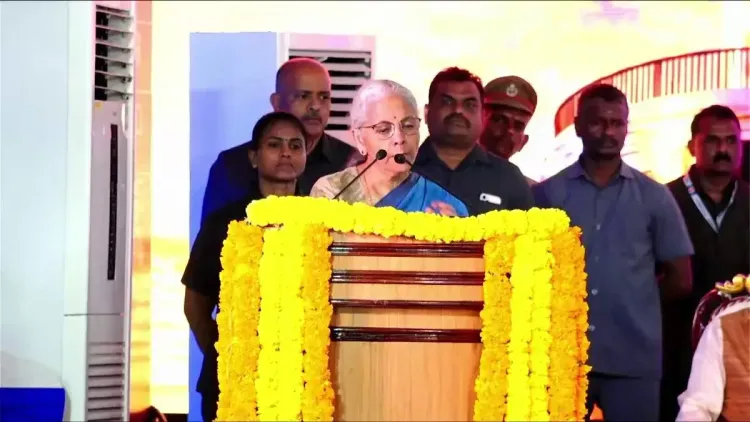
Union Finance Minister Nirmala Sitharaman on Thursday, 25 June 2026, drew on the symbolism of a lighthouse to describe the role of Customs and the Central Board of Indirect Taxes and Customs (CBIC) in guiding Indian trade, delivering the remarks at an event in Puducherry.
Context
Speaking in Puducherry, the Finance Minister used the image of a lighthouse — a structure built to guide, protect and serve — as a metaphor for the institutional purpose of Customs and CBIC. 'Like a Light House guides ships through uncertainty, our institutions like Customs and CBIC guide trade through the complexities of a modern economy,' she said.
She identified four core values that define the mandate of these institutions: Duty, Vigilance, Service and Steadiness. These, she said, are reflected in CBIC's combined functions of regulation, revenue collection, security enforcement and trade facilitation.
Policy Backdrop
CBIC has been at the centre of India's customs modernisation drive since 2019–2020, when the government rolled out faceless assessment and the Turant Customs clearance initiative to automate and depersonalise border procedures. These reforms were designed to cut logistics costs, reduce dwell time at ports and bring India's trade processes in line with its commitments under the WTO Trade Facilitation Agreement.
The broader push spans multiple domains — GST rationalisation, direct-tax faceless assessment and the National Logistics Policy — all aimed at improving India's ease-of-doing-business standing. Customs modernisation sits at the intersection of revenue integrity and trade competitiveness, making CBIC's institutional character a recurring subject of high-level attention.
Risk-based security screening and digital single-window clearances have become standard features of the CBIC framework, allowing the board to balance its twin responsibilities of facilitating legitimate trade and intercepting contraband and duty evasion.
Stakeholders and Impact
The primary stakeholders in CBIC's functioning are importers, exporters and the wider trade and logistics community. For them, the speed and predictability of customs clearance directly affects supply-chain costs and competitiveness in global markets.
The Finance Minister's remarks signal continued political backing for an institution that processes billions of dollars in cross-border trade annually and contributes significantly to the Union government's indirect-tax revenues. Her invocation of 'Steadiness' as a core value also carries a message of institutional continuity to the business community.
What's Next
Further simplifications to customs procedures or related legislative amendments are likely to surface in the next Union Budget or a forthcoming Foreign Trade Policy review. Sitharaman's framing of CBIC as a lighthouse — an institution that guides rather than obstructs — suggests the government will continue to position customs reform as a facilitation exercise rather than a purely revenue-driven one. The Puducherry address, part of a series of remarks flagged as '3/n' (the third in a thread), indicates a sustained engagement with the theme of institutional purpose and public service.
Point of View
Which aligns with the government's long-running effort to recast regulatory bodies as enablers of commerce. The choice of Puducherry, a coastal Union Territory with a port, lends geographic resonance to the maritime imagery. Her enumeration of four values — Duty, Vigilance, Service, Steadiness — reads as a public charter for the organisation, signalling to the trade community that predictability and facilitation remain policy priorities even as revenue targets grow. Coming as part of a multi-tweet thread, the remarks suggest a structured communications push around CBIC's identity and reform record.
NationPress
25 Jun 2026
Frequently Asked Questions
What did Nirmala Sitharaman say about CBIC in Puducherry?
Finance Minister Nirmala Sitharaman said CBIC and Customs, like a lighthouse, guide trade through the complexities of a modern economy, embodying the values of Duty, Vigilance, Service and Steadiness.
What is CBIC and what does it do?
CBIC, the Central Board of Indirect Taxes and Customs, is India's apex body for administering customs duties, trade facilitation, border security and indirect-tax compliance, including GST.
What is the Turant Customs scheme?
Turant Customs is a CBIC initiative launched around 2019–2020 to enable faster, automated and faceless customs clearances, reducing dwell time and human interface at Indian ports.
Why did Sitharaman speak about customs in Puducherry?
Sitharaman delivered remarks at an event in Puducherry — a coastal Union Territory — where she drew on lighthouse symbolism to highlight the institutional role of Customs and CBIC in facilitating trade.
Will India's customs procedures change in the next Budget?
Further simplifications to customs procedures or legislative amendments are expected to be announced in the next Union Budget or a Foreign Trade Policy review, consistent with the government's ongoing modernisation drive.