Sitharaman marks 10 years of IBC, calls it cornerstone of financial reform
Synopsis
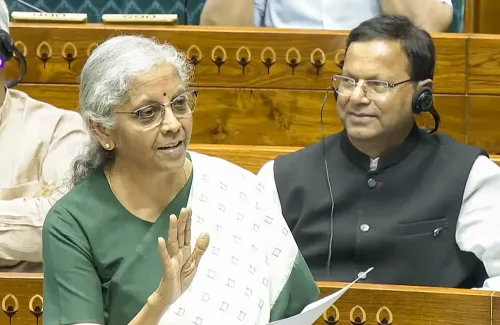
Union Finance Minister Nirmala Sitharaman on 28 May 2026 marked the tenth anniversary of the Insolvency and Bankruptcy Code, 2016, crediting it with transforming India's approach to business distress and calling it a cornerstone of the country's financial reform architecture.
Key Takeaways
The Insolvency and Bankruptcy Code completed 10 years on 28 May 2026 , enacted on the same date in 2016 .
Finance Minister Nirmala Sitharaman described the IBC as a 'cornerstone of India's financial reform architecture.' The IBC replaced fragmented laws including the Sick Industrial Companies (Special Provisions) Act, 1985 , consolidating insolvency proceedings under the NCLT .
The Insolvency and Bankruptcy Board of India (IBBI) was established under the code as the statutory regulator for insolvency professionals and processes.
The code is part of a broader post- 2014 reform agenda complementing GST and banking-sector consolidation.
Further amendments on timelines and cross-border insolvency provisions are expected to be watched closely in the upcoming monsoon session of Parliament .
Union Finance Minister Nirmala Sitharaman on Thursday, 28 May 2026, marked the tenth anniversary of the Insolvency and Bankruptcy Code, 2016, describing the landmark legislation as a cornerstone of India's financial reform architecture that has transformed the country's approach to business distress from delay and uncertainty to resolution and revival.
Context
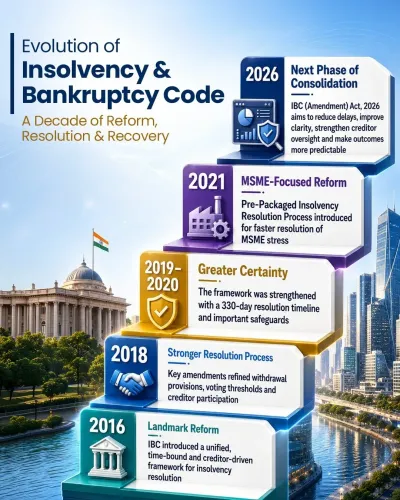
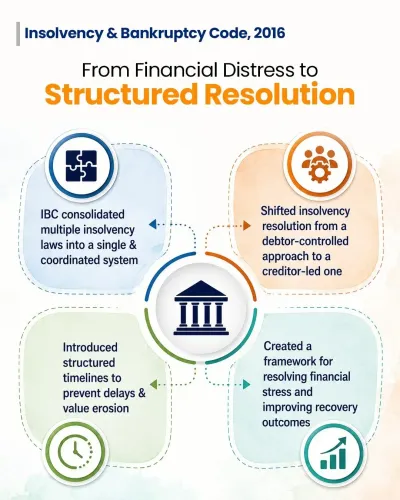
The Insolvency and Bankruptcy Code (IBC) was enacted on 28 May 2016, consolidating a web of fragmented insolvency laws into a single, time-bound framework for resolving corporate and individual financial distress. Before its passage, creditors and lenders navigated a maze of overlapping statutes — including the now-repealed Sick Industrial Companies (Special Provisions) Act, 1985 — that were widely criticised for prolonged delays and uncertain outcomes. The IBC centralised adjudication under the National Company Law Tribunal (NCLT) and created the Insolvency and Bankruptcy Board of India (IBBI) as the statutory regulator overseeing insolvency professionals, agencies, and information utilities.
Sitharaman, posting under the hashtag #10YearsOfIBC, said the code has 'strengthened confidence among creditors, investors and enterprises,' signalling the government's view that the reform has delivered on its foundational promise of predictability and speed.
Policy Backdrop
The IBC did not emerge in isolation. Its intellectual foundation was laid by the Bankruptcy Law Reforms Committee, which submitted its report in 2015 recommending a comprehensive overhaul of India's insolvency ecosystem. Earlier efforts — including the Recovery of Debts Due to Banks and Financial Institutions Act, 1993, which established Debt Recovery Tribunals, and the SARFAESI Act, 2002, which empowered secured creditors to enforce security interests without court intervention — had made incremental progress but suffered from persistent case backlogs and limited reach.
The IBC is widely regarded as a centrepiece of the post-2014 financial-sector reform agenda, complementing other structural changes such as the rollout of the Goods and Services Tax and the consolidation of public-sector banks. By creating a creditor-driven, time-bound exit mechanism for distressed firms, it was designed to reduce non-performing assets on bank balance sheets and improve India's standing in global ease-of-doing-business rankings. Periodic amendments since enactment have addressed implementation gaps while preserving the original emphasis on resolution over liquidation.
Stakeholders and Impact
The code's decade-long journey has touched a broad spectrum of stakeholders — banks, financial creditors, operational creditors, MSMEs, and foreign investors — each of whom now operates within a more clearly defined legal framework when a counterparty faces insolvency. For creditors, the shift from an open-ended recovery process to a structured, time-bound resolution plan has reduced the uncertainty that historically discouraged lending to operationally stressed but viable businesses. For enterprises, particularly smaller firms, the code introduced a formal but accessible mechanism to restructure liabilities and continue as going concerns rather than face piecemeal liquidation.
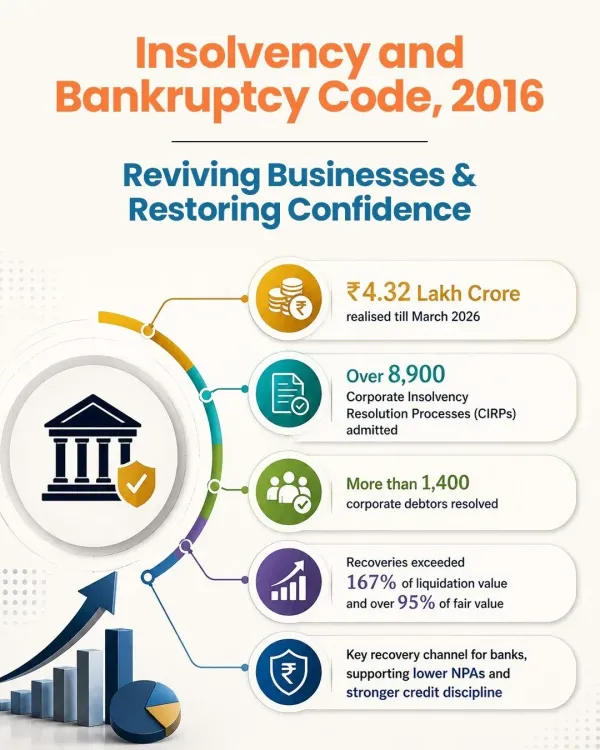
The IBBI and the NCLT have together handled thousands of cases since 2016, with a significant share resolved through approved resolution plans that preserved jobs and productive assets. Analysts have pointed to the IBC as a key factor in improving creditor confidence and encouraging fresh capital formation in sectors that were previously seen as recovery dead-ends.
What's Next
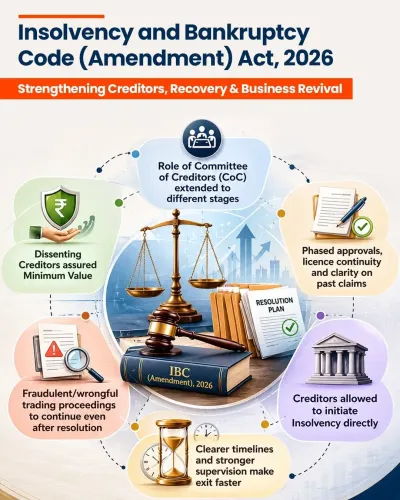
As the IBC enters its second decade, attention in policy circles is focused on pending high-value cases before the NCLT and the National Company Law Appellate Tribunal (NCLAT), as well as the prospect of further legislative refinements. Possible amendments being discussed include tighter timelines to prevent resolution processes from stretching beyond statutory limits, and the development of cross-border insolvency provisions to handle cases involving assets or creditors in multiple jurisdictions. With the monsoon session of Parliament approaching, any new amendment bill tabled by the government will be closely watched by lenders, legal practitioners, and investors as a signal of how the Ministry of Finance intends to sharpen the code's effectiveness in its next phase.
Point of View
Surviving multiple governments' scrutiny and earning broad creditor-community support, which makes it a relatively safe terrain for the Finance Minister to claim. By framing the code as a shift 'from delay and uncertainty to resolution and revival,' she is also implicitly drawing a contrast with the pre-2016 regime of regulatory fragmentation. The timing, ahead of a likely monsoon-session amendment bill, may also be laying the groundwork for public acceptance of further refinements to the code.
NationPress
19 Sept 2026
Frequently Asked Questions
What is the Insolvency and Bankruptcy Code, 2016?
The Insolvency and Bankruptcy Code, 2016 (IBC) is a unified Indian law that consolidates multiple earlier insolvency statutes into a single time-bound framework, with the National Company Law Tribunal as the primary adjudicating body for corporate insolvency cases.
Why did Nirmala Sitharaman post about the IBC?
Finance Minister Nirmala Sitharaman posted on 28 May 2026 to mark the tenth anniversary of the IBC's enactment, calling it a cornerstone of India's financial reform architecture that has strengthened confidence among creditors, investors and enterprises.
What laws did the IBC replace in India?
The IBC replaced several overlapping laws, most notably the Sick Industrial Companies (Special Provisions) Act, 1985, and subsumed provisions from the Recovery of Debts Due to Banks and Financial Institutions Act, 1993, creating a single, streamlined insolvency process.
What is the role of IBBI under the IBC?
The Insolvency and Bankruptcy Board of India (IBBI) is the statutory regulator established under the IBC to license and supervise insolvency professionals, insolvency professional agencies, and information utilities.
Will the IBC be amended in the 2026 monsoon session of Parliament?
No amendments have been officially confirmed, but policy observers are watching for possible changes to resolution timelines and cross-border insolvency provisions, which have been discussed as areas needing further refinement.