IBC recoveries hit ₹4.32 lakh crore: How India's bankruptcy code reshaped credit
Synopsis
India's bankruptcy code has quietly become the country's most powerful debt-recovery tool — outperforming SARFAESI, DRTs, and Lok Adalats combined. With ₹4.32 lakh crore recovered and resolved firms tripling their market valuations, the IBC's nine-year track record is now backed by hard data. The outstanding challenge: resolution timelines still routinely breach the 330-day statutory cap.
Key Takeaways
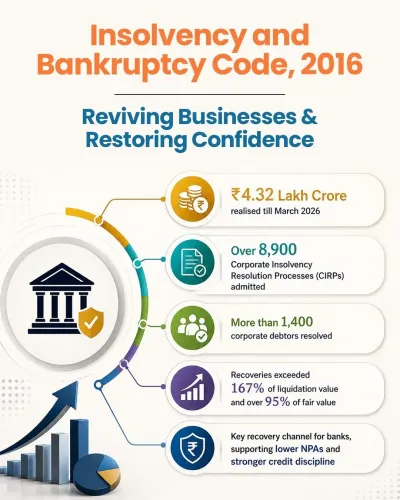
Creditors recovered ₹4.32 lakh crore through IBC resolution plans as of March 2026 , exceeding 116.85% of liquidation value.
The IBC contributed ₹54,528 crore — 52.4% of total bank recoveries — surpassing SARFAESI, DRTs, and Lok Adalats, per the RBI's 2024-25 banking report .
An IIM Ahmedabad study found resolved firms achieved 76% sales growth and a 130% rise in capital expenditure post-resolution.
Market valuations of listed resolved firms tripled from ₹2 lakh crore to ₹6 lakh crore ; liquidity improved by 80% .
Average 'Overdue' loan tenure fell from 248–344 days to 30–87 days , reflecting sharply improved credit discipline.
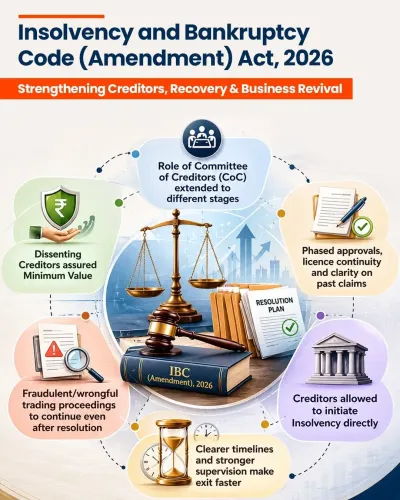
Resolution timelines in several cases still exceeded the statutory 330-day cap; the IBC Amendment Act, 2026 aims to address this.
India's Insolvency and Bankruptcy Code (IBC), 2016 has helped creditors recover approximately ₹4.32 lakh crore through approved resolution plans as of March 2026, according to an official factsheet released on Thursday, 28 May 2026. The recoveries exceeded 116.85% of liquidation value and more than 94.56% of fair value, underscoring the framework's growing effectiveness in resolving corporate distress.
IBC's Contribution to Bank Recoveries
The Reserve Bank of India (RBI)'s 'Report on Trends and Progress of Banking in India for 2024-25', released on 29 December 2025, highlights a striking statistic: of the total ₹1,04,099 crore recovered by scheduled commercial banks across all channels, the IBC alone accounted for ₹54,528 crore — or 52.4% of total recoveries. This surpassed recoveries through the SARFAESI Act, Debt Recovery Tribunals (DRTs), and Lok Adalats combined, marking the IBC as the single most effective recovery mechanism in the banking sector.
IIM Studies Reveal Post-Resolution Gains
The factsheet draws on independent research by IIM Ahmedabad and IIM Bengaluru to validate the IBC's impact on resolved firms. According to the IIM Ahmedabad study, creditors recovered 32% of admitted claims and 168% of liquidation value. Resolved firms recorded 76% sales growth, reached operational break-even by the third year, and saw a 50% rise in employee expenses — an indicator of higher employment generation.
Total assets of resolved companies grew by 50%, capital expenditure rose 130%, and profitability aligned with industry benchmarks. Market valuations for listed firms tripled, climbing from ₹2 lakh crore to ₹6 lakh crore, while liquidity improved by 80%. A separate IIM Bengaluru study found a 3% reduction in the cost of debt and improved governance through the addition of independent directors.
Credit Discipline Strengthens Across Corporates
The IIM Bengaluru research also examined IBC's broader impact on credit culture, analysing corporate loan accounts, Corporate Insolvency Resolution Process (CIRP) data, and NPA trends. The findings point to a meaningful shift in borrower behaviour: the number and value of loan accounts classified as 'Overdue' declined significantly during the review period.
Notably, the average number of days a loan account remained in the 'Overdue' category before transitioning to 'Normal' status fell sharply — from a range of 248–344 days to just 30–87 days. The yearly proportion of accounts moving from 'Overdue' to 'Normal' also increased, suggesting that both debtors and creditors are now resolving delinquencies far more swiftly than before.
Challenges Persist: Delays and Litigation
Despite these gains, operational challenges remain unresolved. Average resolution timelines in several cases exceeded the statutory limit of 330 days, and prolonged litigation in some proceedings has affected value maximisation, according to the data. Delays in adjudication continue to be a structural concern for the framework's long-term credibility.
What Comes Next
The government's factsheet notes that subsequent legislative amendments, including the Insolvency and Bankruptcy Code (Amendment) Act, 2026, are aimed at improving timelines, institutional efficiency, and recovery outcomes. As India's credit ecosystem continues to mature, the IBC's ability to enforce discipline while delivering value to creditors will remain a key benchmark for its success.
Point of View
But the more telling number is the shift in credit culture: loan accounts moving from 'Overdue' to 'Normal' in 30–87 days instead of 248–344 days. That behavioural change — borrowers repaying to avoid the IBC trigger — is arguably the code's most durable contribution, and one that aggregate recovery data alone does not capture. The persistent breach of the 330-day resolution timeline, however, is a structural failure that successive amendments have promised to fix without fully delivering. Until adjudication capacity matches the volume of cases, value erosion during prolonged proceedings will remain the IBC's Achilles heel.
NationPress
27 Sept 2026
Frequently Asked Questions
How much have creditors recovered under the IBC as of March 2026?
Creditors have recovered approximately ₹4.32 lakh crore through approved resolution plans under the Insolvency and Bankruptcy Code as of March 2026. Recoveries exceeded 116.85% of liquidation value and more than 94.56% of fair value, according to an official government factsheet.
How does the IBC compare to other bank recovery channels?
The IBC contributed ₹54,528 crore — 52.4% of the ₹1,04,099 crore total recovered by scheduled commercial banks in 2024-25, surpassing recoveries through SARFAESI, Debt Recovery Tribunals, and Lok Adalats. This makes it the single most effective recovery mechanism for the banking sector, per the RBI's 2024-25 banking trends report.
What do IIM studies say about firms resolved under the IBC?
An IIM Ahmedabad study found that resolved firms achieved 76% sales growth, 130% higher capital expenditure, and reached operational break-even by their third year. Market valuations of listed resolved firms tripled from ₹2 lakh crore to ₹6 lakh crore, while a separate IIM Bengaluru study recorded a 3% reduction in cost of debt.
Has the IBC improved credit discipline among Indian corporates?
Yes, according to an IIM Bengaluru study cited in the government factsheet. The average time a loan account stays in the 'Overdue' category before returning to 'Normal' has fallen from 248–344 days to 30–87 days, indicating that borrowers are resolving delinquencies much faster to avoid insolvency proceedings.
What are the key challenges facing the IBC, and what is being done?
Average resolution timelines in several cases have exceeded the statutory 330-day limit, and prolonged litigation has affected value maximisation in some proceedings. The Insolvency and Bankruptcy Code (Amendment) Act, 2026 has been enacted to improve timelines, institutional efficiency, and recovery outcomes.