Rajnath Singh: India's rise built on inclusion, not conflict
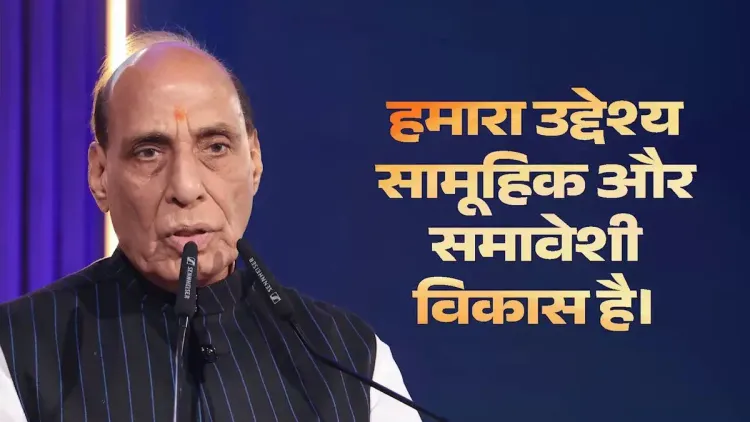
Synopsis
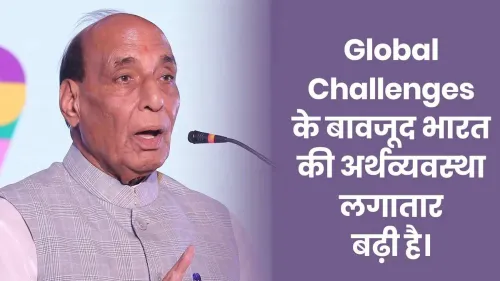
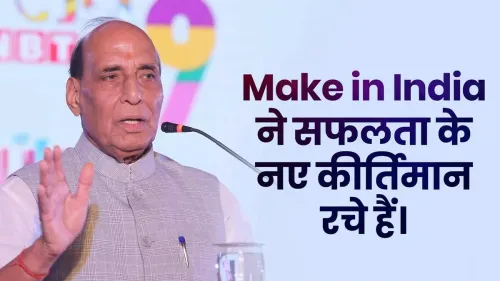
Union Defence Minister Rajnath Singh on 27 September 2026 posted a crisp foreign-policy statement framing India's global ascent as inherently inclusive — 'Rise without Rupture, Progress without Conflict' — and arguing that India's progress embodies the world's progress.
Key Takeaways
Union Defence Minister Rajnath Singh posted on X on 27 September 2026 articulating India's global vision.
He coined the phrase 'Rise without Rupture, Progress without Conflict' to describe India's international posture.
Singh asserted that India's progress carries within it the spirit of the world's progress — framing Indian growth as a collective gain.
The statement aligns with India's longstanding foreign-policy emphasis on a multipolar world order and multilateral cooperation.
The message signals broad Cabinet consensus on an inclusive global-rise narrative, not just a diplomatic-corps position.
A rising power can choose to elbow its way to the top — or it can chart a different course entirely. On Sunday, 27 September 2026, Union Defence Minister Rajnath Singh articulated India's chosen path in a crisp formulation that frames the country's global ambitions not as a zero-sum contest, but as a shared ascent.
Posting on X, Singh wrote: 'भारत का उदय सबको साथ लेकर आगे बढ़ने के लिए है।' — 'India's rise is meant to carry everyone forward together.' He distilled the philosophy into two sharp phrases: 'Rise without Rupture' and 'Progress without Conflict', closing with the assertion that India's progress carries within it the spirit of the world's progress.
A phrase that does real diplomatic work
The formulation 'Rise without Rupture' is deceptively compact. It addresses, head-on, the anxiety that haunts every era of great-power transition — that a rising nation inevitably disrupts or displaces those already at the table. Singh's framing rejects that logic explicitly, positioning India as a power whose growth does not come at a rival's expense.
This sits squarely within India's longstanding foreign-policy grammar: a multipolar world order, multilateral cooperation, and the idea that the Global South's development is inseparable from global stability. It is a posture India has carried from the Nehruvian era of Non-Alignment through to its active stewardship of the G20 presidency in 2023 and beyond.
Why a Defence Minister is speaking the language of diplomacy
Singh is not India's foreign minister — and that is precisely what makes the statement notable. When the country's second-most senior Cabinet minister and a former Union Home Minister and former Chief Minister of Uttar Pradesh speaks in the idiom of inclusive multilateralism, it signals that this worldview is not confined to South Block's diplomatic corridors. It is a consensus across India's top leadership.
India's defence posture in recent years has mirrored this philosophy in practice — deepening ties with partners across the Indo-Pacific, Africa, and the Global South while explicitly positioning those relationships as mutual capacity-building rather than alliance-formation against any third party.
The audience this message is meant for
Singh's post arrives as India watches several multilateral forums on global governance and development converge on the calendar. The timing of such a statement — even without a named triggering event — functions as a standing signal to the international community: India's growing military, economic, and diplomatic weight is designed to stabilise the international order, not strain it.
That is a message with a global inbox.
Whether the world takes Singh at his word will depend less on the philosophy and more on the choices India makes the next time rupture and progress pull in opposite directions.
Point of View
The BJP government is preemptively countering narratives that frame a stronger India as a destabilising force. It reinforces the G20-era brand of 'Vishwabandhu' — India as a friend to all — and extends it into the security domain, which is significant coming from the Defence Minister. Watched over time, the real test of the doctrine will be whether India's strategic partnerships and defence posture remain legible as genuinely non-disruptive to existing regional orders.
NationPress
27 Sept 2026
Frequently Asked Questions
What did Rajnath Singh say about India's rise?
Singh said India's rise is meant to carry everyone forward together, encapsulated in the phrases 'Rise without Rupture' and 'Progress without Conflict', and that India's progress embodies the spirit of the world's progress.
What does 'Rise without Rupture' mean in India's foreign policy?
'Rise without Rupture' means India seeks to grow as a global power without displacing or disrupting other nations — a rejection of zero-sum great-power competition in favour of an inclusive, multipolar order.
Why is India's Defence Minister speaking about foreign policy?
When a senior Cabinet minister like the Defence Minister echoes foreign-policy doctrine, it signals broad government consensus — this worldview shapes not just diplomacy but also India's defence partnerships and military posture internationally.
How does this statement connect to India's G20 presidency?
It reinforces the 'Vishwabandhu' or 'friend to all' brand India cultivated during its G20 presidency in 2023 , extending that inclusive-development narrative further into 2026's multilateral environment.
What is Rajnath Singh's political background?
Rajnath Singh is a senior BJP leader who has served as Chief Minister of Uttar Pradesh , Union Home Minister , and currently holds the portfolio of Union Defence Minister in the Government of India.