Sitharaman receives ₹2,853 cr dividend from Union Bank

Synopsis
Union Finance Minister Nirmala Sitharaman received a ₹2,853 crore dividend cheque for FY 2025-26 from Union Bank of India MD and CEO Asheesh Pandey, reflecting the improved profitability of public sector banks following post-2020 mergers and earlier capital infusions.
Key Takeaways
Union Bank of India handed a dividend cheque of ₹2,853 crore to the central government for FY 2025-26 .
The cheque was presented by Asheesh Pandey , MD and CEO of Union Bank of India, to Finance Minister Nirmala Sitharaman on July 29, 2026 .
Union Bank was formed through the 2020 merger of Andhra Bank and Corporation Bank into it, as part of the government's PSB consolidation drive.
PSB dividends form a key component of the central government's non-tax revenue , reducing reliance on market borrowing.
Improved bank profitability follows the government's large-scale recapitalisation programme initiated after the 2017 asset quality review.
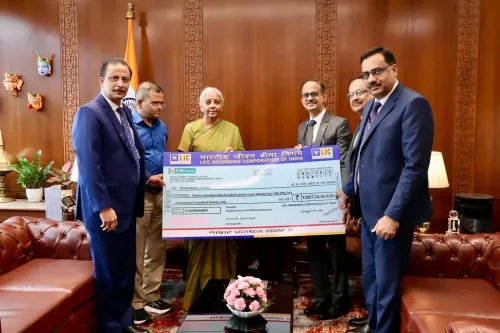
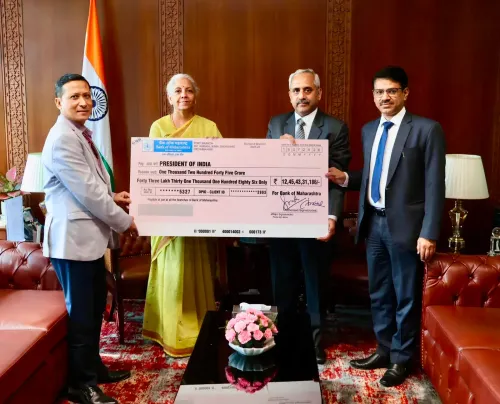
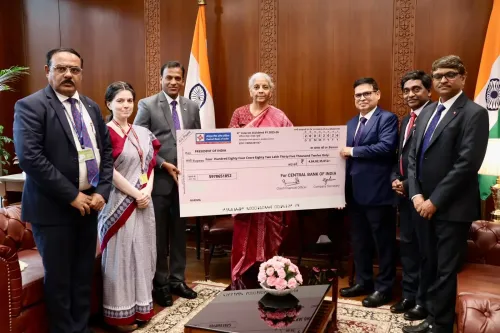
A cheque worth ₹2,853 crore — that is the return the Indian government is collecting from one of its own banks. Union Finance Minister Nirmala Sitharaman on Wednesday, July 29, 2026 received the dividend cheque for FY 2025-26 from Asheesh Pandey, MD and CEO of Union Bank of India, as the public sector lender transferred its annual profit share to its majority shareholder — the central government.
Why Union Bank writing this cheque matters
Union Bank of India is a product of the government's 2020 mega-merger that folded Andhra Bank and Corporation Bank into it, creating one of India's larger public sector lenders. The consolidation was painful — it forced balance-sheet rationalisation and branch restructuring — but the logic was always that bigger, leaner banks would eventually return more to the exchequer. A ₹2,853 crore dividend cheque is that logic paying off. The backstory runs further back. After the 2017 asset quality review exposed the true scale of bad loans on public sector bank books, the government pumped tens of thousands of crores into recapitalisation. Those infusions were not charity — they were equity stakes. Dividends like this one are the return leg of that investment cycle.Non-tax revenue and the fiscal arithmetic
For the Finance Ministry, dividends from public sector banks and financial institutions are a critical line in the non-tax revenue column of the Union Budget. Unlike tax collections, which fluctuate with economic cycles and compliance, PSB dividends are relatively predictable once banks return to sustained profitability — and that predictability has grown considerably since the merger wave of the early 2020s. The broader pattern is clear: as more public sector banks clear their legacy bad-loan overhang and post consistent profits, their annual dividend payouts to the government have climbed. That reduces pressure on the government to raise equivalent funds through market borrowing, giving the fiscal deficit arithmetic a quieter but meaningful cushion.Pandey hands over; Sitharaman receives
The ceremonial handover — Asheesh Pandey, MD and CEO of Union Bank of India, presenting the cheque to Smt. Nirmala Sitharaman — is standard protocol for large PSB dividend transfers, but it carries institutional weight. It marks the formal completion of a profitable financial year for the bank and the government's acknowledgement of that performance. With the next Union Budget cycle already in view, watch whether the cumulative dividend flow from profitable public sector banks is flagged as a non-tax revenue outperformer — and whether that headroom quietly shapes decisions on capital expenditure or fiscal consolidation targets.Point of View
853 crore dividend from Union Bank of India is a tangible return on the government's decade-long bet on PSB consolidation and recapitalisation — a strategy that was deeply contested when it began. It fits a broader arc in which the Finance Ministry has sought to convert state-owned banks from fiscal liabilities into revenue contributors. For Sitharaman, who has overseen both the merger completions and subsequent governance reforms, this payout is also a political data point: proof that the consolidation thesis is yielding results. The bigger question is whether rising PSB dividend flows will give the government room to ease fiscal consolidation targets or fund higher capital expenditure without widening the deficit.
NationPress
29 Jul 2026
Frequently Asked Questions
How much dividend did Union Bank of India pay to the government in FY 2025-26?
Union Bank of India paid a dividend of ₹2,853 crore to the central government for FY 2025-26 , presented as a cheque to Finance Minister Nirmala Sitharaman on July 29, 2026.
Why does the government receive dividends from public sector banks?
The central government is the majority shareholder in public sector banks. As the banks earn profits, they distribute a portion as dividends to all shareholders, including the government, which counts this as non-tax revenue in the Union Budget.
Who is Asheesh Pandey?
Asheesh Pandey is the MD and CEO of Union Bank of India , who formally presented the FY 2025-26 dividend cheque to Finance Minister Nirmala Sitharaman.
What is the history behind Union Bank of India's current size?
In 2020 , the government merged Andhra Bank and Corporation Bank into Union Bank of India as part of a broader PSB consolidation drive, making it one of India's larger public sector lenders.
How do PSB dividends help India's fiscal management?
Dividends from profitable public sector banks contribute to the government's non-tax revenue , reducing the need to borrow from the market to meet expenditure targets and providing a cushion in fiscal deficit management.