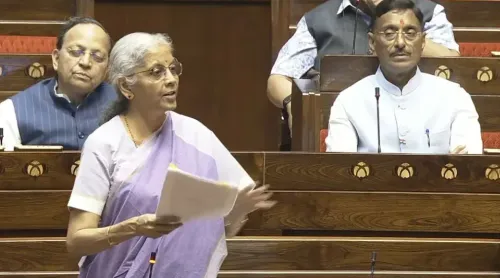
Sitharaman Replies to Bankers' Books Evidence Bill Debate in Rajya Sabha

Synopsis
Union Finance Minister Nirmala Sitharaman replied in the Rajya Sabha on 10 August 2026 to the discussion on The Bankers' Books Evidence Bill, 2026, a legislative overhaul of the colonial-era Bankers' Books Evidence Act, 1891, which governs the admissibility of bank records as court evidence.
Key Takeaways
Nirmala Sitharaman delivered the government's full reply to the Rajya Sabha debate on The Bankers' Books Evidence Bill, 2026 on 10 August 2026 .
The bill seeks to update the Bankers' Books Evidence Act, 1891 , a colonial-era law governing the admissibility of bank records in Indian courts.
Banking institutions and legal practitioners are the primary stakeholders affected by the proposed evidentiary changes.
The government shared the full video of Sitharaman's reply through official channels, providing a public record of the ministry's position.
The bill's next steps include a potential Rajya Sabha vote, presidential assent, and gazette notification before it becomes enforceable law.
A colonial-era law governing how bank records are admitted in court is being rewritten — and on Monday, 10 August 2026, Union Finance Minister Nirmala Sitharaman stood in the Rajya Sabha to deliver the government's full reply to the discussion on The Bankers' Books Evidence Bill, 2026.
A 135-Year-Old Law Meets a Modern Parliament
The original Bankers' Books Evidence Act, 1891 — drafted under British rule — established that certified copies of bank records could be admitted as evidence in Indian courts. For over a century, that framework governed how banks interacted with the judiciary. The 2026 Bill represents Parliament's effort to bring those evidentiary rules into step with a banking sector that now runs largely on digital infrastructure. Sitharaman's reply in the upper house is the government's formal closing argument in that legislative debate — the moment the Finance Ministry lays out its rationale, addresses opposition concerns, and signals the bill's direction before any final vote.Rajya Sabha's Role in Shaping Banking Law
The upper house has long served as the chamber where financial legislation gets its sharpest scrutiny. Banking institutions and legal practitioners are the two communities most directly affected: banks must comply with whatever evidentiary standards the law sets, while lawyers and courts depend on those standards to admit or challenge financial records in disputes and fraud cases. The government's decision to share the full video of Sitharaman's reply through official channels signals a push for transparency around the bill's passage — letting stakeholders hear the minister's reasoning in her own words.What Comes Next for the Bill
A ministerial reply in Rajya Sabha typically precedes a vote. Should the bill pass the upper house, it moves toward presidential assent and gazette notification before becoming enforceable law. Any amendments accepted during the debate would shape the final text that banks and courts must follow. India's periodic legislative overhauls of colonial-era financial statutes have historically drawn bipartisan interest — the question is rarely whether to modernise, but how far and how fast. Sitharaman's full reply, now in the public domain, gives Parliament, the banking sector, and legal professionals a clear record of where the government stands.Point of View
2026 fits into a broader pattern of the Modi government systematically retiring colonial-era statutes — a legislative agenda that carries both genuine modernisation value and political symbolism. Sitharaman's personal appearance to deliver the reply, rather than delegating to a junior minister, signals the Finance Ministry's ownership of the bill and its confidence in defending the measure. For the BJP, passing a banking-sector reform through the upper house — where coalition arithmetic has historically been trickier — would count as a legislative win heading into the latter half of 2026. The public release of the full reply video also reflects a communications strategy of building a verifiable record around contentious legislation.
NationPress
10 Aug 2026
Frequently Asked Questions
What is the Bankers' Books Evidence Bill 2026?
The Bankers' Books Evidence Bill, 2026 is a proposed Indian law aimed at updating the colonial-era Bankers' Books Evidence Act, 1891, which governs how certified copies of bank records are admitted as evidence in courts.
What did Nirmala Sitharaman say in Rajya Sabha on 10 August 2026?
Union Finance Minister Nirmala Sitharaman delivered the government's full reply to the parliamentary discussion on The Bankers' Books Evidence Bill, 2026 in the Rajya Sabha on 10 August 2026. The full video was shared through official government channels.
Why is the Bankers' Books Evidence Act being amended?
The original Act dates to 1891 and was drafted under British rule. India's banking sector has since shifted largely to digital operations, making a legislative update necessary to align evidentiary rules with modern banking practices.
What happens after Rajya Sabha discusses the Bankers' Books Evidence Bill?
After the discussion and the minister's reply, the Rajya Sabha may vote on the bill. If passed, it proceeds to presidential assent and gazette notification before becoming enforceable law.
Who are the main stakeholders affected by the Bankers' Books Evidence Bill 2026?
Banking institutions and legal practitioners are the two communities most directly affected, as the bill determines the standards by which bank records can be submitted and challenged as evidence in Indian courts.