Smriti Irani Champions Young Scientific Minds
Synopsis
BJP leader Smriti Irani posted on November 19, 2026, that the next great scientific discovery may come from a curious young mind challenging old assumptions — a pointed nudge toward youth-driven innovation as India's education reforms deepen.
Key Takeaways
BJP leader Smriti Irani posted on November 19, 2026 , championing young minds over legacy institutions as the source of future scientific breakthroughs.
The post frames curiosity and the willingness to question assumptions as the core driver of discovery.
The messaging aligns with the National Education Policy framework, which elevates critical thinking and inquiry-based learning as national priorities.
Senior BJP leaders have consistently linked youth-driven innovation to the Aatmanirbhar Bharat self-reliance agenda.
No specific scheme, budget, or legislative action was cited — the post functions as a philosophical signal aimed at students and young researchers across India.
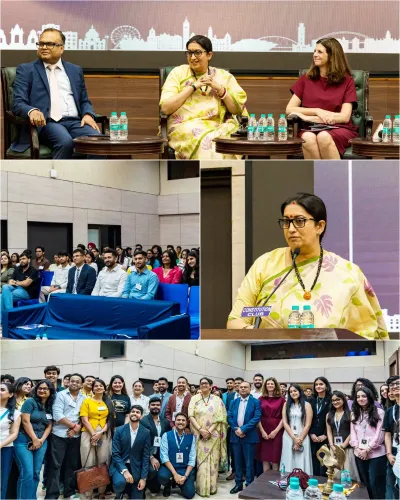
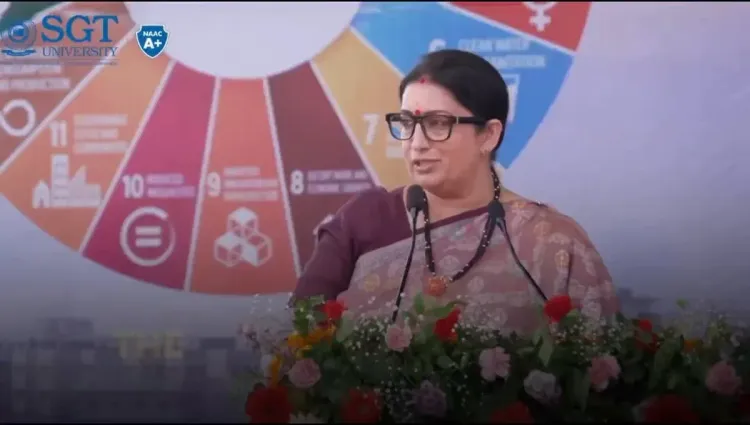
A single sentence about curiosity challenging a century of assumptions — and BJP leader Smriti Irani has put India's next generation of researchers front and centre. On Thursday, November 19, 2026, the former Union Minister for Women and Child Development posted a quietly powerful reflection on the future of scientific discovery.
Irani's post reads: 'The next great scientific discovery may not emerge from a lab with a century of history. It may emerge from a young mind curious enough to question a century of assumptions.' Short, deliberate, and pointed — it is the kind of line that travels.
Why 'questioning assumptions' lands differently in 2026
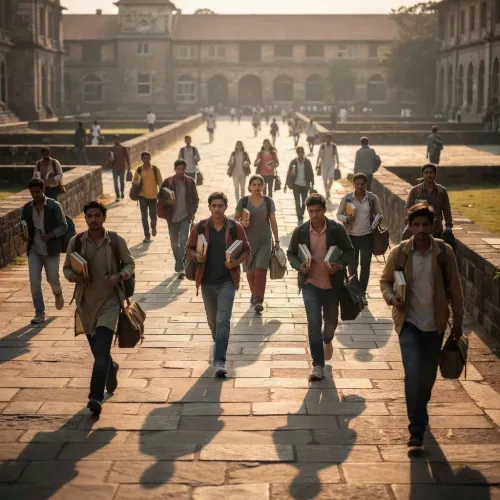
India's science and education landscape has been in active flux. The National Education Policy (NEP) framework, which formally elevated critical thinking, inquiry-based learning, and multidisciplinary research as national priorities, has been in various stages of implementation across states. The message Irani sends — that institutional age is no guarantee of discovery — slots neatly into a broader political narrative that positions young, hungry minds as India's most underutilised resource. It also carries an implicit challenge. Legacy institutions, however storied, do not hold a monopoly on breakthrough thinking. Some of the most cited recent advances in science globally have come from younger universities, start-up research labs, and individual researchers working outside traditional hierarchies. Irani's framing reflects that global shift in how discovery actually happens.Youth, science, and the self-reliance argument
Leaders from the ruling party have consistently woven youth-driven innovation into the larger Aatmanirbhar Bharat (self-reliant India) argument — the idea that domestic intellectual capital, not imported expertise, must power the country's next phase of growth. Science education reform, research funding, and the push to retain talent within India are recurring threads in this conversation. Irani's post does not cite a specific scheme or budget line — but it does something arguably more durable: it frames ambition as a democratic asset, not an institutional one. Any young student in a tier-2 city reading this gets the same message as a postgraduate at an elite institution. Curiosity, the post argues, is the great equaliser. Watch whether this feeds into parliamentary-session commentary on NEP implementation or science funding announcements in the weeks ahead — a philosophical nudge from a senior leader rarely arrives in isolation.Point of View
She reinforces a strand of BJP messaging that positions the NEP and self-reliance agenda as vehicles for democratising ambition. It is also a subtle pressure point on established institutions to remain relevant. Whether it precedes a concrete policy announcement — a research funding push, an NEP milestone, or a parliamentary statement — will determine whether this reads as vision or vibe.
NationPress
19 Nov 2026
Frequently Asked Questions
What did Smriti Irani post about science and youth?
On November 19, 2026, Smriti Irani posted that the next great scientific discovery may come not from a century-old laboratory but from a young mind curious enough to question long-held assumptions.
What is the National Education Policy and how does it relate to this post?
The National Education Policy is India's major education reform framework that prioritises critical thinking, inquiry-based learning, and multidisciplinary research. Irani's emphasis on curiosity and questioning assumptions directly echoes NEP's core philosophy.
Is Smriti Irani currently a Union Minister?
Smriti Irani is a senior BJP leader and former Union Minister who held portfolios including Women and Child Development and Minority Affairs. As of November 2026, she remains an influential voice within the party.
What is Aatmanirbhar Bharat and why does it connect to science education?
Aatmanirbhar Bharat, or self-reliant India, is a policy vision championed by the BJP government to build domestic capability across sectors including science, technology, and research, reducing dependence on foreign expertise and institutions.
Why do Indian politicians emphasise youth-driven innovation?
India has one of the world's largest youth populations, and channelling that demographic into science and research is seen as critical for economic growth, technological self-reliance, and global competitiveness — making it a recurring political priority.