Smriti Irani flags women's role in electronics manufacturing growth
Synopsis
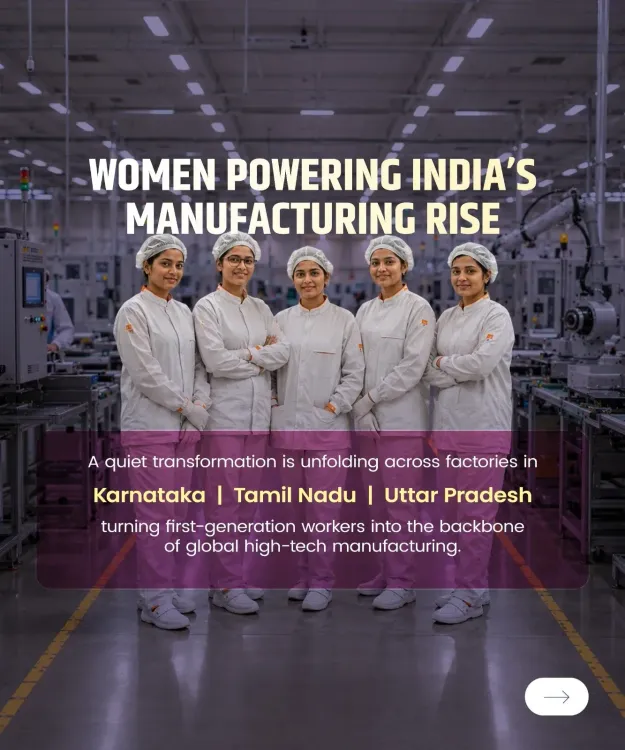
BJP leader Smriti Irani has called investing in women's skills one of India's most powerful economic strategies, spotlighting female workers in electronics manufacturing clusters in Tamil Nadu and Noida as drivers of industrial growth and household income expansion.
Key Takeaways
BJP leader Smriti Irani posted on 3 August 2026 highlighting women's role in India's electronics manufacturing sector.
She identified Tamil Nadu and Noida as key corridors where women are strengthening productivity and manufacturing competitiveness.
Irani framed skill investment in women as a 'multiplier effect' — boosting industries, household incomes, and economic growth simultaneously.
India's PLI scheme for electronics (notified 2020 ) and the Skill India Mission (launched 2015 ) form the structural backdrop to rising female participation in the sector.
Electronics assembly has emerged as one of the more accessible entry points for women into organised industrial employment in India.
From assembly lines in Tamil Nadu to industrial clusters in Noida, women workers are quietly reshaping India's electronics manufacturing story — and BJP leader Smriti Irani wants that shift to be seen for what it is: an economic strategy, not a footnote.
Posting on 3 August 2026, Irani, former Union Minister of Women and Child Development, framed female workforce participation in electronics manufacturing as 'one of India's most powerful strategies for driving sustainable economic growth.' Her message was pointed: investing in women's skills, she argued, creates a 'multiplier effect' that strengthens industries, expands household incomes, raises aspirations, and accelerates growth.
Why electronics manufacturing is where this argument lands hardest
India's electronics manufacturing sector has undergone significant structural expansion since the Production Linked Incentive (PLI) scheme for electronics was notified in 2020, designed to boost domestic production of mobile phones and components and attract large-scale investment. The sector's labour-intensive assembly operations — particularly in states like Tamil Nadu, which hosts major mobile phone and component manufacturing clusters — have drawn women into organised industrial employment in notable numbers. Noida, in Uttar Pradesh's National Capital Region, anchors another major electronics and IT hardware belt. Together, these two corridors represent the sharpest edge of India's manufacturing ambitions — and, increasingly, the visible face of women's industrial participation.Skill India and the workforce pipeline
The structural backdrop to Irani's argument is the Skill India Mission, launched in 2015, which has targeted vocational and technical training across sectors including manufacturing. For women entering electronics assembly, skill development is the entry point — and the multiplier Irani describes begins there: a trained worker earns more, spends more locally, and opens doors for others in her household. India has simultaneously pushed for greater female labour force participation in organised industry, recognising that closing the gender gap in manufacturing is not merely a social goal but a productivity lever. Electronics assembly, with its precision requirements and structured work environments, has proven to be one of the more accessible on-ramps.The multiplier case Irani is making
Irani's framing is explicitly economic rather than welfare-oriented — a deliberate rhetorical choice. By anchoring the argument in productivity, manufacturing competitiveness, and local economic growth, she positions women's workforce inclusion as industrial policy, not charity. The 'multiplier effect' language echoes development economics literature on how female income disproportionately recirculates into families and communities. What she does not cite — and what remains to be quantified — is fresh data on exactly how many women are employed across India's electronics clusters today, or what skilling programmes are currently active in these corridors. The Periodic Labour Force Survey's forthcoming data on female workforce participation in manufacturing will be the next hard number to watch. The argument is well-grounded in direction. The scale is still being written.Point of View
Not peripheral to them — a shift from welfare framing to productivity framing that carries political weight ahead of any manufacturing-focused policy announcements. By naming Tamil Nadu alongside Noida, she signals a cross-state, pan-India narrative rather than a UP-centric one, which broadens the political reach of the message. The 'multiplier effect' language aligns with mainstream development economics and gives the argument credibility beyond party positioning. The missing piece — hard, current data on female employment in electronics clusters — is also the space where policy action, if any follows, would need to land.
NationPress
3 Aug 2026
Frequently Asked Questions
What did Smriti Irani say about women in manufacturing?
Smriti Irani stated that investing in women's skills is one of India's most powerful strategies for sustainable economic growth, highlighting women workers in electronics manufacturing clusters in Tamil Nadu and Noida as a defining force behind industrial growth.
Which states have major women-led electronics manufacturing clusters in India?
Tamil Nadu and Uttar Pradesh (particularly Noida in the NCR region) are among the leading states with established electronics manufacturing clusters where women have entered organised industrial employment in significant numbers.
What is the PLI scheme for electronics in India?
The Production Linked Incentive scheme for electronics was notified in 2020 to boost domestic production of mobile phones and components and attract large-scale investment, significantly expanding India's electronics manufacturing base.
How does Skill India support women in manufacturing?
The Skill India Mission, launched in 2015 , provides vocational and technical training across sectors including manufacturing, serving as a key pipeline for women entering electronics assembly and other industrial roles.
What is the multiplier effect of investing in women's skills?
The multiplier effect refers to how income earned by skilled women workers recirculates into families and local economies — boosting household spending, raising living standards, and generating broader community economic growth beyond the factory floor.