Sonowal hails Lok Sabha passage of exam anti-cheating amendment bill

Synopsis
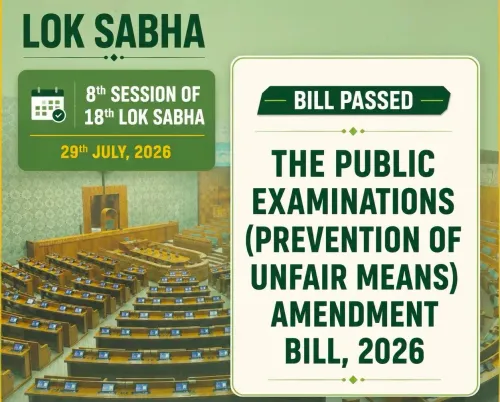
The Lok Sabha passed the Public Examinations (Prevention of Unfair Means) Amendment Bill, 2026 on July 30, strengthening India's 2024 anti-cheating law. Union Minister Sarbananda Sonowal hailed the move as a landmark step by the Modi government to protect the integrity of public exams and the futures of millions of youth aspirants.
Key Takeaways
The Lok Sabha passed the Public Examinations (Prevention of Unfair Means) Amendment Bill, 2026 on July 30, 2026 .
The bill amends the Public Examinations (Prevention of Unfair Means) Act, 2024 , which first established penalties for malpractices in exams by bodies like UPSC and SSC .
Union Minister Sarbananda Sonowal credited PM Narendra Modi with driving the reform to protect student interests.
The bill must still clear the Rajya Sabha before becoming law.
The legislation is part of a sustained government effort to combat recurring paper leak scandals in India's competitive examination system.
India's war on examination fraud just got a new weapon. Union Ports and Shipping Minister Sarbananda Sonowal on Thursday, July 30, 2026, welcomed the passage of the Public Examinations (Prevention of Unfair Means) Amendment Bill, 2026 in the Lok Sabha, calling it a landmark step toward securing the futures of India's youth aspirants.
Sonowal framed the bill squarely around Prime Minister Narendra Modi, describing it as a reflection of the PM's 'unwavering commitment to securing the aspirations of our youth.' The minister added that the amendments would 'further strengthen the legal framework to prevent use of unfair means in public examinations and safeguard the interests of students.'
Building on the 2024 Act's foundation
The 2026 Amendment Bill builds on the Public Examinations (Prevention of Unfair Means) Act, 2024 — the central government's landmark legislation that first imposed structured penalties for malpractices in examinations conducted by bodies such as UPSC and SSC. That original law was itself a direct legislative response to a string of high-profile paper leak scandals that shook public confidence in India's competitive examination ecosystem. Amendments of this kind typically target enforcement gaps that surface after a law's initial implementation — the pressure points where bad actors find room to manoeuvre.Why India's exam integrity crisis demanded a legislative answer
The stakes here are not abstract. Millions of young Indians — from small towns, from farming families, from the first generation to sit a competitive exam — pin their entire economic futures on the credibility of a single test. When a paper leaks, it is not just a procedural failure; it is a betrayal of that trust at scale. Successive governments have grappled with this problem, but the pattern of incidents persisted, making the case for tighter law stronger with each cycle. Sonowal invoked the phrase 'Yuva Shakti' — the energy and potential of India's young population — signalling the BJP government's intent to position examination integrity as a youth-welfare priority, not merely a law-and-order matter.What comes next: the Rajya Sabha test
The bill's passage through the Lok Sabha is one half of the parliamentary journey. It must now clear the Rajya Sabha before it can be enacted into law. Watchers will also look for the Ministry of Education to notify implementing rules and enforcement mechanisms that give the amended legislation real teeth on the ground. For millions of aspirants preparing for their next attempt at a government exam, the message from Parliament is pointed: the system is being rebuilt around you. The question is how quickly the new framework translates from statute to street-level accountability.Point of View
Signalling that the 2024 Act alone did not fully close the enforcement gaps that allow paper leaks and malpractice to persist. By championing the bill publicly, senior ministers like Sonowal are reinforcing a political narrative that positions the Modi government as the guardian of meritocracy for India's vast aspirant class — a vote-sensitive demographic. The real test of the legislation, however, will be in implementation: whether enforcement agencies receive the resources and mandate to act, and whether the Rajya Sabha passage follows without dilution. Legislative intent and ground-level deterrence have historically diverged in India's exam-fraud ecosystem.
NationPress
30 Jul 2026
Frequently Asked Questions
What is the Public Examinations (Prevention of Unfair Means) Amendment Bill 2026?
It is a bill passed by the Lok Sabha on July 30, 2026 that amends the Public Examinations (Prevention of Unfair Means) Act, 2024, aiming to further strengthen the legal framework against cheating and malpractice in public examinations conducted by bodies like UPSC and SSC.
What was the original Public Examinations (Prevention of Unfair Means) Act 2024?
The 2024 Act was the central government's foundational legislation imposing structured penalties for malpractices in competitive public examinations, introduced in response to a series of paper leak scandals that undermined public confidence in India's exam system.
Has the exam anti-cheating bill 2026 become law yet?
Not yet. The bill passed the Lok Sabha on July 30, 2026, but it must also be passed by the Rajya Sabha and receive Presidential assent before it becomes law.
Which exams does the Public Examinations Act cover?
The Act covers public examinations conducted by central bodies including UPSC (Union Public Service Commission) and SSC (Staff Selection Commission), among others.
Why did India need a new amendment to the 2024 exam integrity law?
Amendments typically address enforcement gaps identified after a law's initial implementation. The 2026 bill is intended to close loopholes and strengthen mechanisms that the 2024 Act may not have fully covered.