Sonowal notifies 4 ports as 'Mega Ports' in trade push
Synopsis
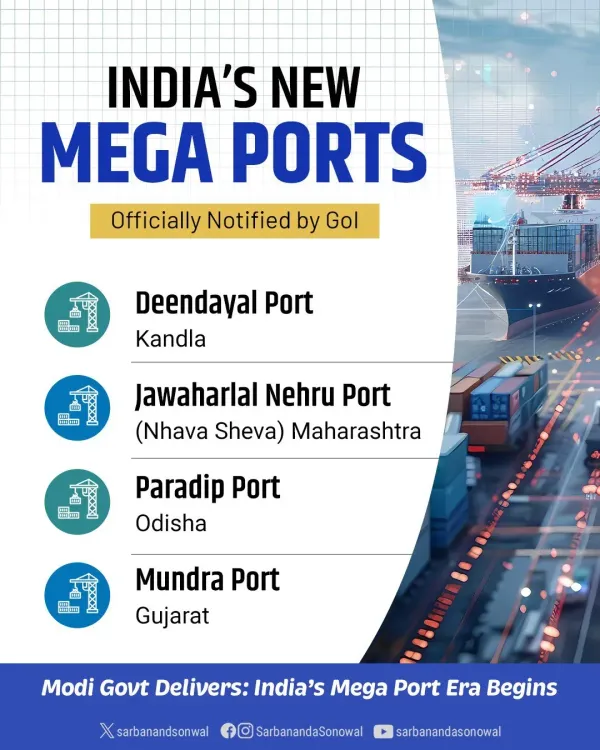
The Government of India has formally notified Deendayal, Jawaharlal Nehru (Nhava Sheva), Paradip, and Mundra ports as 'Mega Ports', Minister Sarbananda Sonowal announced on 25 September 2026, marking a new tier in India's port governance and trade infrastructure strategy.
Key Takeaways
Four ports designated: Deendayal Port (Gujarat), Jawaharlal Nehru Port/Nhava Sheva (Maharashtra), Paradip Port (Odisha), and Mundra Port (Gujarat) have been formally notified as 'Mega Ports' by the Government of India.
Private sector included: Mundra Port, operated by Adani Ports and India's largest private port, is the only non-government port in the designated quartet.
Policy lineage: The designation builds on the Sagarmala Project (2015), Maritime India Vision 2030, and the Major Port Authorities Act 2021.
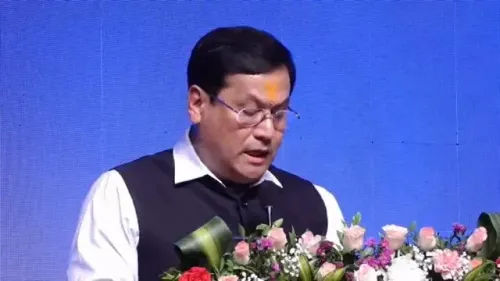
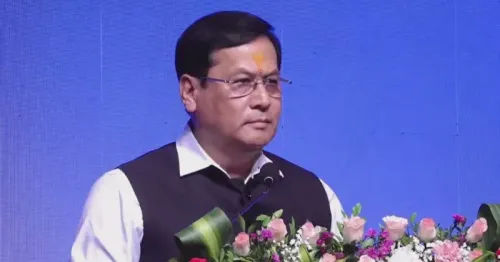
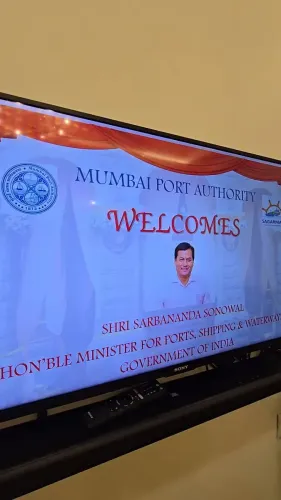
Ministerial announcement: Union Minister Sarbananda Sonowal made the announcement on 25 September 2026, crediting Prime Minister Narendra Modi's leadership.
Trade ambition: The government frames the Mega Port status as a step toward positioning India's coastline as a global trade and logistics anchor.
Next steps to watch: Formal criteria, capacity thresholds, and linked infrastructure investments such as multimodal logistics parks are expected to follow the notification.
Four of India's most strategically vital trade gateways just got a formal elevation that signals a new chapter for the country's maritime ambitions. Union Minister of Ports, Shipping and Waterways Sarbananda Sonowal announced on Friday, 25 September 2026 that the Government of India has officially notified Deendayal Port, Jawaharlal Nehru Port (Nhava Sheva), Paradip Port, and Mundra Port as 'Mega Ports' — a formal designation that places them in a distinct tier of national trade infrastructure.
Four ports, one formal tier — what the designation means
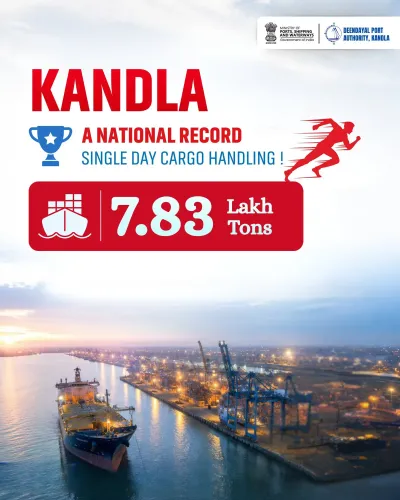
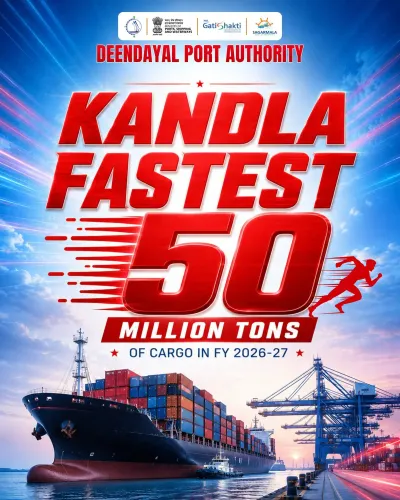
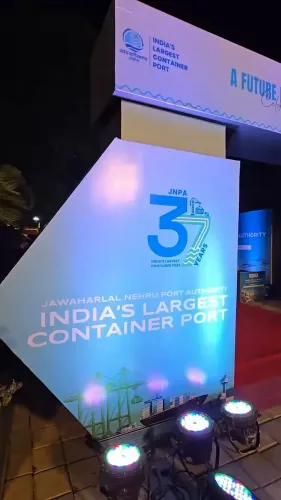
The move covers an extraordinary cross-section of India's cargo economy. Deendayal Port in Kandla, Gujarat, one of India's oldest major ports, handles bulk and liquid cargo critical to the country's energy and commodity supply chains. Jawaharlal Nehru Port at Nhava Sheva, Maharashtra, is India's largest container port — the western gateway through which a dominant share of containerised exports and imports flow. Paradip Port in Odisha anchors eastern India's bulk cargo trade, specialising in coal, iron ore, and fertilisers. And Mundra Port in Gujarat, India's largest private port operated by Adani Ports, rounds out a group that collectively touches virtually every major cargo category.
Together, these four handle an outsized share of India's total seaborne trade volume. The 'Mega Port' designation is a formal policy signal — not simply a rebranding — pointing toward differentiated capacity targets, governance frameworks, and infrastructure investment that the government intends to channel toward these hubs.
The policy arc: Sagarmala, Vision 2030, and port autonomy
This notification does not arrive in isolation. It is the latest step in a sustained, decade-long push to restructure India's maritime infrastructure from the ground up. The Sagarmala Project, launched in 2015, placed port-led development at the centre of India's logistics strategy, funding hundreds of projects across port modernisation, connectivity, and coastal economic zones. Maritime India Vision 2030, released in 2021, set hard capacity expansion and efficiency benchmarks for the sector. That same year, the Major Port Authorities Act 2021 granted major ports greater operational autonomy — reducing bureaucratic drag and enabling faster commercial decision-making.
The Mega Port notification is the next logical layer: identifying the highest-volume, highest-strategic-value nodes within the already-elevated 'major port' tier and signalling that they will be treated differently — in investment prioritisation, in regulatory attention, and in the infrastructure built around them.
Gujarat and Odisha in focus — and one private giant
The geographic and ownership spread of the four designated ports is itself a story. Two of the four — Deendayal and Mundra — sit in Gujarat, making the state the undisputed anchor of India's western maritime corridor. Mundra's inclusion is particularly notable: it is the only private port in the quartet, a marker of how India's port economy has evolved since liberalisation, with private operators now commanding cargo volumes that rival or exceed their public-sector counterparts.
Sonowal, expressing gratitude to Prime Minister Narendra Modi, framed the moment in expansive terms: 'India's coastline is ready to anchor global trade and drive the next wave of economic growth.' That framing connects the Mega Port designation directly to India's ambition to position itself as a global manufacturing and logistics hub — a goal that depends, critically, on the speed, capacity, and reliability of its ports.
What trade and shipping circles will watch next
The immediate question for exporters, shipping lines, and logistics operators is what concrete infrastructure commitments and regulatory benefits follow the notification. Multimodal logistics parks, deeper draft investments to accommodate ultra-large container vessels, and upgraded rail-port connectivity are all on the table under existing national programmes — and the Mega Port tag is expected to accelerate their prioritisation at these four locations. The full criteria, capacity thresholds, and linked project timelines are what the industry will press the ministry to detail in the weeks ahead.
India has been steadily climbing global port efficiency rankings. The Mega Port framework, if backed with matching capital and governance muscle, could be the instrument that closes the remaining gap with top-tier Asian port economies. The notification is on the books. The execution clock starts now.
Point of View
Allowing the Centre to channel differentiated investment, regulatory attention, and infrastructure linkages to its highest-volume trade nodes. The inclusion of Mundra, a private port, reflects the government's pragmatic acknowledgment that port capacity leadership in India is no longer exclusively a public-sector story. Placed within the decade-long Sagarmala-to-Vision-2030 arc, this designation signals that the Modi government is shifting from broad-based port modernisation to targeted, tiered excellence — a strategy more consonant with how competing Asian maritime economies have scaled. The real test will be whether the 'Mega Port' label is followed swiftly by hard capital commitments and measurable throughput targets.
NationPress
25 Sept 2026
Frequently Asked Questions
Which ports have been designated as Mega Ports in India?
The Government of India has notified four ports as 'Mega Ports': Deendayal Port in Kandla (Gujarat), Jawaharlal Nehru Port at Nhava Sheva (Maharashtra), Paradip Port in Odisha, and Mundra Port in Gujarat.
What does Mega Port status mean for a port?
The 'Mega Port' designation places a port in a distinct, elevated tier within India's port governance framework, expected to unlock differentiated investment priorities, infrastructure linkages such as multimodal logistics parks, and potentially enhanced operational autonomy — though full formal criteria are yet to be detailed.
Is Mundra Port a government port?
No. Mundra Port is India's largest private port, operated by Adani Ports and Special Economic Zone. It is the only private port among the four designated Mega Ports.
What is the Sagarmala Project and how does it relate to Mega Ports?
The Sagarmala Project, launched in 2015, is the Government of India's flagship programme for port-led development, funding modernisation, connectivity, and coastal economic zone projects. The Mega Port designation is part of the same broader policy arc that also includes Maritime India Vision 2030 and the Major Port Authorities Act 2021.
Which minister announced India's Mega Port designation?
Union Minister of Ports, Shipping and Waterways Sarbananda Sonowal announced the formal notification of the four Mega Ports on 25 September 2026, attributing the initiative to Prime Minister Narendra Modi's leadership.