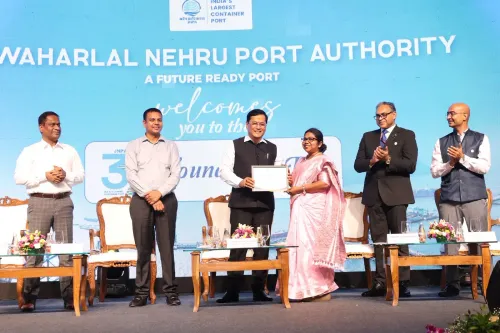
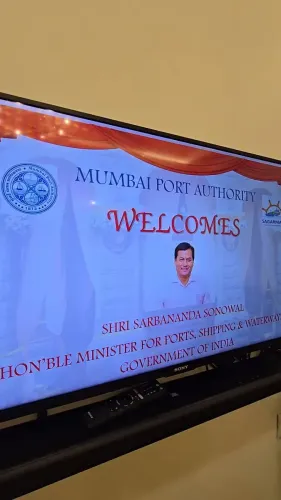
Sonowal Highlights JN Port-to-UP Freight Run as Global Benchmark
Synopsis
Union Minister Sarbananda Sonowal on 26 July 2026 cited a container moving from JN Port to Uttar Pradesh's Dadri and Khurja in roughly a day across 1,500 km as proof that India's port-freight networks now rival the fastest in the developed world.
Key Takeaways
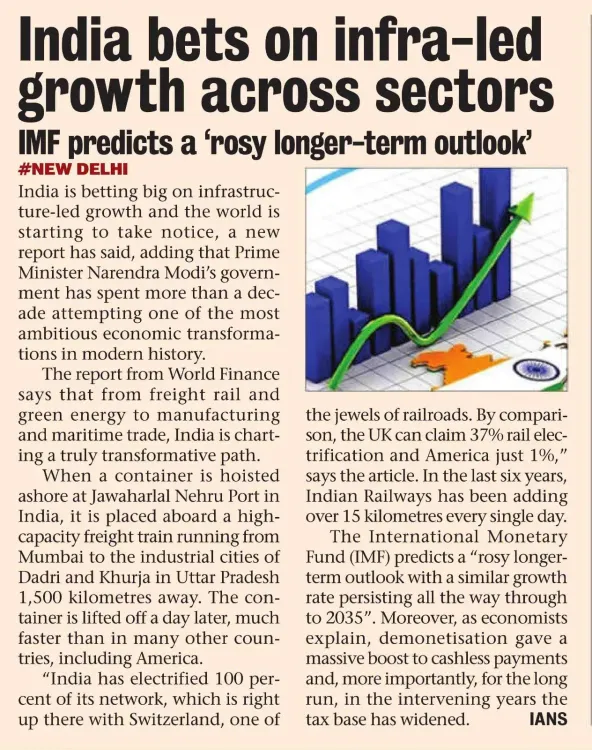
A container from JN Port reached Dadri and Khurja in Uttar Pradesh , roughly 1,500 km away, within a single day.
Minister Sonowal called the turnaround 'faster than many developed nations.' The movement used the Western Dedicated Freight Corridor , a key piece of infrastructure linking Mumbai's port hinterland to northern industrial clusters.
The IMF was cited as predicting a 'rosy longer-term outlook' for India with strong growth to 2035 .
The milestone connects to three overlapping policy frameworks: Sagarmala (2015) , PM Gati Shakti (2021) , and the National Logistics Policy (2022) .
Maritime India Vision 2030 and further WDFC capacity additions remain the key milestones to watch.
Union Minister of Ports, Shipping and Waterways Sarbananda Sonowal on Sunday, 26 July 2026 cited a live logistics demonstration — a container moving from Jawaharlal Nehru Port (JN Port) near Mumbai to industrial hubs in Uttar Pradesh within roughly a day — as evidence that India's maritime and freight networks are now setting global standards for speed and efficiency.
Context
In his post, Sonowal described a container being hoisted ashore at JN Port, loaded onto a high-capacity freight train, and delivered to the industrial towns of Dadri and Khurja in Uttar Pradesh — a distance of roughly 1,500 km — within a single day. He called the turnaround speed 'faster than many developed nations.' The minister also quoted the International Monetary Fund (IMF) as predicting a 'rosy longer-term outlook' for India, with strong growth persisting to 2035, linking this economic confidence directly to infrastructure investment.
Sonowal attributed the transformation to what he described as the 'visionary efforts and decadal push for infrastructure' by Prime Minister Narendra Modi, framing the freight milestone as a product of sustained policy direction rather than a one-off event.
Policy Backdrop
The port-to-hinterland freight corridor that enabled this movement has roots in at least three overlapping policy frameworks. The Sagarmala Project, launched in 2015, set the foundation for port modernisation and port-led economic development along India's coastline. The PM Gati Shakti National Master Plan, announced in 2021, aimed to integrate multimodal transport networks — road, rail, and waterways — under a single planning architecture.
The National Logistics Policy, released in 2022, added a cost-reduction target to the mix, seeking to bring India's logistics expenses — estimated at roughly 13-14 per cent of GDP at the time — closer to the 8 per cent benchmark seen in advanced economies. The Western Dedicated Freight Corridor (WDFC), which connects the port hinterland of western India to northern industrial clusters including Dadri, is the physical rail infrastructure that makes the kind of transit Sonowal described operationally possible.
JN Port, located at Nhava Sheva in Navi Mumbai, is India's busiest container port by volume and handles a significant share of the country's containerised export-import trade. Its integration with the WDFC has been a stated priority under Maritime India Vision 2030.
Stakeholders and Impact
The most direct beneficiaries of faster port-to-hinterland transit are exporters and manufacturers in Uttar Pradesh's industrial belt. Dadri hosts the Inland Container Depot (ICD) that serves as a key node on the WDFC, while Khurja is known for its ceramics and light-manufacturing clusters. Faster container turnaround reduces dwell time, cuts warehousing costs, and improves the competitiveness of goods in export markets.
Port operators and logistics service providers also stand to gain from higher throughput, as reduced transit cycles allow the same infrastructure to handle greater cargo volumes without proportional capacity additions. For the broader economy, lower logistics costs are seen as a structural enabler of manufacturing growth, particularly as India positions itself to attract supply chains diversifying away from other Asian manufacturing hubs.
What's Next
Attention will now turn to rollout milestones under Maritime India Vision 2030 and further capacity additions on the Western Dedicated Freight Corridor. The government has signalled plans to expand the number of port-linked ICDs and to increase the share of freight moved by rail rather than road, which carries both cost and emissions benefits. If the transit times cited by Sonowal can be replicated at scale and across multiple origin-destination pairs, it would represent a structural shift in India's logistics competitiveness — one that international investors and trade partners are likely to watch closely as the country targets a larger share of global merchandise trade through the rest of the decade.
Point of View
Concrete, time-stamped movement of a container. By invoking an IMF growth forecast in the same breath as a rail transit time, the minister is constructing a causal chain: infrastructure investment drives logistics efficiency, which drives economic credibility, which drives long-term growth. The choice of Dadri and Khurja as destinations is also pointed — both are in Uttar Pradesh, a politically critical state, signalling that the benefits of port-side investment are reaching the landlocked north. Whether the transit time cited can be consistently replicated at scale will determine whether this becomes a durable policy talking point or a one-off demonstration.
NationPress
25 Oct 2026
Frequently Asked Questions
How long did the container from JN Port take to reach Dadri and Khurja in UP?
According to Minister Sonowal's post, the container was loaded at JN Port and reached Dadri and Khurja in Uttar Pradesh — roughly 1,500 km away — within a single day.
What is the Western Dedicated Freight Corridor and how does it connect JN Port to UP?
The Western Dedicated Freight Corridor is a dedicated rail line linking the port hinterland of western India to northern industrial clusters. It connects JN Port near Mumbai to inland container depots including the one at Dadri in Uttar Pradesh, enabling high-speed, high-capacity freight movement without sharing tracks with passenger trains.
What is Sagarmala and how is it related to India's port logistics?
Sagarmala is a central government project launched in 2015 to modernise India's ports and promote port-led economic development. It laid the policy foundation for integrating ports with road, rail, and inland waterway networks to reduce logistics costs and transit times.
What did the IMF say about India's economic outlook?
Minister Sonowal cited the IMF as predicting a 'rosy longer-term outlook' for India, with strong growth persisting to 2035, linking this projection to the country's sustained infrastructure investment drive.
What is Maritime India Vision 2030?
Maritime India Vision 2030 is the government's long-term blueprint for the maritime sector, covering port capacity expansion, shipbuilding, inland waterways, and deeper integration of ports with freight corridors. It sets targets for India to become a leading global maritime nation by the end of the decade.