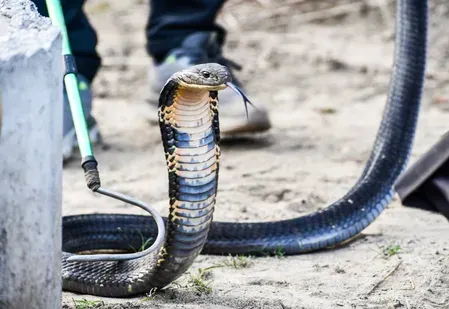
Spectacled cobra (Naja naja) genetically uniform across India, study finds
Synopsis
India's spectacled cobra looks different across regions — but genetically, it is one species. A new EVL study of nearly 100 snakes confirms a single panmictic population on the mainland, overturns the Asia-to-Africa migration theory, and could reshape how anti-venoms are designed for a snake that kills an estimated 58,000 Indians every year.
Key Takeaways
The Evolutionary Venomics Lab (EVL) sequenced genetic markers from nearly 100 spectacled cobras across India's major biogeographical zones.
Mainland Naja naja is a single, panmictic genetic population — no deep subdivision despite visible differences in colour, markings, and venom.
The genus Naja originated in Africa and entered South Asia during the Miocene epoch (23–5.3 million years ago), not the other way around.
The Sri Lankan N. naja is genetically distinct, having colonised the island from India when sea levels were lower.
The spectacled cobra contributes to an estimated 58,000 snakebite deaths in India annually; genetic uniformity simplifies anti-venom strategy.
In 2024 , the EVL developed a synthetic anti-venom aimed at reducing the number of formulations hospitals must stock.
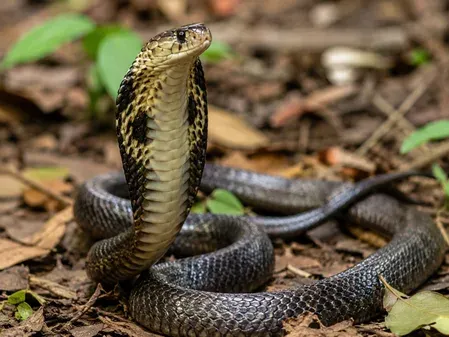
The Evolutionary Venomics Lab (EVL) has published landmark research on the spectacled cobra (Naja naja), establishing that despite striking visible differences in colour, markings, and venom composition, the snake forms a single, genetically connected population across mainland India. The findings carry significant implications for anti-venom development in a country where snakebites claim an estimated 58,000 lives annually.
What the Research Found
Researchers at the EVL sequenced nuclear and mitochondrial genetic markers from nearly 100 snakes sampled across the major biogeographical zones of the Indian subcontinent. The results revealed no evidence of deep genetic subdivision within mainland India — a condition scientists describe as a panmictic population, meaning the species interbreeds freely across its range despite geographic barriers such as rivers, mountains, and deserts.
'Across mainland India, the spectacled cobra appears to be largely one connected genetic population. Despite all the visible variation in colour, marking, ecology, and venom, the genetic data did not support the presence of multiple deeply separated species,' said Kartik Sunagar, associate professor at EVL and a lead researcher on the project.
African Origins, Not Asian
The study also overturns a long-held assumption about the cobra's migration history. Earlier theories suggested Naja naja moved from Asia to Africa. The EVL research concludes the reverse: the genus Naja originated in Africa and dispersed into South Asia during the Miocene epoch — between 23 and 5.3 million years ago — travelling through the Middle East. The species subsequently moved from India to Sri Lanka when sea levels were lower, creating a genetically distinct island population.
The Sri Lankan N. naja, the research notes, is genetically differentiated from its mainland counterpart — a distinction that matters for targeted anti-venom formulation.
Why Genetic Uniformity Matters for Anti-Venom
The spectacled cobra is one of India's 'big four' snakes — the quartet responsible for the overwhelming majority of snakebite fatalities in the country. Its near-countrywide distribution and variable venom composition had previously raised the possibility that different regional populations might require different anti-venoms.
The confirmation of genetic uniformity across the mainland simplifies that picture. 'If different populations have different venoms, evolutionary histories, or levels of relatedness, the knowledge can influence how we think of anti-venom, conservation and snakebite biology,' Sunagar explained.
Notably, in 2024, the EVL developed a synthetic anti-venom — part of a broader effort to reduce the number of anti-venom variants that need to be stocked at hospitals and clinics across India.
Broader Scientific Significance
The research paper, published by the EVL, describes N. naja as 'among the most iconic and clinically significant species' yet notes that 'its evolutionary history, phylogenetic diversity, and biogeographical origins remain poorly understood.' This study begins to fill that gap systematically.
Sunagar contextualised the stakes: 'When a species is spread across a vast area, rivers, mountains, deserts, climate, or sea-level changes can separate populations. Over thousands or millions of years, these isolated populations may evolve independently. Eventually, what we once called one species may turn out to be several.' The fact that this has not happened with mainland N. naja is itself a significant scientific result.
With snakebite mortality remaining a critical public health challenge in India, further genetic and venom-composition mapping of the spectacled cobra is expected to directly inform the next generation of anti-venom therapies.
Point of View
Hood markings, and venom, fuelling assumptions of cryptic species diversity. The data says otherwise, and that has a direct policy consequence: a single well-calibrated anti-venom formulation may suffice for the mainland, potentially cutting procurement costs and stockpile complexity for an already strained public health system. The Sri Lankan exception, however, is a reminder that island isolation can drive divergence even over relatively short geological timescales — and that the same analytical rigour now needs to be applied to the other three members of India's 'big four'. Snakebite remains a neglected tropical disease in India's public health discourse; studies like this are the foundation for changing that.
NationPress
26 Aug 2026
Frequently Asked Questions
What did the EVL study find about the spectacled cobra in India?
The Evolutionary Venomics Lab found that the spectacled cobra (Naja naja) forms a single, genetically connected population across mainland India, despite visible differences in colour, markings, and venom. Genetic markers from nearly 100 snakes showed no evidence of deep population subdivision.
Why does the genetic uniformity of the spectacled cobra matter?
It matters because anti-venom design depends on understanding venom variation across populations. If mainland cobras are one genetic population, a single well-targeted anti-venom formulation may be sufficient, simplifying production and hospital stockpiling across India.
Where did the spectacled cobra originally come from?
According to the EVL research, the genus Naja originated in Africa and dispersed into South Asia during the Miocene epoch, between 23 and 5.3 million years ago, travelling through the Middle East. This overturns earlier theories of an Asian-to-African migration.
Is the Sri Lankan spectacled cobra the same as the Indian one?
No. The Sri Lankan Naja naja is genetically distinct from its mainland Indian counterpart. Researchers believe it colonised the island from India when sea levels were lower, and subsequent isolation drove genetic differentiation.
How many people die from snakebites in India each year?
An estimated 58,000 people die from snakebites in India annually, with the spectacled cobra — one of the 'big four' species — responsible for a significant share of those fatalities. The EVL's genetic and synthetic anti-venom research is directly aimed at reducing this toll.