Stalin Backs Delhi Student Protests, Demands NEET Abolition
Synopsis
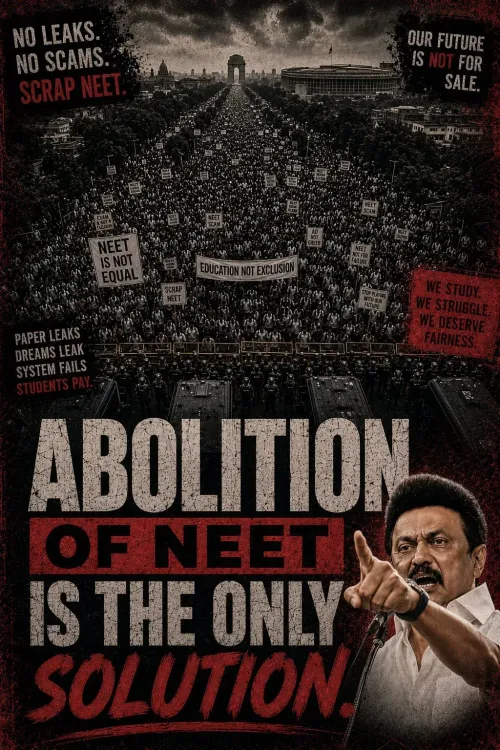
DMK president M. K. Stalin on 22 July 2026 backed New Delhi student protests against NEET, calling for its complete abolition. He cited Tamil Nadu's social-justice legacy and the DMK's long-standing opposition to the exam, arguing only scrapping NEET will resolve systemic inequities in medical admissions.
Key Takeaways
Stalin publicly backed student protests against NEET in New Delhi on 22 July 2026 .
Stalin declared that the DMK had warned of large-scale irregularities in NEET's design since the exam's inception.
Tamil Nadu passed a bill in 2021 seeking a permanent NEET exemption; it remains pending presidential assent.
The Supreme Court made NEET mandatory nationwide in 2016 , overriding state-level medical entrance tests.
Stalin invoked the First Constitutional Amendment of 1951 to frame Tamil Nadu as the historical defender of social justice in education.
The post called #AbolitionOfNEET the central demand that should anchor all ongoing student protests.
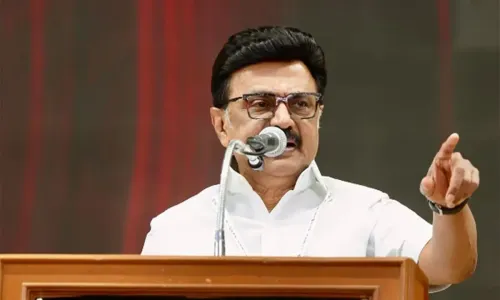
DMK president M. K. Stalin on Wednesday, 22 July 2026, threw his weight behind student protests in New Delhi against the National Eligibility cum Entrance Test (NEET), asserting that scrapping the exam is the only lasting solution to the systemic problems it has created. Stalin, posting on X, declared that the DMK had warned of large-scale irregularities in NEET's design from the very beginning and reiterated Tamil Nadu's singular demand: the complete abolition of NEET.
Context
In his post, Stalin wrote that 'the students' protest in New Delhi has now captured the attention of the entire country,' framing the demonstrations as a national inflection point. He invoked Tamil Nadu's historical role in defending social justice, pointing specifically to the state's contribution to the First Constitutional Amendment of 1951, which enabled special provisions for socially and educationally backward classes. His message closed with a direct call: 'Only scrapping NEET will provide a lasting solution to all these problems.'
The post carried the hashtags #AbolitionOfNEET, #BanNEET, and #SaveStudents, signalling an effort to consolidate protest energy around a single legislative demand rather than incremental reforms.
Policy Backdrop
The DMK and its predecessor state government, the AIADMK, have opposed NEET since its pilot phase around 2013, arguing that the centrally administered test disadvantages students from rural backgrounds and those who studied under the state-board curriculum. In 2016, the Supreme Court made NEET mandatory nationwide, effectively overriding state-level medical entrance examinations including those that had long been in use in Tamil Nadu.
The Tamil Nadu Legislative Assembly passed a bill in 2021 seeking a permanent exemption from NEET for state medical admissions. That legislation was reserved for presidential assent and has not received it, leaving the state's medical aspirants subject to the national exam. Stalin's statement on Wednesday renews pressure on the central government to act on that pending legislation or to legislate NEET's repeal outright.
Stakeholders and Impact
Tamil Nadu's medical aspirants — particularly those from rural districts and government schools studying under the state board — have long been identified as disproportionately affected by NEET's syllabus alignment with the CBSE curriculum. Social-justice advocates argue the exam undermines decades of reservation policy by introducing a uniform filter that does not account for structural educational inequalities.
The broader Dravidian political tradition, which has historically prioritised caste-based affirmative action and state-specific educational frameworks, sees NEET as a centralising instrument that erodes federal rights over education. Similar concerns have been raised by other southern states, making Tamil Nadu's demand a potential rallying point for a wider coalition.
What's Next
Stalin's intervention is likely to intensify parliamentary and public debate around the Tamil Nadu NEET exemption bill still awaiting presidential assent, as well as any related private member bills in the Lok Sabha and Rajya Sabha. Legal avenues — including review petitions before the Supreme Court — remain open to state governments seeking to challenge the exam's mandatory status.
With student protests in the capital drawing national attention, the political cost of inaction on NEET reform is rising. Whether the central government responds with a review, a constitutional amendment, or continued silence will shape the next phase of this long-running federal dispute over who controls the gateway to medical education in India.
Point of View
He is attempting to elevate a regional grievance into a pan-Indian federal rights argument. The timing pressures the central government ahead of any parliamentary session, making inaction on the pending NEET exemption bill politically more costly. It also reinforces the DMK's positioning as the ideological anchor of anti-NEET sentiment across southern states.
NationPress
22 Jul 2026
Frequently Asked Questions
Why is DMK against NEET?
The DMK has opposed NEET since its pilot phase around 2013 , arguing the centrally designed exam disadvantages rural students and those schooled under the Tamil Nadu state board curriculum, thereby undermining decades of reservation-based social justice policy.
What is the Tamil Nadu NEET exemption bill?
The Tamil Nadu Legislative Assembly passed a bill in 2021 seeking a permanent exemption from NEET for state medical admissions. The bill was reserved for presidential assent and has not yet received it, leaving Tamil Nadu students subject to the national exam.
What did M. K. Stalin say about NEET on 22 July 2026?
M. K. Stalin backed student protests in New Delhi and demanded the complete abolition of NEET , saying it was 'designed to enable large-scale irregularities' and that only scrapping it would provide a lasting solution.
Is NEET mandatory in India?
Yes. The Supreme Court made NEET mandatory for all medical admissions across India in 2016 , overriding individual state-level entrance examinations including those previously used in Tamil Nadu .
What is the First Constitutional Amendment and why does Tamil Nadu cite it?
The First Constitutional Amendment of 1951 enabled special provisions for socially and educationally backward classes in education and public employment. Tamil Nadu cites it to establish its historical role in pioneering affirmative action and to argue that uniform national tests like NEET undermine that constitutional commitment.