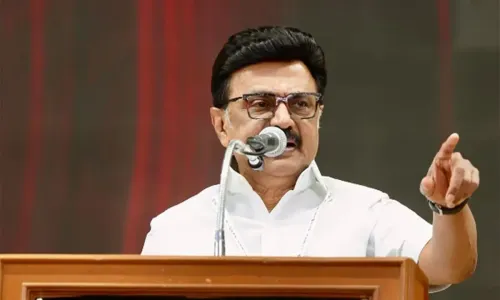
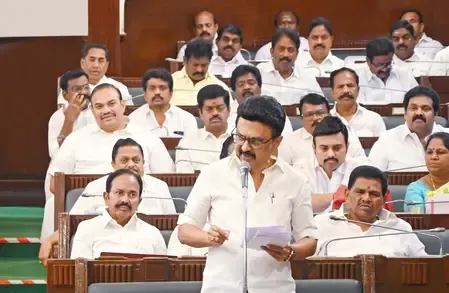
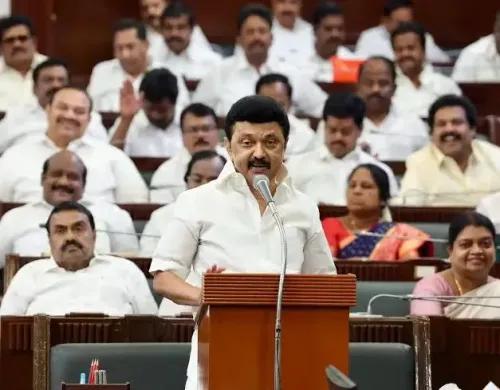
Stalin calls for NEET abolition, says it has failed on all counts
Synopsis
DMK president M. K. Stalin on 23 July 2026 demanded the abolition of NEET, arguing in a published op-ed that the exam has failed all three of its founding promises — reducing student burden, eliminating commercialisation, and improving standards — and called on the Union Government to trust states with medical admissions.
Key Takeaways
Stalin publicly called for the abolition of NEET on 23 July 2026 via a published op-ed and a post on X.
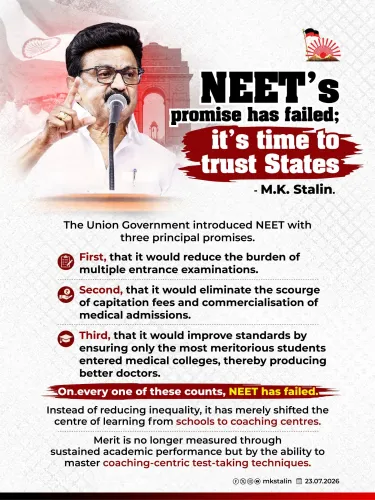
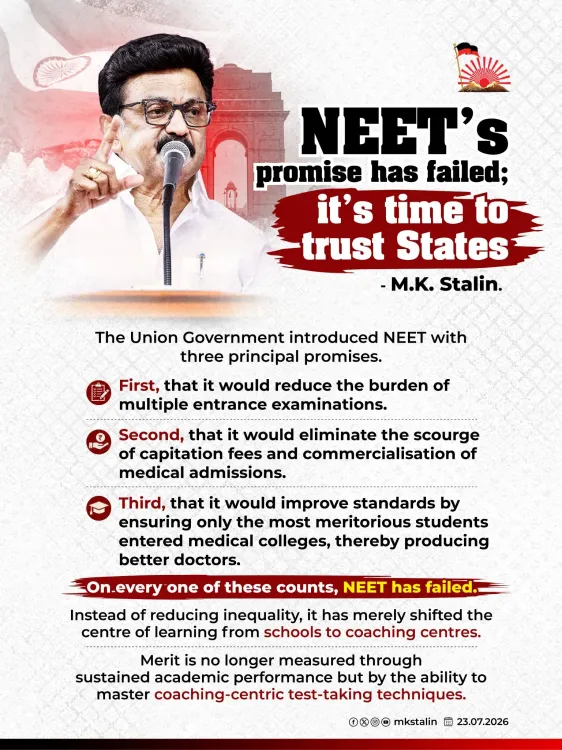
He argued NEET has failed on all three of its original promises: reducing burden, eliminating commercialisation, and improving standards.
Stalin stated the exam has 'merely shifted the centre of learning from schools to coaching centres,' calling the problem structural rather than procedural.
Tamil Nadu has opposed NEET since 2017 , when the state assembly passed a bill seeking exemption that did not receive presidential assent.
A state-constituted high-level committee in 2021–22 had already recommended scrapping NEET and restoring state control over medical admissions.
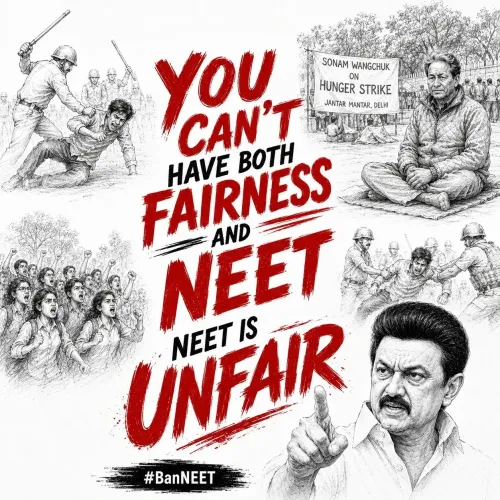
Stalin cited ongoing student protests as a 'wake-up call' for the Union Government and demanded it trust states to manage their own admissions.
DMK president M. K. Stalin on Thursday, 23 July 2026, publicly called for the abolition of the National Eligibility cum Entrance Test (NEET), arguing in an op-ed that the examination has failed to deliver on every one of its founding promises and that the Union Government must now trust states to manage their own medical admissions.
Context
Stalin wrote that NEET was introduced with three core promises: reducing the burden on students, eliminating commercialisation in medical admissions, and improving academic standards. In his assessment, the exam has failed on all three counts. 'It has merely shifted the centre of learning from schools to coaching centres,' he wrote, pointing to a structural — not merely procedural — flaw at the heart of the policy.
He added that 'recent events' and ongoing student protests must serve as a 'wake-up call' for the Union Government, and concluded with a direct demand: 'It's time to trust the states. It's time to abolish NEET.'
Policy Backdrop
NEET was declared the sole medical entrance examination by the Supreme Court of India in 2016, replacing a patchwork of state-level tests. Tamil Nadu has been among the most persistent opponents of the exam since its inception. The Tamil Nadu Legislative Assembly passed a bill in 2017 seeking an exemption from NEET on social equity grounds, but the legislation did not receive presidential assent.
In 2021–22, the state government constituted a high-level committee that formally recommended scrapping NEET and restoring state control over admissions. The DMK has long argued that the exam disadvantages rural students, first-generation learners, and those from economically weaker sections who cannot afford the high-cost coaching ecosystem that the test has spawned.
The broader debate mirrors centre-state friction visible in resistance to other centralised tests such as the Common University Entrance Test (CUET), with non-BJP-ruled states contending that national entrance exams erode regional autonomy and contradict the social justice frameworks embedded in state education policy.
Stakeholders and Impact
The primary stakeholders are the hundreds of thousands of medical aspirants who appear for NEET each year, particularly students from Tamil Nadu's government schools who have historically been disadvantaged against peers from well-resourced urban coaching institutes. State education departments across opposition-ruled states also have a direct interest, as the outcome of any legal or legislative action on NEET would determine their authority over admissions policy.
Stalin's intervention carries political weight beyond Tamil Nadu. As one of the most prominent voices in the anti-NEET movement, his op-ed is likely to reinforce calls from other opposition-ruled states for a re-examination of centralised education policy. The Dravidian tradition's emphasis on school-based, socially inclusive learning sits in direct tension with a coaching-driven national examination model.
What's Next
Attention will now turn to any fresh hearings in the Supreme Court on pending NEET petitions filed by Tamil Nadu, as well as possible Assembly resolutions or renewed exemption bills from opposition-governed states. Student protests, which Stalin cited as a catalyst, may intensify pressure on the Union Government to respond formally to demands for structural reform or state-level autonomy in medical admissions.
If the Centre continues to resist, the issue is likely to become a flashpoint in the ongoing debate over cooperative federalism — and a mobilising issue for the DMK and allied parties ahead of future electoral contests.
Point of View
Timed to ride the momentum of student unrest and reframe the issue as a structural indictment rather than a procedural grievance. By anchoring his argument in NEET's own stated promises, he neutralises the standard defence that the exam merely needs better implementation. The intervention also serves a broader political purpose: consolidating opposition-ruled states around an education-federalism platform at a moment when centre-state tensions are already elevated. Whether the Union Government treats this as a serious policy signal or a partisan position will shape the next phase of the NEET debate.
NationPress
23 Jul 2026
Frequently Asked Questions
Why does MK Stalin want to abolish NEET?
Stalin argues that NEET has failed on all three of its founding promises — reducing student burden, eliminating commercialisation, and improving standards — and has instead shifted learning from schools to expensive coaching centres, disadvantaging rural and first-generation students.
What is Tamil Nadu's history with NEET?
Tamil Nadu has opposed NEET since the Supreme Court made it mandatory in 2016. The state assembly passed an exemption bill in 2017 that did not receive presidential assent, and a high-level committee in 2021–22 formally recommended scrapping the exam and restoring state control over medical admissions.
What does 'trust the states' mean in the NEET debate?
It means allowing individual state governments to design and conduct their own medical entrance examinations, as they did before 2016, rather than being subject to a single centrally administered test.
Has NEET been abolished anywhere in India?
As of the available public record, no state has been granted a formal, legally operative exemption from NEET, though Tamil Nadu's legislative efforts to seek one have been the most sustained in the country.
What are the student protests about NEET demanding?
Stalin referenced ongoing student protests as evidence that NEET's structural problems have reached a crisis point, calling them a 'wake-up call' for the Union Government, though the specific demands of the July 2026 protests have not been independently detailed in verified public record.