Stalin honours Panagal Raja, calls his reforms foundation of Dravidian model
Synopsis
DMK president M. K. Stalin marked Panagal Raja's birth anniversary on 9 July 2026, crediting the Justice Party leader's 1920s reforms — communal reservations, temple oversight, women's franchise, and Sanskrit-free medical education — as the foundation of the Dravidian model of social justice.
Key Takeaways
Stalin paid tribute to Panagal Raja on his birth anniversary on 9 July 2026 , invoking Periyar's praise of the Justice Party leader.
Stalin credited a book on Panagal Raja with inspiring Kalaignar Karunanidhi's entry into politics.
The 1921 Communal Government Order introduced class-wise reservations in education and public employment across the Madras Presidency.
The Madras Hindu Religious Endowments Act of 1927 brought temple administration under state oversight, curbing hereditary priestly control.
The Justice Party also extended women's franchise and removed the mandatory Sanskrit requirement for medical education in the 1920s.
Stalin called on supporters to protect these historic rights 'as they would their own lives,' framing them as actively contested gains.
DMK president M. K. Stalin on Thursday, 9 July 2026, paid tribute to Panagal Raja on his birth anniversary, calling the early 20th-century Justice Party leader's reforms the bedrock of the Dravidian model of social justice. Stalin also recalled that a book on Panagal Raja first sparked the political interest of DMK patriarch Kalaignar M. Karunanidhi.
Context
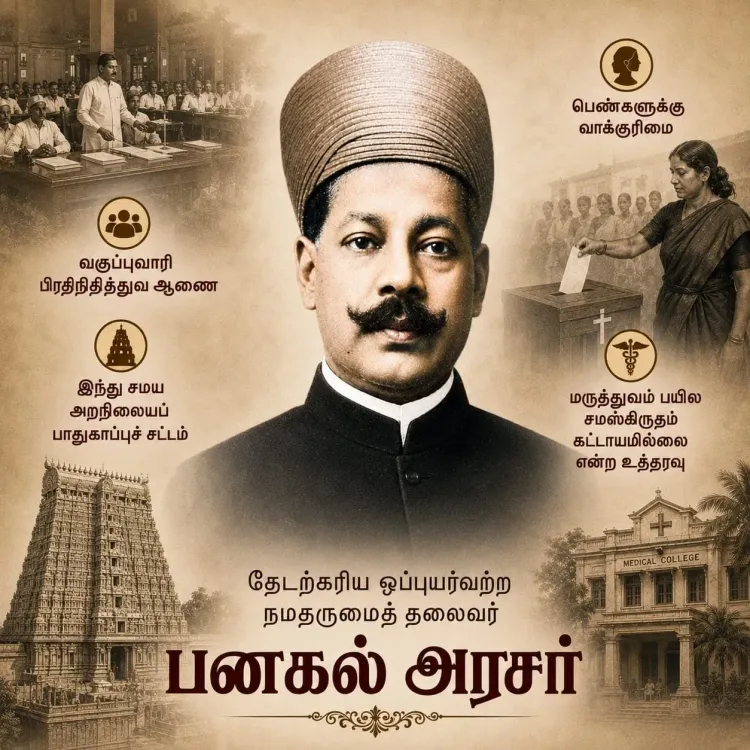
Sir Panaganti Ramarayaningar, the Raja of Panagal, was a towering figure in the Justice Party — formally the South Indian Liberal Federation — which governed the Madras Presidency from 1920 and championed non-Brahmin interests in education, employment, and public life. Stalin quoted the praise of social reform icon Periyar E. V. Ramasamy, who described Panagal Raja as 'thedarkkariya oppuyarvaratra namadaiumaittalaiver' ('our incomparable, rare and beloved leader'), to underscore the historical reverence for him within the Dravidian movement.
Stalin noted that a book on Panagal Raja was directly credited by Kalaignar Karunanidhi himself with kindling his entry into politics — a lineage that ties the DMK's founding generation to the Justice Party's early struggle against caste hierarchy.
Policy Backdrop
Stalin's post specifically highlighted four landmark measures from Panagal Raja's tenure. The Communal Government Order of 1921 introduced class-wise reservations in education and public employment across the Madras Presidency, laying the structural foundation for what became India's reservation system. The Madras Hindu Religious Endowments Act of 1927 placed temple administration under state oversight, curbing hereditary priestly control — a reform whose successor legislation, the Hindu Religious and Charitable Endowments Act, remains a live political issue in Tamil Nadu today.
The Justice Party also progressively extended women's franchise through legislative changes in the mid-1920s and issued an order removing the mandatory requirement to study Sanskrit in order to pursue a medical education — a move that widened access to professional degrees for non-Brahmin and lower-caste students.
Stakeholders and Impact
The communities most directly shaped by these reforms — non-Brahmin communities, Other Backward Classes, and women — remain the core social coalition of the DMK. By invoking Panagal Raja, Stalin is reinforcing the party's claim to an unbroken ideological lineage stretching from the Justice Party's founding in 1916 through Periyar's Self-Respect Movement to the DMK's own governance record since 1967.
Stalin closed his post with a call to action: 'Nam kolvai munnoargal namakku petruthanda urimaigalai uyirena kaapom!' — 'Let us protect the rights our ideological forebears won for us as we would protect our own lives!' The statement signals that the DMK views these historic gains as actively contested, not merely commemorated.
What's Next
References to the 1921 Communal Government Order and the Hindu Religious Endowments Act are expected to resurface in the Tamil Nadu Legislative Assembly as debates over reservation policy and temple administration continue. The tribute also sets the rhetorical stage for the DMK to defend its social-justice credentials ahead of future electoral cycles, framing any rollback of reservation or temple reform as a betrayal of a century-old Dravidian compact.
Point of View
Anchoring the DMK's present-day social-justice agenda in a century-old reform tradition that predates the party itself. By invoking Periyar's endorsement of Panagal Raja and linking Karunanidhi's political birth to the Justice Party's legacy, Stalin constructs an unbroken Dravidian lineage that is difficult for rivals to contest. The closing call to 'protect these rights as our own lives' is a coded signal that the party regards reservation policy and temple administration as non-negotiable — issues likely to dominate the Tamil Nadu assembly's next session. Such tributes have become a recurring instrument in Tamil Nadu's political vocabulary, where historical legitimacy is as electorally potent as current governance performance.
NationPress
9 Jul 2026
Frequently Asked Questions
Who was Panagal Raja and why is he important in Tamil Nadu politics?
Panagal Raja, formally Sir Panaganti Ramarayaningar, was a Justice Party leader who served as a minister in the Madras Presidency in the 1920s. He is remembered for pioneering communal reservations, state oversight of temples, and women's franchise — reforms that the DMK and other Dravidian parties cite as the origin of their social-justice ideology.
What is the 1921 Communal Government Order that Stalin mentioned?
The 1921 Communal Government Order, issued under the Justice Party government of the Madras Presidency, introduced class-wise reservations in education and public employment for non-Brahmin communities. It is widely regarded as the forerunner of India's modern reservation system.
How is Panagal Raja connected to Kalaignar Karunanidhi?
Karunanidhi credited a book about Panagal Raja with inspiring his interest in politics, making the Justice Party leader a symbolic intellectual ancestor of the DMK. Stalin referenced this connection in his 9 July 2026 tribute to underline the party's historical lineage.
What did the Madras Hindu Religious Endowments Act of 1927 do?
The Act placed temple administration in the Madras Presidency under state oversight, reducing the hereditary control of priestly families over temple finances and management. Its successor legislation continues to govern Tamil Nadu's temples and remains a politically sensitive subject.
Why does the DMK frequently invoke the Justice Party's legacy?
The DMK traces its ideological roots to the non-Brahmin mobilisation of the early 20th century, of which the Justice Party was the first organised political expression. Invoking this legacy helps the party claim historical ownership of reservation policy, temple reform, and social-justice measures that remain central to Tamil Nadu's political debates.