Stalin Pays Tribute to VOC, Warns Against Letting Legacy Fade
Synopsis
DMK president M. K. Stalin marked the memory of freedom fighter V. O. Chidambaram Pillai on 18 November 2026, honouring the founder of the Swadeshi Steam Navigation Company and warning the current Tamil Nadu government not to let DMK-era VOC legacy programmes lapse.
Key Takeaways
Stalin paid tribute to V.
Chidambaram Pillai (VOC) on 18 November 2026 .
Pillai founded the Swadeshi Steam Navigation Company in 1906 , challenging British colonial shipping dominance.
Stalin highlighted VOC's roles as anti-colonial entrepreneur, labour-rights pioneer, torture survivor, and Tamil literary patron.
Stalin warned the current 'U-Turn' government not to allow DMK's VOC commemoration initiatives to slow down.
The tribute is part of the DMK's broader Dravidian Model political identity, which centres Swadeshi-era Tamil icons in governance and education.
The post signals continued DMK scrutiny of how the state maintains memorials, curricula, and institutional names linked to VOC.
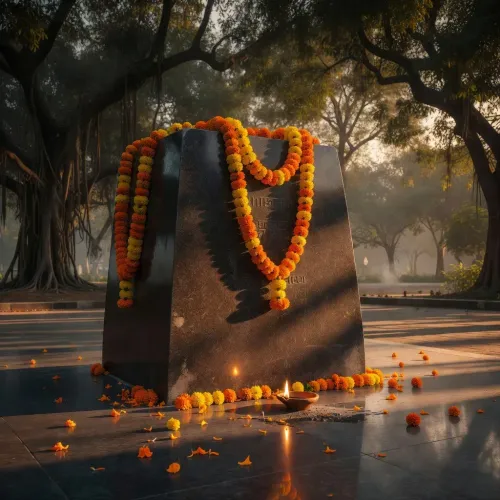
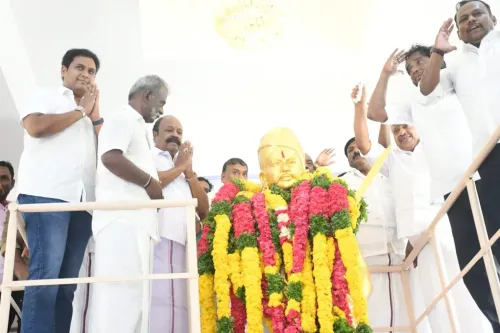
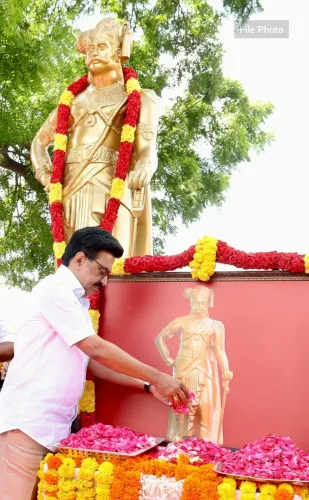
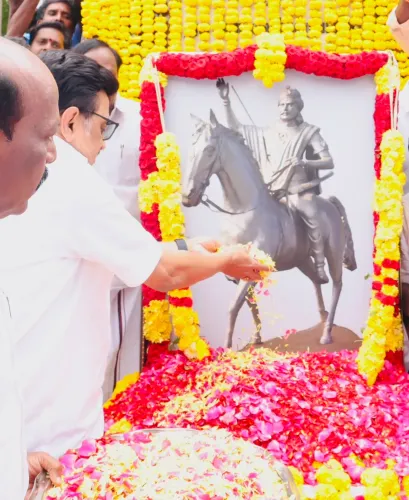
A freedom fighter who defied the British Empire with a steamship and paid for it with prison and forced labour — DMK president M. K. Stalin marked the memory of V. O. Chidambaram Pillai on Wednesday, 18 November 2026, with a tribute that doubled as a pointed political warning: the work of honouring Tamil Nadu's anti-colonial icons must not be allowed to slow down.
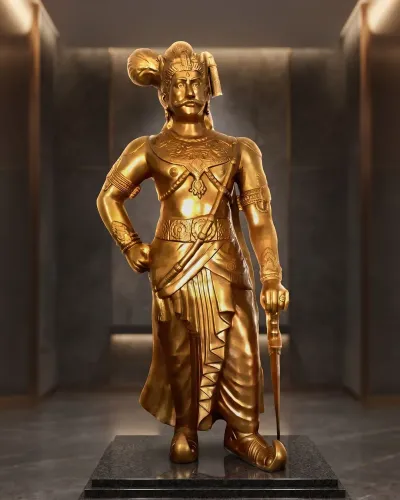
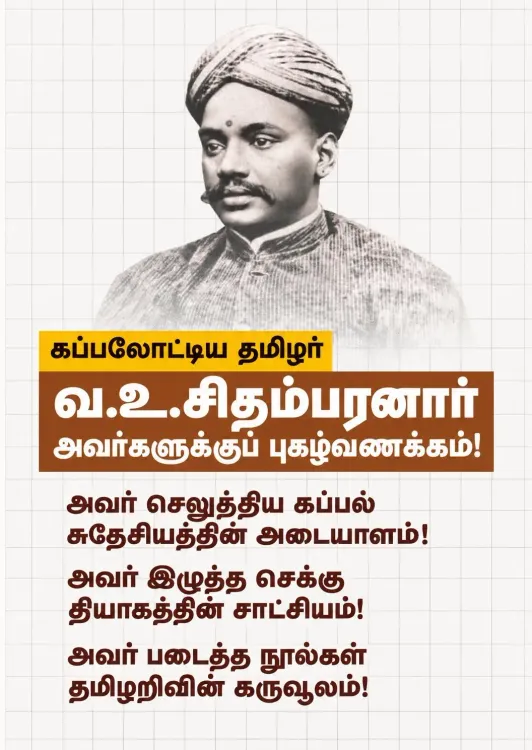
Posting in Tamil, Stalin saluted Pillai — reverentially known as Kappalottiya Tamilan (the Tamil who steered the ship) — across four distinct dimensions of his life: as the man who launched the Swadeshi Steam Navigation Company to shatter a British shipping monopoly, as a champion of workers' rights, as a prisoner who endured the grinding torture of the sekku (oil-press) and yet never surrendered his convictions, and as a scholar who nurtured classical Tamil literature even from behind prison bars.
The Man Behind the Legend: VOC and the Swadeshi Steamship
V. O. Chidambaram Pillai, born in Thoothukudi, founded the Swadeshi Steam Navigation Company in 1906 — a direct challenge to the British India Steam Navigation Company's stranglehold on the coastal trade between Thoothukudi and Colombo. It was an act of economic insurgency at a time when the colonial state controlled almost every lever of commerce. He also organised labour strikes among Coral Mill workers in Thoothukudi, making him one of India's earliest trade-union pioneers. The British arrested him, sentenced him to hard labour, and subjected him to the oil-press — a punishment that became a symbol of colonial brutality and Tamil resilience in equal measure.
Tamil Nadu's ruling parties have long competed to claim ownership of such Swadeshi-era icons, and the DMK has consistently framed VOC's legacy as central to its Dravidian model of governance — expanding memorials, naming institutions after him, and weaving his story into school curricula.
Stalin's Dig at the 'U-Turn' Government
The tribute was not purely ceremonial. Stalin's post carried an unmistakable political edge, warning that the commemorative and educational efforts undertaken by the DMK administration must not be allowed to 'wither away' under what he called the current 'U-Turn' government — his sharp shorthand for political opponents he accuses of reversing the DMK's development agenda. Without naming any individual, he insisted: 'The ideological footprint he left on our soil shall never be erased by time.'
The remark places the question of VOC's legacy squarely in the arena of live political contestation. Whether the state's education department, archaeology department, and public institutions continue — or quietly scale back — existing VOC commemoration projects, curriculum content, and memorial upkeep will be a concrete test of that claim.
Why the Kappalottiya Tamilan Still Commands the Political Imagination
In Tamil political culture, V. O. Chidambaram Pillai is not a footnote — he is a founding myth. His story fuses three currents that animate Dravidian politics simultaneously: economic self-reliance, workers' rights, and Tamil cultural pride. Any government that lets his memorials decay or his curriculum presence shrink faces a credibility cost that rivals in Tamil Nadu are quick to exact. Stalin is signalling, in advance, that he is watching — and so are DMK's supporters.
Point of View
He frames any future rollback as an affront to Tamil pride rather than a mere policy adjustment. The 'U-Turn' label is a recurring DMK branding device designed to impose a credibility cost on rivals before they act. In Tamil Nadu's intensely competitive identity politics, Swadeshi-era icons like VOC function as shared sacred ground — which is precisely why staking a visible, public claim to them carries outsized strategic value ahead of any electoral cycle.
NationPress
18 Nov 2026
Frequently Asked Questions
Who is V. O. Chidambaram Pillai?
V. O. Chidambaram Pillai, also known as VOC or Kappalottiya Tamilan (the Tamil who steered the ship), was a Tamil freedom fighter who founded the Swadeshi Steam Navigation Company in 1906 to challenge British colonial shipping monopolies and was one of India's earliest trade-union organisers.
Why is VOC called Kappalottiya Tamilan?
He earned the title 'Kappalottiya Tamilan' — meaning 'the Tamil who steered the ship' — because he launched and operated the Swadeshi Steam Navigation Company, running steamships on the Thoothukudi–Colombo route in direct defiance of the British India Steam Navigation Company's monopoly.
What did MK Stalin say about VOC on 18 November 2026?
DMK president M. K. Stalin paid tribute to V. O. Chidambaram Pillai, praising him as a Swadeshi shipping pioneer, a workers'-rights champion, a man who endured colonial torture without breaking, and a Tamil literary patron — and warned the current government not to let DMK's VOC commemoration efforts stall.
What is the Swadeshi Steam Navigation Company?
Founded by V. O. Chidambaram Pillai in 1906 in Thoothukudi, the Swadeshi Steam Navigation Company was India's first Indian-owned shipping company, set up to break the British India Steam Navigation Company's monopoly on the coastal trade between Thoothukudi and Colombo.
What is DMK's Dravidian Model of governance?
The Dravidian Model is the DMK's governing framework emphasising social justice, regional identity, Tamil cultural pride, and welfare-driven policy — with icons like VOC positioned as ideological ancestors of that tradition.