CM Fadnavis Busts Interstate Racket Targeting Women Sarpanches
Synopsis
Chief Minister Devendra Fadnavis acted on a live complaint from women sarpanches at Lohari Sawanga, directing Nagpur police to investigate threats made under a fake newspaper name. The crackdown uncovered three illegal call centres in Bhopal and resulted in four arrests.
Key Takeaways
CM Devendra Fadnavis personally received the complaint at a public interaction at Lohari Sawanga and directed immediate police action.
Threats were made in the name of 'Dainik Shreshtha News' , demanding money under the pretext of advertisement payments.
Nagpur rural police traced the operation to Bhopal, Madhya Pradesh , uncovering three illegal call centres .
Four women accused were arrested in connection with the interstate extortion racket.
The case highlights the vulnerability of women sarpanches — elected panchayat heads — to organised intimidation using fake media identities.
Cross-state police coordination enabled swift arrests before the network could relocate or destroy evidence.
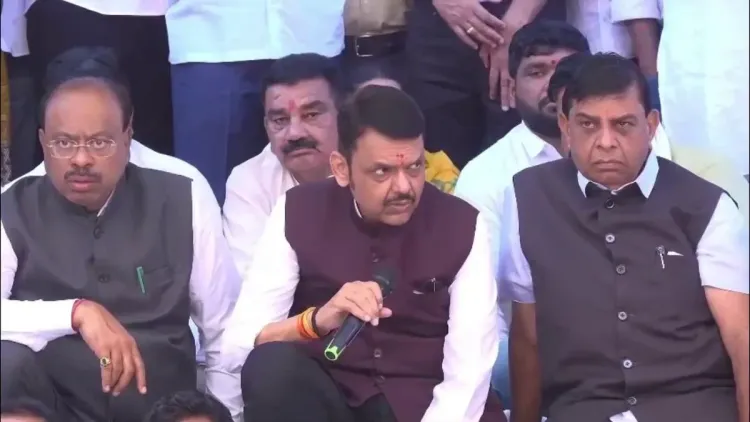
A phone call at a public meeting in rural Maharashtra has cracked open an interstate extortion network. During an interaction with local representatives at Lohari Sawanga, women sarpanches raised a complaint with Chief Minister Devendra Fadnavis about threatening phone calls being made in the name of a publication called 'Dainik Shreshtha News' — demanding money under the guise of advertisement dues, on 18 November 2026.
From a village complaint to Bhopal arrests
Fadnavis did not wait for the complaint to travel up a bureaucratic ladder. He directed the district Superintendent of Police to act immediately. Nagpur rural police moved fast — investigators traced the operation across state lines into Madhya Pradesh, uncovering three illegal call centres in Bhopal. Four women accused linked to the racket were subsequently arrested.
The post from the Chief Minister's Office of Maharashtra described it as the busting of an आंतरराज्यीय खंडणीखोर टोळी — an 'interstate extortion gang' — a phrase that underscores both the scale and the deliberate cross-border structure of the operation.
Women sarpanches as a pressure point
The targeting of women elected heads of village panchayats is not incidental. Women sarpanches — a category whose numbers have grown significantly under mandatory reservation in the panchayati raj system — often manage local government budgets and public works, making them visible targets for intimidation. Fake media identity is a known tactic: a threatening call 'from a newspaper' carries implicit reputational menace, pressuring elected officials to pay rather than risk adverse coverage in their constituencies.
Cross-state call-centre fraud of this kind has emerged as a recurring law-enforcement headache across central India, with operations typically headquartered in one state while targeting victims in another — deliberately complicating jurisdiction.
Swift coordination between Maharashtra and Madhya Pradesh
What is notable here is the speed of the response chain: a floor-level complaint at a public interaction reached the Chief Minister, who converted it into a police directive within hours. Nagpur police then coordinated a cross-state investigation that reached Bhopal — the capital of Madhya Pradesh — and dismantled multiple illegal call centres before the network could scatter.
Investigators are expected to pursue follow-up chargesheets, and there may be directives to district administrations across Maharashtra to create a reporting mechanism for sarpanches facing similar threats.
An extortion racket that banked on a sarpanch's silence has instead handed the Chief Minister a headline — and the police a template for what rapid cross-state action can look like.
Point of View
Fadnavis demonstrates a governance model where the chief minister's office functions as a rapid-action escalation channel — a posture with political dividends in rural Maharashtra. The Bhopal nexus also points to a larger law-enforcement gap: call-centre-based extortion deliberately straddles state boundaries to evade jurisdiction, suggesting a need for standing coordination protocols between state police forces rather than ad hoc crisis responses.
NationPress
18 Nov 2026
Frequently Asked Questions
What is the extortion racket targeting women sarpanches in Maharashtra?
An interstate gang operated illegal call centres in Bhopal and made threatening phone calls to women sarpanches in Maharashtra, demanding money under the pretext of advertisement payments for a fake publication called 'Dainik Shreshtha News'.
How did CM Devendra Fadnavis respond to the complaints?
CM Fadnavis received the complaint directly at a public interaction at Lohari Sawanga and immediately directed the Nagpur district Superintendent of Police to investigate, leading to swift arrests.
How many people were arrested and where were the call centres found?
Four women accused were arrested and three illegal call centres were uncovered in Bhopal, the capital of Madhya Pradesh.
Why are women sarpanches targeted by extortion gangs?
Women sarpanches manage local government budgets and public works under the panchayati raj system, making them visible targets. Threats made under a newspaper's name also carry implicit reputational risk, pressuring them to pay rather than seek help.
What could happen next in the Nagpur police Bhopal call centre case?
Investigators are expected to file chargesheets and there may be further arrests. District administrations across Maharashtra could also receive directives to set up reporting mechanisms for sarpanches facing similar threats.