CM Sukhu forms commission to redraw HP's district boundaries

Synopsis
Himachal Pradesh CM Sukhvinder Singh Sukhu has formed a commission to study all districts, tehsils and blocks for potential reorganisation, including boundary changes, responding sharply to opposition criticism by invoking the courage to take on administrative challenges.
Key Takeaways
CM Sukhvinder Singh Sukhu announced a new commission on October 18, 2026 to study administrative reorganisation across Himachal Pradesh .
The commission will examine all blocks, tehsils and districts on geographical and multi-dimensional parameters before any recommendations are made.
Possible outcomes include creation of new districts, redrawing of tehsil and SDM-zone boundaries, and inter-district area transfers.
Himachal Pradesh currently has 12 districts , a structure largely unchanged since statehood.
Sukhu directly challenged the opposition, framing administrative boldness as a test of political courage.
No reorganisation decision will be taken until the commission completes its geographic and administrative study.
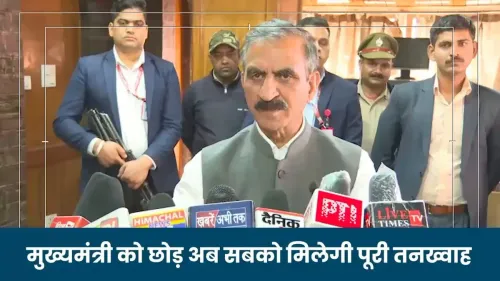
Himachal Pradesh Chief Minister Sukhvinder Singh Sukhu threw down a direct challenge to the opposition on Sunday, October 18, 2026 — and backed it with a structural move: a freshly constituted commission tasked with studying every block, tehsil and district in the state before recommending wholesale administrative reorganisation.
Speaking pointedly at critics, Sukhu said: 'I want to tell the opposition that challenges are faced only by those who have the courage — and that courage is in us.' The message was unmistakably aimed at those questioning his government's administrative ambitions.
What the commission will actually do
The commission's mandate is sweeping. It will examine every block, tehsil and district through a geographical and multi-dimensional lens — terrain, connectivity, population spread, service-delivery gaps — before arriving at any recommendations. Only after the commission reports, Sukhu said, will the government decide whether to create new districts, redraw tehsil boundaries, reconfigure Sub-Divisional Magistrate (SDM) zones or restructure development blocks.
Critically, boundary changes are explicitly on the table. If evidence warrants it, areas currently under one district could be transferred to an adjacent one — a provision that addresses long-standing local grievances in Himachal's rugged mountain corridors where administrative reach has historically been uneven.
Why Himachal's geography makes this urgent
Himachal Pradesh currently comprises 12 districts, a structure that has remained largely unchanged since statehood. The state's terrain — deep valleys, high-altitude passes, remote tribal pockets — means that residents in outlying areas often travel impractical distances to reach the nearest tehsil office or district headquarters. Periodic district reorganisation is a recognised governance tool across Indian states, but Himachal's mountainous reality makes the case more acute than most.
Past state governments considered but rarely acted on boundary rationalisation at this scale. By commissioning a formal geographic study first, Sukhu is setting up a process-driven, evidence-backed sequence — a deliberate contrast to ad hoc reorganisations that have drawn political fire elsewhere in India.
The political subtext
The opposition has questioned both the necessity and the timing of the reorganisation push. Sukhu's combative framing — 'courage' versus political timidity — signals he intends to own this as a governance signature, not cede it as a liability. Administrative reorganisation in India almost always carries local electoral implications: new districts and tehsils shift patronage networks and voter-identification patterns. The commission's findings, whenever they arrive, will land squarely in that charged terrain.
For now, the ball is with the commission. What it recommends will determine whether Himachal Pradesh's map looks different in the months ahead — and whether Sukhu's gamble on bold governance pays off at the ballot box.
Point of View
He also turns a technocratic exercise into a political asset. The broader arc here is Congress using proactive governance signals in Himachal to counter a narrative of administrative drift in a fiscally stretched state. Watch whether the commission's timeline accelerates as the next assembly election cycle draws nearer.
NationPress
18 Oct 2026
Frequently Asked Questions
Why is Himachal Pradesh forming a commission to redraw district boundaries?
CM Sukhu announced the commission to conduct a comprehensive geographical and administrative study of all districts, tehsils and blocks before deciding on any reorganisation — aimed at improving governance reach in the state's difficult mountain terrain.
How many districts does Himachal Pradesh currently have?
Himachal Pradesh currently has 12 districts , a structure that has remained largely unchanged since the state was formed.
Will Himachal Pradesh get new districts after this commission?
That depends on the commission's findings. CM Sukhu said new districts, revised tehsil boundaries, restructured SDM zones or block-level changes will only be considered after the commission completes its multi-dimensional study.
What did CM Sukhu say to the opposition about district reorganisation?
Sukhu said: 'I want to tell the opposition that challenges are faced only by those who have the courage — and that courage is in us,' directly defending his government's decision to pursue administrative restructuring.
Can areas be transferred from one Himachal district to another under this plan?
Yes. CM Sukhu explicitly stated that if evidence warrants it, areas under one district can be reorganised into an adjacent district as part of the boundary-rationalisation exercise.