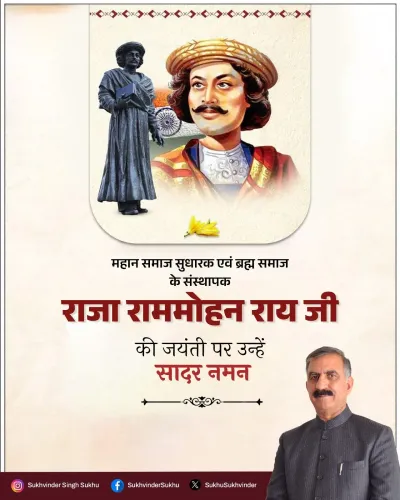
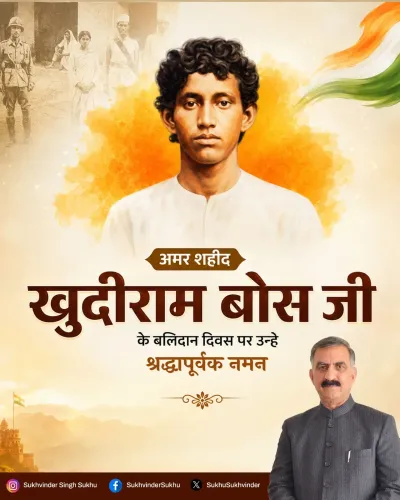
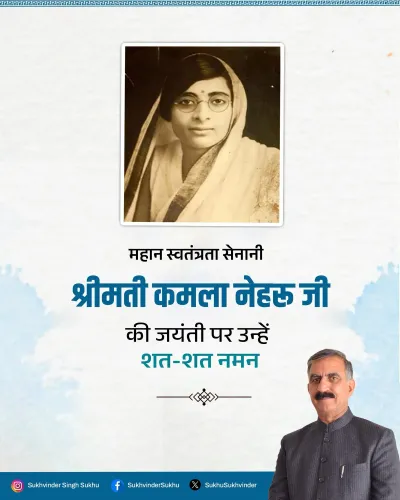
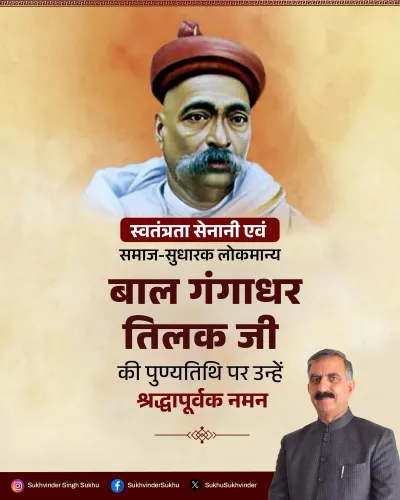
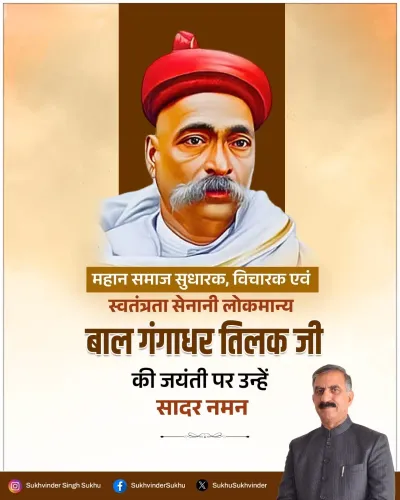
CM Sukhu pays tribute to Bipin Chandra Pal on birth anniversary
Synopsis
Himachal Pradesh Chief Minister Sukhvinder Singh Sukhu marked the birth anniversary of revolutionary nationalist Bipin Chandra Pal on 7 November 2026, honouring his contributions to the Swadeshi movement, Swaraj, and India's national consciousness.
Key Takeaways
CM Sukhvinder Singh Sukhu posted a tribute on X on 7 November 2026 marking the birth anniversary of Bipin Chandra Pal .
Pal ( 1858–1932 ) was a revolutionary, journalist, and teacher central to the early Indian nationalist movement.
He was part of the celebrated Lal-Bal-Pal trio alongside Lala Lajpat Rai and Bal Gangadhar Tilak.
Pal championed the Swadeshi movement , Swaraj, and was among the earliest advocates of complete independence from British rule.
Indian political leaders routinely mark such anniversaries to invoke the nationalist movement's legacy in public discourse.
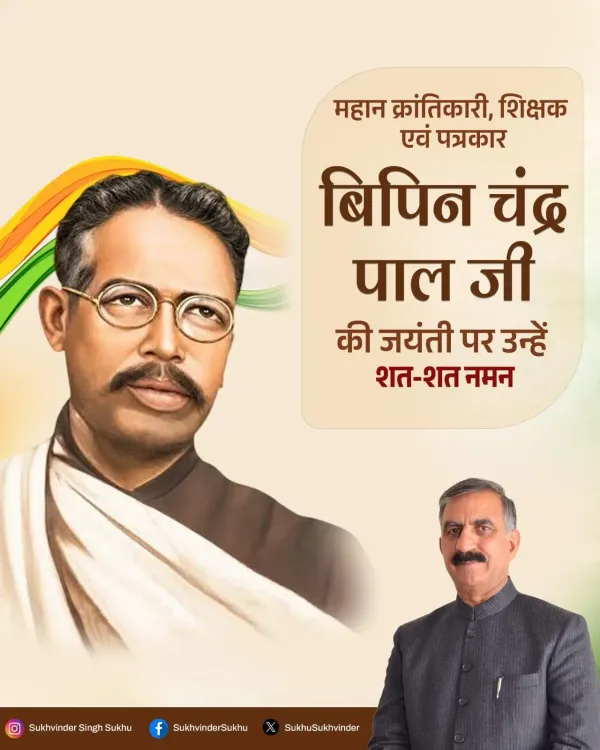
On the birth anniversary of one of India's most fearless nationalist voices, Himachal Pradesh Chief Minister Sukhvinder Singh Sukhu paid homage to Bipin Chandra Pal on Saturday, 7 November 2026, saluting the revolutionary's enduring legacy in India's freedom struggle.
Posting on X in Hindi, CM Sukhu wrote: 'महान क्रांतिकारी, शिक्षक एवं पत्रकार बिपिन चंद्र पाल जी की जयंती पर उन्हें शत्-शत् नमन।' — 'On the birth anniversary of the great revolutionary, teacher and journalist Bipin Chandra Pal, I offer him a hundred salutes.' He added that Pal's invaluable contribution to the spread of the Swadeshi movement, Swaraj, and national consciousness 'will always be remembered.'
The revolutionary who gave Swaraj its fire
Bipin Chandra Pal (1858–1932) was no armchair nationalist. Born in present-day Bangladesh, he rose to become one of the most electrifying orators and thinkers of colonial India's resistance movement — a journalist whose pen cut as sharply as any political speech. He became the third pillar of the legendary Lal-Bal-Pal trio, alongside Lala Lajpat Rai and Bal Gangadhar Tilak, a triumvirate that pushed the Indian National Congress decisively toward confrontation with the British Empire in the early 20th century.
It was Pal, more than almost any other leader of his era, who gave the Swadeshi movement its ideological spine — arguing not merely for the boycott of British goods, but for a complete spiritual and cultural regeneration of Indian identity. His concept of 'purna swaraj' — complete self-rule — predated its formal adoption by the Congress by decades. As a journalist, he founded and edited several nationalist publications that carried the message of resistance into Indian homes across the subcontinent.
A tradition of invoking the nationalist legacy
CM Sukhu's tribute fits a well-established pattern in Indian political life: leaders across parties mark the birth and death anniversaries of independence-era figures as a way of connecting present-day governance to the moral authority of the freedom struggle. For the Indian National Congress, figures like Pal carry a particular resonance — they represent the party's founding intellectual tradition of combining mass mobilisation with principled anti-colonialism.
The practice is more than ceremonial. Each invocation of Pal, Tilak, or Lajpat Rai is an implicit claim to that lineage — a reminder, especially in a competitive political landscape, of who carried the torch first. On a date as charged as 7 November, with Pal's memory still capable of drawing genuine public reflection, the tribute lands with quiet weight.
Point of View
And anniversaries like this are low-cost, high-visibility opportunities to reinforce that connection. In a state like Himachal Pradesh, where the Congress governs in a competitive environment, aligning the CM's public image with India's most revered freedom fighters serves a quiet but deliberate brand-building purpose. Pal's particular emphasis on mass mobilisation and ideological self-reliance also resonates with Congress's current messaging around economic sovereignty. Such tributes, however sincere, are never purely historical — they are always, in part, a present-tense political statement.
NationPress
7 Nov 2026
Frequently Asked Questions
Who was Bipin Chandra Pal?
Bipin Chandra Pal (1858–1932) was a prominent Indian nationalist, journalist, and teacher who played a key role in the Swadeshi movement and was part of the famous Lal-Bal-Pal trio alongside Lala Lajpat Rai and Bal Gangadhar Tilak.
When is Bipin Chandra Pal's birth anniversary?
Bipin Chandra Pal's birth anniversary falls on 7 November , commemorated annually across India by political leaders and citizens alike.
What was Bipin Chandra Pal's contribution to India's freedom movement?
Pal was a leading advocate of the Swadeshi movement, promoted the idea of Swaraj (self-rule), and used journalism to spread nationalist consciousness, making him one of the most influential thinkers of the early 20th-century independence struggle.
What did CM Sukhu say about Bipin Chandra Pal?
CM Sukhvinder Singh Sukhu described Pal as a 'great revolutionary, teacher and journalist' and said his invaluable contributions to the Swadeshi movement, Swaraj, and national consciousness will always be remembered.
Who were the Lal-Bal-Pal trio?
The Lal-Bal-Pal trio comprised Lala Lajpat Rai, Bal Gangadhar Tilak, and Bipin Chandra Pal — three nationalist leaders who pushed for a more assertive, confrontational approach to British rule in India during the early 1900s.