CM Sukhu pushes Kangra Airport expansion, VGF for HP flights
Synopsis
CM Sukhvinder Singh Sukhu has announced a ₹3,000 crore Kangra Airport expansion to enable Airbus A320 operations and a ₹35 crore state VGF — the first of its kind in Himachal Pradesh — to sustain flights to Shimla and Dharamshala year-round.
Key Takeaways
Kangra Airport expansion pegged at ₹3,000 crore ; land acquisition has already commenced.
CM Sukhu has raised the project with the Union Civil Aviation Minister to enable Airbus A320 landings within four to five years .
Himachal Pradesh is providing a ₹35 crore VGF — the first such state-funded aviation subsidy — to protect flight operations to Shimla and Dharamshala during low-demand periods.
A large golf course in Kangra is under consideration as part of a broader high-value tourism push.
The state currently operates three airports ; mountainous terrain makes new airport construction slow, reinforcing the case for expanding existing infrastructure.
The move mirrors the logic of the central government's UDAN scheme (2016) but adds direct state treasury commitment to fill seasonal revenue gaps.
A mountainous state with three airports and a tourism economy that punches above its weight is about to bet big on the skies. Himachal Pradesh Chief Minister Sukhvinder Singh Sukhu on Sunday, 25 October 2026, outlined an ambitious aviation push — anchoring it on a ₹3,000 crore expansion of Kangra Airport and a first-of-its-kind state-funded Viability Gap Funding (VGF) of ₹35 crore to keep flights to Shimla and Dharamshala running even when passenger numbers dip.
The Kangra Airport gamble — and why A320s matter
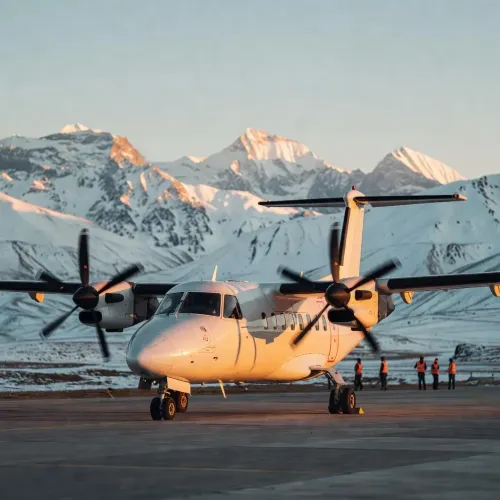
Kangra Airport, also known as Gaggal Airport, currently handles only small turboprop aircraft, a limitation that quietly caps how many tourists can actually fly into the Kangra-Dharamshala belt. CM Sukhu said land acquisition for the expansion project has already begun, and that he recently placed the case before the Union Minister of Civil Aviation to ensure wide-body access within the next four to five years.
The prize: an Airbus A320-capable runway. That single upgrade would collapse travel times from metros, open the valley to chartered and seasonal high-volume flights, and dramatically change the economics of leisure tourism in the region. In terrain as challenging as the Kangra valley, getting to that point is no small feat — mountain airports demand extraordinary land acquisition, grading, and environmental clearances, which is precisely why the state is moving now rather than later.
₹35 crore VGF — Himachal's first aviation subsidy play
Even before runways are lengthened, Sukhu's government is tackling the harder commercial problem: airlines simply don't find thin mountain routes profitable year-round. The state's answer is a ₹35 crore VGF commitment — described by the CM as happening 'for the first time' in Himachal Pradesh — designed to bridge the revenue gap so that udaan (flights) to Shimla and Dharamshala stay on the schedule even in off-peak seasons.
Viability gap support is not a new concept nationally; the central government's UDAN scheme, launched in 2016, pioneered exactly this logic for underserved regional airports. But states backstopping routes independently with their own treasury signals a sharper political commitment to connectivity — and a recognition that waiting for central allocation alone hasn't been enough for Himachal's seasonal markets.
Golf courses, high-value tourism, and the bigger picture
Sukhu also flagged that a large golf course in Kangra is under consideration, pairing infrastructure investment with a deliberate pitch for high-spend leisure tourism. The combination — upgraded airport, subsidised year-round flights, premium sporting amenity — traces an integrated strategy rather than piecemeal announcements.
Himachal Pradesh's tourism economy is deeply dependent on road access, making it vulnerable to landslides, bad weather, and seasonal highway closures. Better air connectivity is therefore not just a convenience upgrade; it is a resilience investment for a state whose visitor economy can be grounded — literally — by a single blocked mountain pass.
Land acquisition momentum at Kangra and the first flight departures under the new VGF window will be the real test of whether this blueprint lifts off on schedule.
Point of View
000 crore airport expansion and a state-funded VGF — signals a deliberate pivot from road-dependent tourism to aviation-led connectivity in Himachal Pradesh. The VGF move is politically notable: by underwriting routes from state coffers rather than waiting on central UDAN allocations, the Congress-led government is claiming ownership of a development story that has traditionally been narrated from Delhi. The Kangra-A320 pitch, placed directly before the Union Aviation Minister, also tests whether the Centre-state relationship can translate into expedited clearances in terrain where such projects routinely slip timelines. If land acquisition and tendering proceed on schedule, this could become a template other hill states watch closely.
NationPress
25 Oct 2026
Frequently Asked Questions
What is the Kangra Airport expansion project announced by CM Sukhu?
CM Sukhvinder Singh Sukhu has announced a ₹3,000 crore expansion of Kangra Airport (Gaggal Airport) in Himachal Pradesh, with land acquisition already underway, aimed at enabling large aircraft like the Airbus A320 to operate there within four to five years.
What is VGF and why is Himachal Pradesh giving ₹35 crore for flights?
Viability Gap Funding (VGF) is a financial subsidy used to make commercially unviable but socially essential infrastructure routes operational. Himachal Pradesh is providing ₹35 crore in VGF — the first such state-level aviation subsidy in the state's history — to ensure flights to Shimla and Dharamshala continue even during low-passenger seasons.
Which airports does Himachal Pradesh currently have?
Himachal Pradesh currently has three airports. Kangra Airport (Gaggal), which serves the Dharamshala region, is the one earmarked for a major ₹3,000 crore expansion announced by CM Sukhu.
When will Airbus A320 flights start at Kangra Airport?
CM Sukhu has stated the goal is to enable A320-class aircraft operations at Kangra Airport within the next four to five years, contingent on completion of land acquisition, construction, and regulatory clearances.
What is the UDAN scheme and how does Himachal Pradesh's VGF relate to it?
The UDAN (Ude Desh ka Aam Nagrik) regional connectivity scheme, launched by the central government in 2016, provides viability gap support for flights to underserved airports. Himachal Pradesh's own ₹35 crore VGF builds on the same principle but is funded directly by the state to fill gaps central subsidies don't cover.