Supreme Court Affirms Only Competent Authority Can Waive Stamp Duty Penalties
Synopsis
The Supreme Court has clarified that the authority to waive penalties for deficient stamp duty rests solely with the competent authority, not the High Court, establishing clear legal boundaries in stamp duty regulations.
Key Takeaways
High Court lacks authority to waive stamp duty penalties.
Competent authority must impose penalties under the Karnataka Stamp Act.
Mandatory impounding of insufficiently stamped documents.
Discretion to adjust penalties lies with the Deputy Commissioner .
Lessee is liable for stamp duty and penalties in lease agreements.
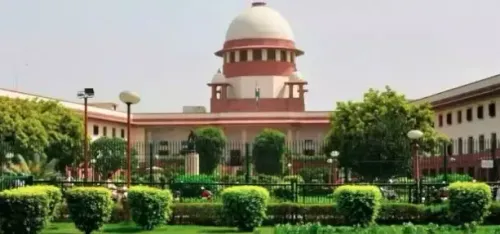
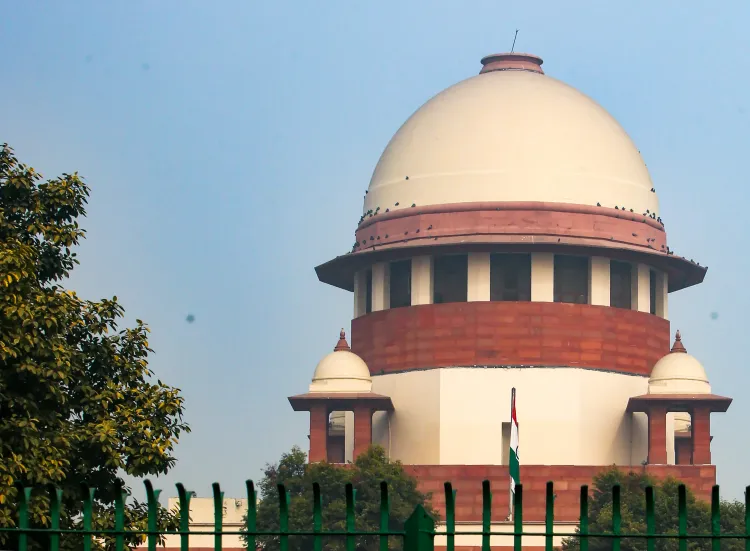
New Delhi, April 7 (NationPress) The Supreme Court has determined that a High Court lacks the authority to waive the statutory penalty related to inadequate stamp duty, emphasizing that this power is solely vested in the competent authority as defined by the applicable Stamp Act.
In a landmark decision, a bench comprising Justices Sanjay Kumar and K. Vinod Chandran overturned a ruling by the Karnataka High Court that had excused the payment of penalties while mandating the settlement of deficient stamp duty on lease agreements.
The apex court's ruling stemmed from an appeal linked to a long-standing partition suit initiated in 2008, where the acceptability of two lease documents was challenged due to insufficient stamping.
The Bench, led by Justice Sanjay Kumar, asserted that once a document is deemed insufficiently stamped, its impounding is obligatory under the Karnataka Stamp Act, 1957, and the statutory framework does not permit courts to mitigate penalty provisions as the High Court had attempted.
"The High Court is not authorized to unilaterally mandate stamp duty payment and release from penalties that are otherwise stipulated by the law," the Supreme Court remarked, highlighting that the identification of deficient duty and the imposition of penalties are responsibilities assigned to the Deputy Commissioner as specified in the Karnataka Stamp Act.
In clarifying the legal stance, the Supreme Court indicated that if a party wishes to submit an insufficiently stamped document as evidence in court, the application of a penalty is obligatory and not open to judicial discretion.
"The Court has no latitude to impose a penalty lower than ten times the shortfall in duty when the document is intended for evidentiary purposes," the ruling stated.
Nonetheless, the bench noted that should the document be forwarded to the Deputy Commissioner, the authority could exercise discretion to adjust or refund any excess penalty in accordance with legal provisions, although such discretion is not available to the High Court in its supervisory capacity.
While granting the plaintiffs the option to either pay the duty and penalty before the court or seek a ruling from the Deputy Commissioner, it underscored that the obligation to cover stamp duty and penalties in lease agreements lies with the lessee.
The Supreme Court also denied a request for a swift trial of the suit, independent of stamp duty matters, making it explicit that documents may only be admitted as evidence after complying with the Stamp Act.
In nullifying the Karnataka High Court’s directive regarding the waiver of penalties, the Supreme Court concluded the appeal without commenting on the merits of the fundamental civil dispute. The appeal was formulated and submitted by Ayush Negi and argued by senior advocate Nachiketa Joshi, alongside advocate Aarushi Gupta representing the petitioner.
Point of View
The Supreme Court's ruling reinforces the importance of adhering to statutory requirements in financial transactions, ensuring that the legal framework surrounding stamp duties and penalties is respected and upheld. This decision emphasizes the necessity for clarity and consistency in judicial interpretations related to financial obligations.
NationPress
16 Sept 2026
Frequently Asked Questions
What did the Supreme Court rule regarding stamp duty penalties?
The Supreme Court ruled that only the competent authority, not the High Court, can waive penalties for deficient stamp duty, clarifying the legal authority in such matters.
Can a High Court direct payment of stamp duty without imposing penalties?
No, the Supreme Court clarified that the High Court cannot absolve penalties mandated under the statute while directing the payment of stamp duty.
What happens if a document is found to be insufficiently stamped?
If a document is insufficiently stamped, its impounding is mandatory, and a penalty must be applied as per the Karnataka Stamp Act.
Who has the authority to reduce or refund excess penalties?
The Deputy Commissioner has the discretion to reduce or refund excess penalties in accordance with the law, but this discretion does not extend to the High Court.
What are the responsibilities of the lessee regarding stamp duty?
The lessee is responsible for paying both the stamp duty and any applicable penalties in lease transactions.