Supreme Court: High Courts must not interfere in arbitration under Section 16, non-stamping a curable defect
Synopsis
The Supreme Court has drawn a firm line: once arbitration begins, High Courts must stay out — even when a party claims the arbitrator erred on stamping. The ruling, arising from a 2004 iron ore deal, also settles a recurring question by confirming that inadequate stamping is a curable defect, not a ground to void an agreement or derail proceedings.
Key Takeaways
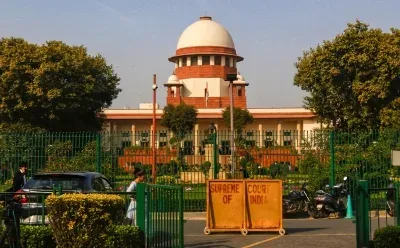
The Supreme Court on 27 May ruled that High Courts must ordinarily not interfere with arbitral tribunal orders under Section 16 of the Arbitration and Conciliation Act during pending proceedings.
A bench of Justices J.K.
Maheshwari and Atul S.
Chandurkar dismissed the appeal filed by mine owner Tarini Prasad Mohanty against the Orissa High Court division bench.
The court held that non-stamping or inadequate stamping is a curable defect — it renders an instrument inadmissible, not void.
Parties must await the final arbitral award and challenge it under Section 34 , not approach High Courts mid-arbitration via writ petitions.
The stamping issue in the underlying 2004 iron ore sale agreement remains open for adjudication at the Section 34 stage.
The Supreme Court of India on Wednesday, 27 May reaffirmed the principle of minimal judicial intervention in arbitration, ruling that High Courts should ordinarily refrain from interfering with orders passed by arbitral tribunals under Section 16 of the Arbitration and Conciliation Act while proceedings are still pending. The judgment arose from a dispute over an iron ore sale agreement dating back to 2004 and has significant implications for how stamping objections are handled in arbitration.
Background: The Iron Ore Dispute
The case involved Tarini Prasad Mohanty, a mine owner, and Sunflag Iron and Steel Company Limited, parties to an agreement for the sale of iron ore executed in 2004, along with subsequent supplementary agreements. During arbitration, Mohanty raised an objection under Section 16, contending that the agreements were insufficiently stamped and constituted a 'conveyance' under the Indian Stamp Act, which would attract higher stamp duty.
The arbitral tribunal rejected this objection in May 2024, holding that the agreements were 'agreements to sell' — not 'conveyance' — and had been properly stamped.
High Court's Conflicting Orders
Mohanty then approached the Orissa High Court under Articles 226 and 227 of the Constitution. A single-judge bench entertained the writ petition, termed the arbitrator's findings 'grossly erroneous and perverse', and directed impounding of the agreements pending payment of proper stamp duty. However, the Orissa High Court's division bench reversed that order, holding that the single judge had exceeded writ jurisdiction by entering into the merits of a contractual dispute.
What the Supreme Court Ruled
A bench of Justices J.K. Maheshwari and Atul S. Chandurkar upheld the division bench's view. The apex court held that once arbitration proceedings have commenced, parties must ordinarily await the final award and then pursue remedies under Section 34 of the Arbitration and Conciliation Act.
Referring to earlier Constitution Bench rulings, the court observed that stamping objections fall squarely within the jurisdiction of the arbitral tribunal itself. Justice Maheshwari, writing for the bench, stated: 'The object of minimising judicial intervention while the matter is in the process of being arbitrated upon, will certainly be defeated if the High Court could be approached under Article 227 or under Article 226 of the Constitution against every order made by the Arbitral Tribunal.'
Non-Stamping Is a Curable Defect, Not a Void
Crucially, the court clarified that non-stamping or inadequate stamping of an agreement is only a 'curable defect' and does not render the instrument void. 'The effect of not paying duty or paying an inadequate amount renders an instrument inadmissible and not void. Non-stamping or improper stamping does not result in the instrument becoming invalid,' the judgment stated.
The court further held that the arbitrator was fully empowered to decide the stamping objection, and that a mere error on merits could not be treated as an inherent lack of jurisdiction warranting writ interference. The single-judge bench, it said, should not have interpreted the agreements while arbitration was still pending and evidence was yet to be led.
What Happens Next
Dismissing the appeal, the Supreme Court clarified that the stamping issue remains open and may be raised by the aggrieved party at the Section 34 challenge stage after the conclusion of arbitration proceedings. The ruling reinforces a consistent judicial trend of insulating arbitral proceedings from premature High Court interference, giving arbitral tribunals greater autonomy to resolve both jurisdictional and evidentiary questions.
Point of View
As a rule, impermissible. The more consequential clarification is on stamping: by confirming it is a curable defect and not a jurisdictional one, the court removes stamping disputes as a tool for delay. The question is enforcement — litigants with resources will continue to test these limits, and the frequency with which this principle needs restatement suggests the message has not fully landed at the High Court level.
NationPress
11 Oct 2026
Frequently Asked Questions
What did the Supreme Court rule on High Court interference in arbitration?
The Supreme Court ruled that High Courts should ordinarily refrain from interfering with arbitral tribunal orders passed under Section 16 of the Arbitration and Conciliation Act while arbitration proceedings are still pending. Parties must await the final award and then seek remedies under Section 34.
What is Section 16 of the Arbitration and Conciliation Act?
Section 16 empowers an arbitral tribunal to rule on its own jurisdiction, including objections about the existence or validity of an arbitration agreement. It allows the tribunal to decide challenges such as insufficient stamping or improper classification of agreements before proceeding with the arbitration.
Why did the Supreme Court say non-stamping is a curable defect?
The court clarified that failure to pay stamp duty or paying an inadequate amount renders an instrument inadmissible in evidence, but does not make it void or invalid. Because the defect can be remedied, it does not strip the arbitral tribunal of jurisdiction to proceed.
What was the background of the Tarini Prasad Mohanty case?
The dispute arose from a 2004 agreement for the sale of iron ore between mine owner Tarini Prasad Mohanty and Sunflag Iron and Steel Company Limited. During arbitration, Mohanty argued the agreements were insufficiently stamped and amounted to a 'conveyance' under the Indian Stamp Act. The arbitral tribunal rejected this in May 2024, and the Orissa High Court's single judge then intervened — a move the division bench and subsequently the Supreme Court overturned.
Can the stamping issue be raised again after the arbitration concludes?
Yes. The Supreme Court expressly kept the stamping question open, clarifying that the aggrieved party may raise it at the Section 34 challenge stage after the conclusion of arbitration proceedings.