Supreme Court Upholds Bombay High Court's Ruling Against Anil Ambani in Loan Fraud Case
Synopsis
In a significant legal development, the Supreme Court has upheld the Bombay High Court's decision to revoke the interim protection for Anil Ambani regarding allegations of fraudulent loan classifications. This ruling impacts Ambani's ongoing civil suits and raises questions about the validity of forensic audits used by banks.
Key Takeaways
The Supreme Court upheld the Bombay High Court's ruling on Anil Ambani's loan fraud allegations.
The court emphasized the need for due process in financial matters.
Ambani's classification as a fraud could hinder his financial transactions.
The forensic audit by BDO India LLP is under scrutiny.
Ambani has filed civil suits contesting the legality of the audit and fraud classification.
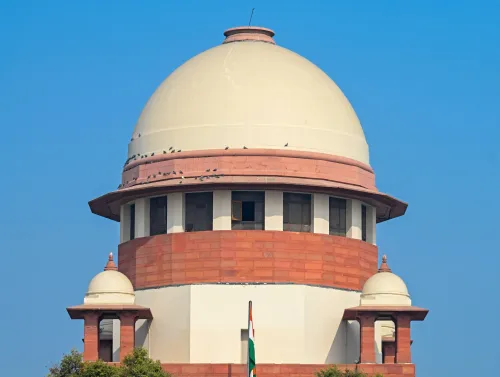
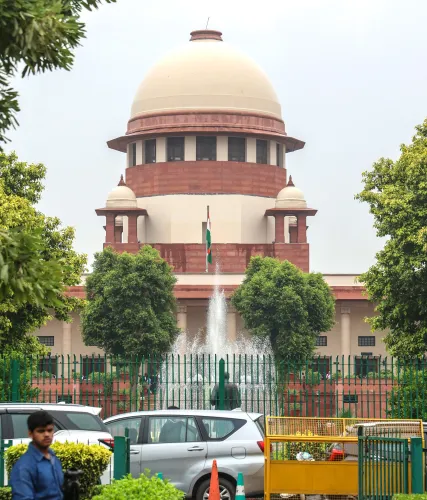
New Delhi, April 16 (NationPress) The Supreme Court has chosen not to intervene in the Bombay High Court's ruling that removed the interim protection previously afforded to industrialist Anil Ambani. This protection pertained to the classification of his loan accounts as "fraudulent" by banking institutions under the Reserve Bank of India’s 2024 Master Directions.
A bench comprising Chief Justice of India (CJI) Surya Kant and Justices Joymalya Bagchi and Vipul Pancholi dismissed Ambani’s appeals that sought to contest the Bombay High Court's division bench ruling, which had overturned the interim stay issued by a single judge in his favor.
Nevertheless, the apex court emphasized that the remarks made by the Bombay High Court would not influence the final resolution of Ambani’s civil suits that challenge the fraud classification procedures.
The court also instructed a prompt trial of the pending lawsuits, contingent upon the cooperation of the involved parties, while keeping all other legal remedies available to Ambani.
During the proceedings, senior advocate Kapil Sibal, representing Ambani, contended that the fraud classification would result in a "virtual civil death" and argued that such interim protection should not have been revoked in the manner executed by the Division Bench.
"I have been labeled a fraud. This is a virtual civil death; no one will lend me money..." Sibal stated.
However, the CJI-led bench was not inclined to grant relief, noting that grave allegations regarding the diversion and siphoning of public funds were currently under investigation.
Sibal argued that the forensic audit upon which the banks relied was legally untenable as it had not been carried out by an auditor qualified under the relevant statutory framework and the RBI’s 2024 Master Directions.
Questioning whether the highest court could impose its judgment over that of the lenders, the bench remarked: "Nationalized banks have engaged the services. They are aware of the best person; can we replace their judgment? It is their capital!"
Solicitor General Tushar Mehta disclosed that the forensic report had been compiled by a reputable professional entity engaged by the consortium of lenders through a transparent process.
The core of the dispute stems from the banks’ reliance on a forensic audit report dated October 15, 2020, prepared by BDO India LLP regarding loans issued to Reliance Communications and associated entities.
In December 2025, a single-judge bench of the Bombay High Court had previously stayed any further action by banks based on the forensic report and related show-cause notices, asserting that prima facie, the forensic audit was not in alignment with the RBI Master Directions and that the repercussions of fraud classification could lead to severe civil consequences. However, the division bench later vacated that interim protection, ruling that the single judge had misinterpreted the 2024 RBI Master Directions retrospectively and questioned the validity of the 2020 forensic audit based on that interpretation.
A Bench led by Chief Justice Shree Chandrashekhar and Justice Gautam A. Ankhad acknowledged the banks’ argument that the forensic audit had been commissioned under the 2016 regulatory framework and that subsequent 2024 Directions could not automatically nullify prior actions.
Ambani has initiated civil suits in the Bombay High Court, requesting declarations that the forensic audit report and resultant fraud classification actions are illegal, void, and contrary to law, in addition to seeking damages.
Point of View
The Supreme Court's decision reflects the judiciary's commitment to uphold the law and ensure accountability among influential figures such as Anil Ambani. The ruling emphasizes the importance of due process in financial matters and the scrutiny of forensic audits that can have far-reaching consequences for individuals and businesses alike.
NationPress
20 Sept 2026
Frequently Asked Questions
What was the Supreme Court's ruling regarding Anil Ambani?
The Supreme Court upheld the Bombay High Court's decision to vacate interim protection for Anil Ambani against the fraudulent classification of his loan accounts.
What does the term 'virtual civil death' refer to in this context?
'Virtual civil death' describes a situation where an individual is labeled a fraud, making it extremely difficult for them to secure loans or engage in financial transactions.
Who conducted the forensic audit that is disputed in this case?
The forensic audit in question was conducted by BDO India LLP, based on loans extended to Reliance Communications and related entities.
What are the implications of the Supreme Court's decision for Ambani?
The decision puts Ambani's ongoing civil suits in jeopardy and raises questions about the future of his business dealings, particularly concerning the classification of loans as fraudulent.
What legal actions has Anil Ambani taken in response to the allegations?
Anil Ambani has filed civil suits in the Bombay High Court, seeking to declare the forensic audit report and fraud classification actions as illegal and contrary to law.