Surat Police rescue woman from cyberblackmail suicide bid, nab accused
Synopsis
A suicide alert on the banks of Surat's Tapi river led police to uncover a cross-state cyberblackmail racket — the accused had sent a manipulated video to the victim's husband, nearly destroying both her life and her marriage. The arrest of Arjun alias Montu Upadhyay in a Chhattisgarh village after he fled Bihar is a striking example of technical surveillance closing the net on sextortion offenders.
Key Takeaways
Surat Police rescued a woman in her thirties from the Tapi river on 19 June following a suicide alert.
The accused, Arjun alias Montu Upadhyay , allegedly obtained an obscene video via Instagram and blackmailed the woman, also sending the video to her husband.
Police tracked the suspect first to Bihar , then arrested him at Telbandha village, Chhattisgarh using technical surveillance.
Upadhyay has been booked under the Bharatiya Nyaya Sanhita and the Information Technology Act and is in judicial custody.
Officers counselled the husband after clarifying the facts; the couple subsequently reconciled.
Surat Police rescued a woman in her thirties from the banks of the Tapi river on 19 June after receiving a suicide alert, an intervention that subsequently unravelled a cyberblackmail racket and helped reconcile a marriage driven to breaking point by a manipulated video. The case, handled by the Amroli Police Station, stands as a rare instance where a single emergency response resolved a criminal case, a domestic crisis, and a mental health emergency simultaneously.
How the Rescue Unfolded
Officers at the Amroli Police Station in Surat received information that a woman was on the verge of ending her life. When a police team arrived at her residence, she was not there. A follow-up search led officers to the Tapi river, where they found her sitting alone in a severely distressed state. She was brought to the police station safely before any harm could occur.
During initial questioning, the woman alleged that her husband had been physically assaulting her. However, deeper inquiry pointed to a different and more complex underlying cause.
The Cyberblackmail Trail
Deputy Commissioner of Police (Zone-5) Lakhadirsinh Zala said the case took a decisive turn during the interrogation of the husband. 'During interrogation, it became clear that the situation stemmed from a cybercrime case involving the woman,' DCP Zala said.
Investigators found that the woman had connected with an individual through Instagram. The accused allegedly obtained an obscene video of her and began threatening to circulate it on social media unless she met his demands. To intensify pressure, he sent the video directly to her husband, triggering deep mistrust and escalating conflict within the marriage. The psychological toll on the woman eventually pushed her to the point of crisis.
Accused Traced Across Two States
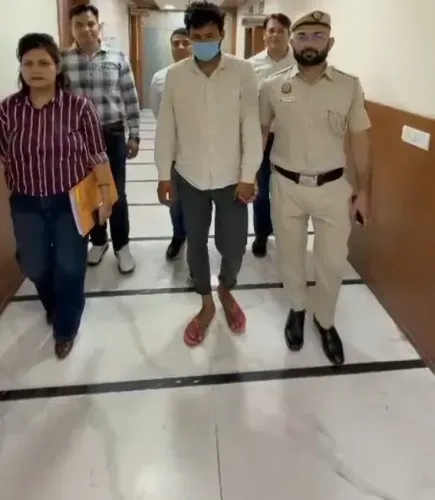
Once the cyberblackmail angle was confirmed, Surat Police launched a technical investigation. The suspect was initially tracked to Bihar, but he fled to Chhattisgarh before he could be detained. Officers eventually located him at Telbandha village in Chhattisgarh through continued surveillance.
The accused, identified as Arjun alias Montu Upadhyay, is described as a semi-skilled labourer who moves frequently between states for work. 'Our team used technical inputs to trace his location and then carried out surveillance in disguise by blending into the local environment before arresting him,' DCP Zala said. Upadhyay has been booked under relevant provisions of the Bharatiya Nyaya Sanhita and the Information Technology Act and remains in judicial custody.
Counselling and Reconciliation
Police did not stop at the arrest. Officers counselled the husband after establishing that his anger had been fuelled by the manipulated video sent by the accused rather than any wrongdoing by his wife. Following clarification of the facts, the couple reconciled.
Officials noted that the case underscores both the psychological devastation cyberblackmail can inflict on victims and their families, and the critical role of swift, sensitive police intervention in preventing irreversible harm.
Broader Implications
This is not an isolated pattern. Cyberblackmail cases involving intimate images — often referred to as sextortion — have been rising steadily across India, with social media platforms frequently cited as the point of first contact between victims and perpetrators. The Surat case is notable for the speed with which police moved from a welfare call to a cross-state criminal arrest, a model that authorities say could inform future response protocols. The next steps include trial proceedings against Upadhyay under both criminal and cyber law provisions.
Point of View
But the accused weaponised the video against her marriage, engineering a domestic crisis to amplify coercive pressure. What stands out is the police response: moving from a welfare call to a cross-state arrest without losing the human thread of counselling and reconciliation. That said, the case also exposes a persistent gap — the accused had time to flee from Bihar to Chhattisgarh before being caught, raising questions about how quickly inter-state alerts are acted upon. As Instagram-facilitated sextortion cases multiply, the speed of platform cooperation with law enforcement will increasingly determine whether perpetrators are caught before victims reach a riverbank.
NationPress
21 Sept 2026
Frequently Asked Questions
What happened in the Surat cyberblackmail case?
Surat Police rescued a woman in her thirties from the Tapi river on 19 June after a suicide alert, and subsequently uncovered a cyberblackmail racket. The accused had allegedly obtained an obscene video of the woman via Instagram and threatened to circulate it unless she complied with his demands, also sending the video to her husband to heighten pressure.
Who is the accused in the Surat cyberblackmail case?
The accused is identified as Arjun alias Montu Upadhyay, a semi-skilled labourer who frequently moves between states for work. He was arrested at Telbandha village in Chhattisgarh after initially evading police in Bihar, and is currently in judicial custody.
What charges have been filed against the accused?
Arjun alias Montu Upadhyay has been booked under relevant provisions of the Bharatiya Nyaya Sanhita and the Information Technology Act. He remains in judicial custody pending trial.
How did the cyberblackmail affect the victim's family?
The accused sent the obscene video to the woman's husband, causing severe mistrust and escalating domestic conflict. The resulting psychological distress pushed the woman to a suicidal crisis. After police clarified the facts and counselled the husband, the couple reconciled.
How did Surat Police trace the accused across states?
After establishing the cyberblackmail angle, Surat Police launched a technical investigation that initially placed the suspect in Bihar. When he fled to Chhattisgarh, officers used continued technical surveillance and undercover methods to locate and arrest him at Telbandha village.